Pharmacognosy Key Terms
Cheatsheet Content
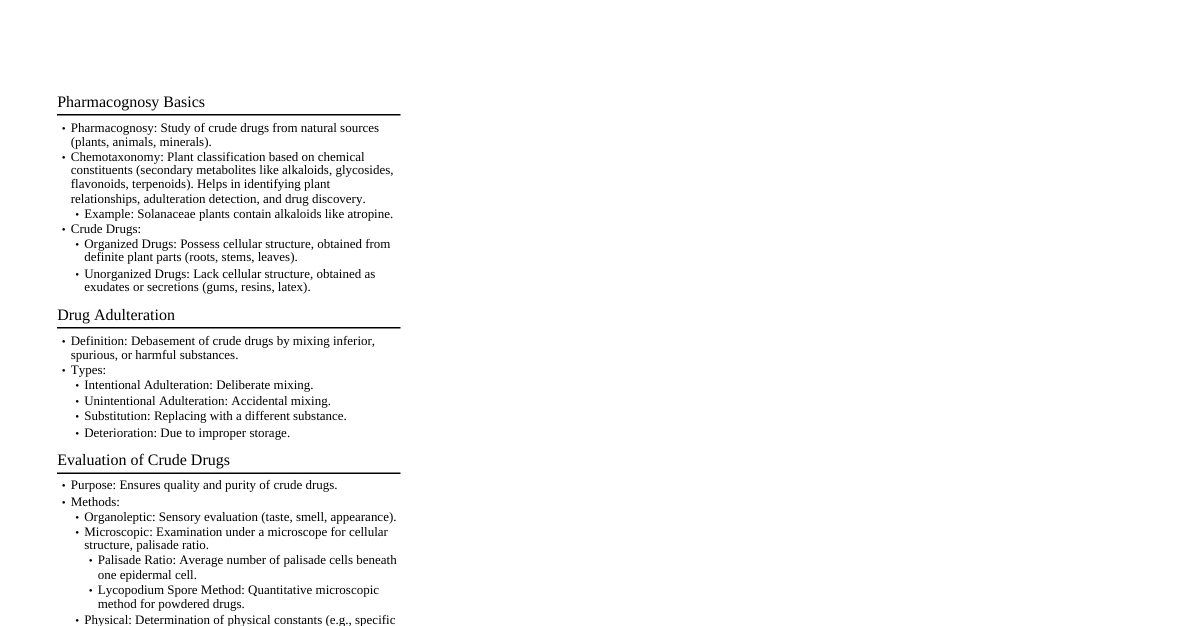
### Chemotaxonomy - **Definition:** A method of classifying plants based on the chemical compounds they produce, particularly secondary metabolites. This approach provides insights into phylogenetic relationships and can be more stable than morphological classifications. - **Key Chemical Constituents:** Alkaloids, glycosides, flavonoids, terpenoids, essential oils, and fatty acids. - **Applications:** - **Identification of Plant Relationships:** Helps in understanding evolutionary pathways and biochemical similarities between species. - **Detection of Adulteration:** Chemical profiles can be used to authenticate plant material and detect the presence of foreign substances. - **Drug Discovery:** Guides the selection of plant species for screening based on known chemical properties or traditional uses. - **Example:** The presence of specific tropane alkaloids (like atropine, scopolamine) is characteristic of plants in the Solanaceae family, aiding in their classification and identification. ### Pharmacognosy - **Definition:** The scientific study of crude drugs obtained from natural sources, including plants, animals, and minerals. It encompasses all aspects of medicinal plants and other natural products as potential sources of drugs. - **Scope:** - **Cultivation and Collection:** Sustainable harvesting, cultivation techniques, and post-harvest processing. - **Identification and Authentication:** Macroscopic and microscopic examination, chemical profiling. - **Preparation and Standardization:** Methods for preparing crude drugs for medicinal use and ensuring consistent quality. - **Phytochemistry:** Isolation, purification, and structural elucidation of active compounds. - **Pharmacology:** Investigation of biological activities and mechanisms of action of natural products. - **Ethnobotany:** Study of traditional uses of plants by different cultures. ### Drug Adulteration - **Definition:** The intentional or unintentional debasement of crude drugs by mixing them with inferior, spurious, or harmful substances, thereby reducing their quality, purity, and therapeutic efficacy. - **Types of Adulteration:** - **Intentional Adulteration:** Deliberate addition of foreign materials for economic gain (e.g., adding cheaper substitutes, artificially weighting drugs). - **Unintentional Adulteration:** Occurs due to improper collection, harvesting, or processing, or due to environmental factors (e.g., presence of weeds, misidentification of plants). - **Substitution:** Replacement of the original drug with an entirely different but similar-looking substance, either inferior or inert. - **Sophistication:** Deliberate addition of artificially manufactured substances or chemicals to enhance appearance or mimic active constituents. - **Deterioration:** Loss of quality due to improper storage conditions, leading to degradation of active compounds or microbial contamination. - **Consequences:** Reduced therapeutic effect, potential toxicity, economic loss, and reputational damage. ### Glycoside - **Definition:** Organic compounds composed of a sugar part (glycone) and a non-sugar part (aglycone or genin), linked by a glycosidic bond (usually through an oxygen, nitrogen, sulfur, or carbon atom). Upon hydrolysis, this bond breaks, releasing the sugar and aglycone. - **Classification by Glycosidic Bond:** - **O-glycosides:** Most common, bond through oxygen (e.g., cardiac glycosides). - **C-glycosides:** Bond through carbon (e.g., aloin in Aloe). - **N-glycosides:** Bond through nitrogen (e.g., nucleosides). - **S-glycosides:** Bond through sulfur (e.g., sinigrin in mustard). - **Classification by Aglycone Type:** - **Cardiac Glycosides:** Steroidal aglycone, affects heart muscle (e.g., digoxin, digitoxin). - **Anthraquinone Glycosides:** Anthracene derivative aglycone, laxative properties (e.g., sennosides, aloin). - **Saponin Glycosides:** Steroidal or triterpenoid aglycone, forms soap-like foam (e.g., glycyrrhizin). - **Cyanogenetic Glycosides:** Contains a cyanide group, releases HCN upon hydrolysis (e.g., amygdalin). - **Identification Tests:** - **Borntrager's Test:** For anthraquinone glycosides (red color in ammoniacal layer). - **Keller-Killiani Test:** For cardiac glycosides (reddish-brown ring at interface, blue-green upper layer). - **Therapeutic Uses:** Cardiac tonics, laxatives, expectorants, anti-inflammatory agents. ### Palisade Ratio - **Definition:** A quantitative microscopic constant defined as the average number of palisade cells beneath one epidermal cell, as observed in a leaf transverse section or a powdered drug specimen. It is a specific characteristic for certain leaf drugs. - **Methodology:** Requires careful preparation of leaf fragments or powdered drug to observe the epidermal layer and underlying palisade cells. Multiple counts are taken and averaged. - **Significance:** - **Identification:** Helps in the identification of powdered leaves, as the ratio is relatively constant for a given species. - **Detection of Adulteration:** Significant deviations from the established palisade ratio for a drug can indicate adulteration with other plant materials. - **Limitations:** Can be affected by environmental factors during plant growth, and precise counting can be challenging. ### Volatile Oil - **Definition:** Aromatic, oily liquids derived from plants that evaporate readily at room temperature. Also known as essential oils, they are complex mixtures of volatile compounds, primarily terpenes and terpenoids, but can also include aldehydes, ketones, esters, and phenols. - **Properties:** - **Aromatic:** Responsible for the characteristic scent of plants. - **Volatile:** Evaporate without leaving a greasy stain (unlike fixed oils). - **Immiscible with water:** But soluble in organic solvents and alcohol. - **Optically active:** Many volatile oils rotate plane-polarized light. - **Extraction Methods:** Steam distillation, hydrodistillation, enfleurage, solvent extraction, cold pressing. - **Therapeutic Uses:** - **Carminatives:** Relieve flatulence (e.g., peppermint oil). - **Antiseptics:** (e.g., eucalyptus oil, tea tree oil). - **Expectorants:** (e.g., pine oil). - **Flavoring Agents:** In food and pharmaceuticals. - **Fragrances:** In perfumery and aromatherapy. ### Resin - **Definition:** Amorphous, solid or semi-solid plant exudates that are typically translucent or transparent. They are complex mixtures of resin acids, resin alcohols, resinotannols, esters, and resenes. Resins are formed in schizogenous or schizolysigenous ducts or cavities within plants. - **Properties:** - **Insoluble in water:** But soluble in organic solvents (e.g., alcohol, ether, chloroform). - **Hardens on exposure to air:** Due to oxidation and polymerization. - **Combustible:** Burns with a smoky flame. - **Types:** - **Resins:** Simple resins (e.g., colophony). - **Oleoresins:** Resins mixed with volatile oils (e.g., capsicum, ginger). - **Gum-resins:** Resins mixed with gums (e.g., asafoetida, myrrh). - **Oleogum-resins:** Resins, volatile oils, and gums (e.g., frankincense). - **Resin Esters:** Esters of resin acids with resin alcohols. - **Therapeutic Uses:** Purgatives (e.g., podophyllum), antiseptics (e.g., benzoin), expectorants (e.g., copaiba), protective coatings, adhesives. ### Lycopodium Spore Method - **Definition:** A quantitative microscopic method used for the evaluation of powdered crude drugs, particularly when chemical assays are difficult or impossible. It relies on the principle of comparing the count of characteristic particles of the drug with a known number of Lycopodium spores. - **Principle:** Lycopodium spores are uniform in size and shape (approximately 25 µm), and 1 mg of Lycopodium powder contains an average of 94,000 spores. By adding a known quantity of Lycopodium powder to a known weight of the powdered drug and counting both the drug's characteristic particles (e.g., starch grains, epidermal cells, trichomes) and the Lycopodium spores in several fields of view, the quantity of the drug or its constituents can be estimated. - **Applications:** - **Estimation of Starch Content:** By counting starch grains. - **Quantification of Cell Components:** Such as epidermal cells or specific tissue fragments. - **Detection of Adulteration:** If the count of characteristic elements deviates from the standard. - **Limitations:** Requires skilled microscopists, and the presence of similar-looking adulterants can complicate analysis. ### Organized and Unorganized Drugs - **Organized Drugs:** - **Definition:** Crude drugs that consist of definite cellular structures and are obtained directly from specific parts of plants or animals. They retain their cellular organization. - **Characteristics:** Possess a distinct morphological form; can be identified by macroscopic and microscopic examination of their cellular features. - **Examples:** Leaves (e.g., Digitalis, Senna), stems (e.g., Cinnamon), roots (e.g., Rauwolfia, Liquorice), rhizomes (e.g., Ginger), barks (e.g., Cinchona), flowers (e.g., Clove), seeds (e.g., Nux Vomica). - **Unorganized Drugs:** - **Definition:** Crude drugs that do not possess any definite cellular structure. They are prepared by various physical processes (e.g., incision, drying, extraction) from plants or animals and are typically exudates, extracts, or secretions. - **Characteristics:** Amorphous or crystalline; lack cellular organization; identified by physical and chemical tests rather than microscopic examination of cells. - **Examples:** Gums (e.g., Acacia, Tragacanth), resins (e.g., Asafoetida, Benzoin), latex (e.g., Opium), oils (e.g., Castor oil, Essential oils), waxes (e.g., Beeswax), dried juices (e.g., Aloe), animal products (e.g., Gelatin, Honey). ### Isolation of Alkaloids - **Definition:** Alkaloids are a diverse group of naturally occurring organic compounds containing at least one nitrogen atom, usually in a heterocyclic ring, and exhibiting pronounced physiological activity. Their isolation typically exploits their basic nature. - **General Method (Acid-Base Extraction):** 1. **Powdering the Crude Drug:** Increases surface area for efficient extraction. 2. **Extraction with Dilute Acid:** The powdered plant material is extracted with an aqueous solution of a dilute acid (e.g., hydrochloric acid, sulfuric acid). Alkaloids, being basic, form water-soluble salts with the acid. Non-alkaloidal components often remain insoluble or are extracted by other solvents later. 3. **Filtration:** The acidic extract containing the alkaloidal salts is filtered to remove insoluble plant debris. 4. **Basification (Making Alkaline):** The acidic filtrate is then made alkaline (pH > 7) using a base (e.g., ammonia, sodium carbonate). This converts the water-soluble alkaloidal salts back into their free, water-insoluble basic forms. 5. **Extraction with Organic Solvents:** The free alkaloids are then extracted from the alkaline aqueous solution using an immiscible organic solvent (e.g., chloroform, ether, dichloromethane, ethyl acetate). The alkaloids preferentially dissolve in the organic layer. 6. **Recovery of Alkaloids:** The organic layer is separated, and the solvent is removed by evaporation (e.g., using a rotary evaporator) to obtain the crude alkaloid mixture. 7. **Purification:** Further purification steps (e.g., recrystallization, chromatography) are often required to obtain individual pure alkaloids. - **Alternative Methods:** Steam distillation (for volatile alkaloids), chromatography (for complex mixtures). ### Evaluation of Crude Drugs - **Purpose:** To ensure the identity, purity, quality, and therapeutic efficacy of crude drugs, thereby guaranteeing patient safety and consistent pharmacological effects. - **Key Evaluation Methods:** 1. **Organoleptic Evaluation:** - **Description:** Assessment using sensory organs (sight, smell, taste, touch). - **Parameters:** Color, odor, taste, size, shape, texture, fracture characteristics. - **Use:** Initial identification and detection of gross adulteration. 2. **Microscopic Evaluation:** - **Description:** Examination under a microscope to study cellular structures, tissue arrangements, and characteristic inclusions. - **Parameters:** Cell types, stomatal index, palisade ratio, vein-islet number, trichomes, starch grains, calcium oxalate crystals. - **Use:** Precise identification, detection of histological adulteration, and differentiation of species. 3. **Physical Evaluation:** - **Description:** Determination of physical constants and properties. - **Parameters:** - **Moisture Content:** Water content affects stability and concentration of active constituents. - **Ash Value:** Total ash, acid-insoluble ash, water-soluble ash indicate inorganic impurities and adulteration. - **Extractive Value:** Amount of constituents extracted by specific solvents, indicates concentration of active principles. - **Volatile Oil Content:** For drugs containing essential oils. - **Viscosity, Melting Point, Refractive Index:** For oils, fats, and waxes. - **Use:** Quality control, detection of inorganic adulteration, and assessment of processing. 4. **Chemical Evaluation:** - **Description:** Chemical tests and assays to determine the presence, absence, and quantity of active constituents. - **Parameters:** - **Qualitative Chemical Tests:** Specific color reactions for identification of chemical groups (e.g., alkaloids, glycosides, tannins). - **Quantitative Chemical Assays:** Titrimetry, gravimetry, spectrophotometry, chromatography (TLC, HPLC, GC) to quantify active compounds. - **Phytochemical Screening:** Broad analysis for various secondary metabolites. - **Use:** Standardization, determination of potency, and detection of chemical adulteration. 5. **Biological Evaluation (Bioassays):** - **Description:** Assessment of the biological activity of the drug using living organisms (animals, isolated organs, microorganisms) or cell cultures. - **Parameters:** Minimum inhibitory concentration (antimicrobial), ED50/LD50 (dose-response), specific pharmacological effects (e.g., cardiac activity of Digitalis). - **Use:** When chemical assays are not feasible or when the activity depends on the complex interaction of multiple components, and to confirm therapeutic efficacy.