Halliday Physics Essentials
Cheatsheet Content
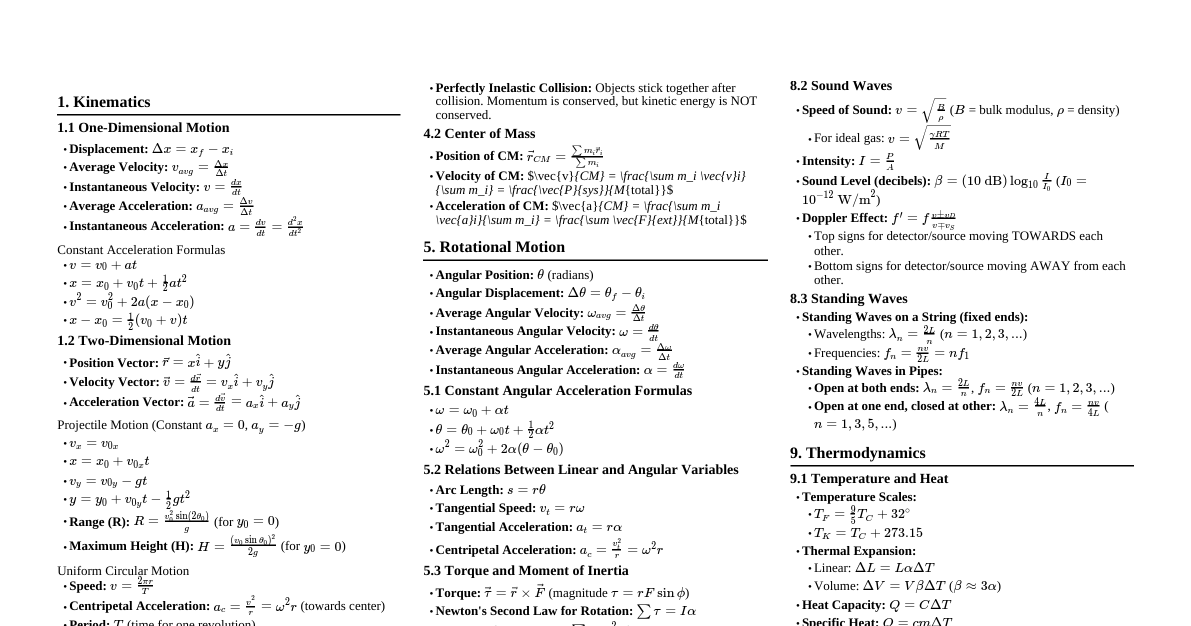
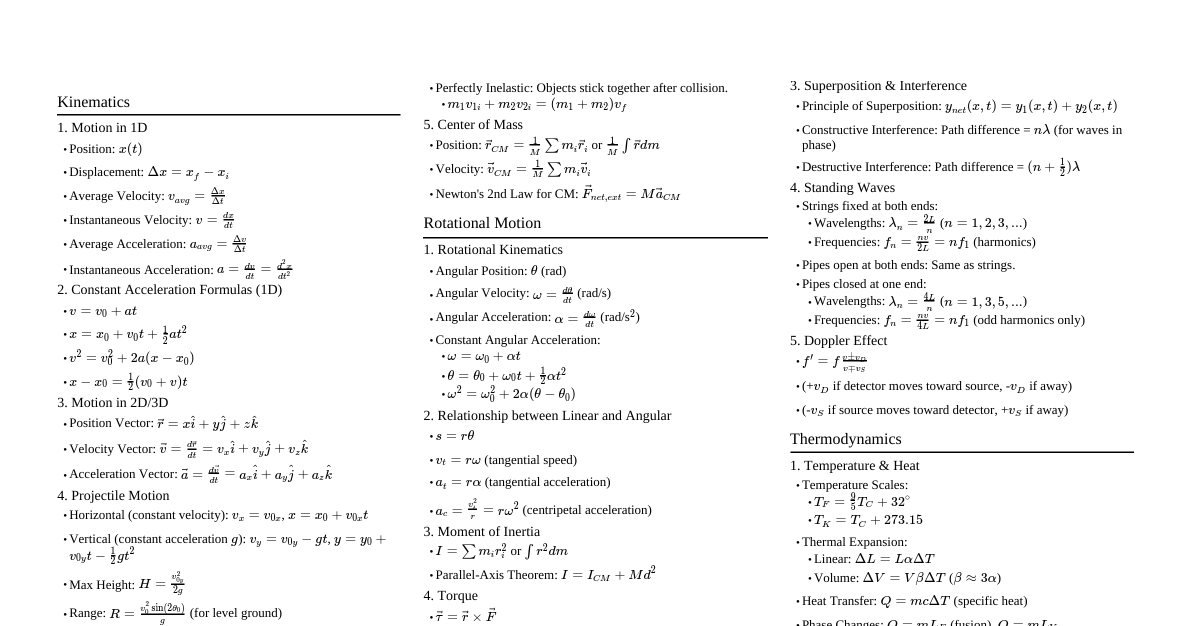
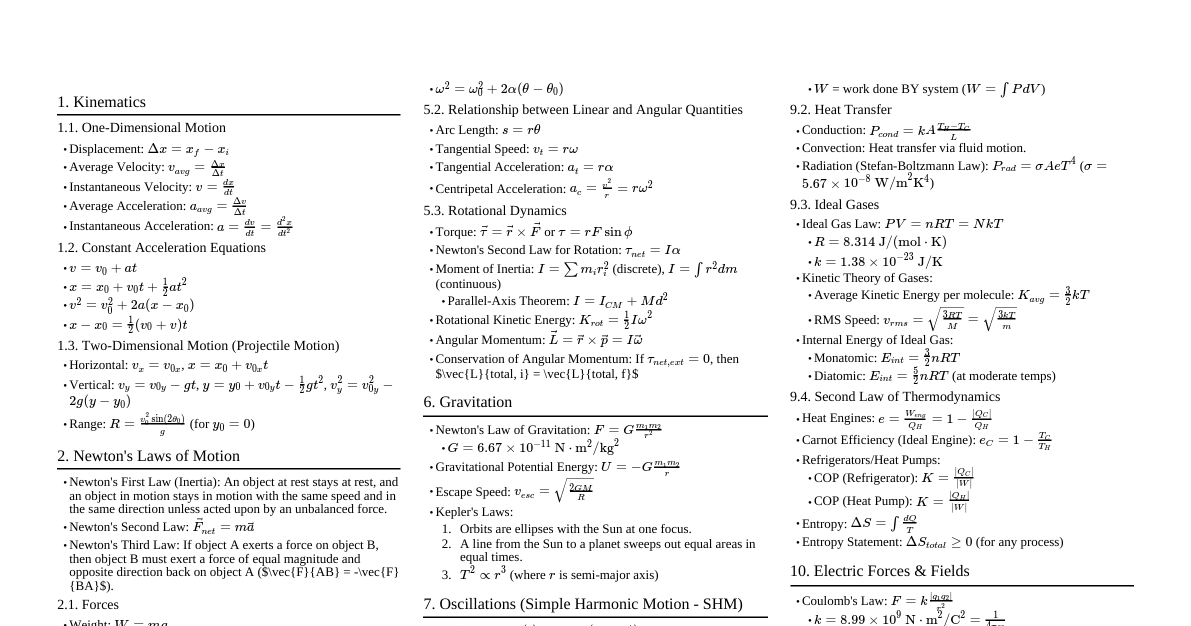
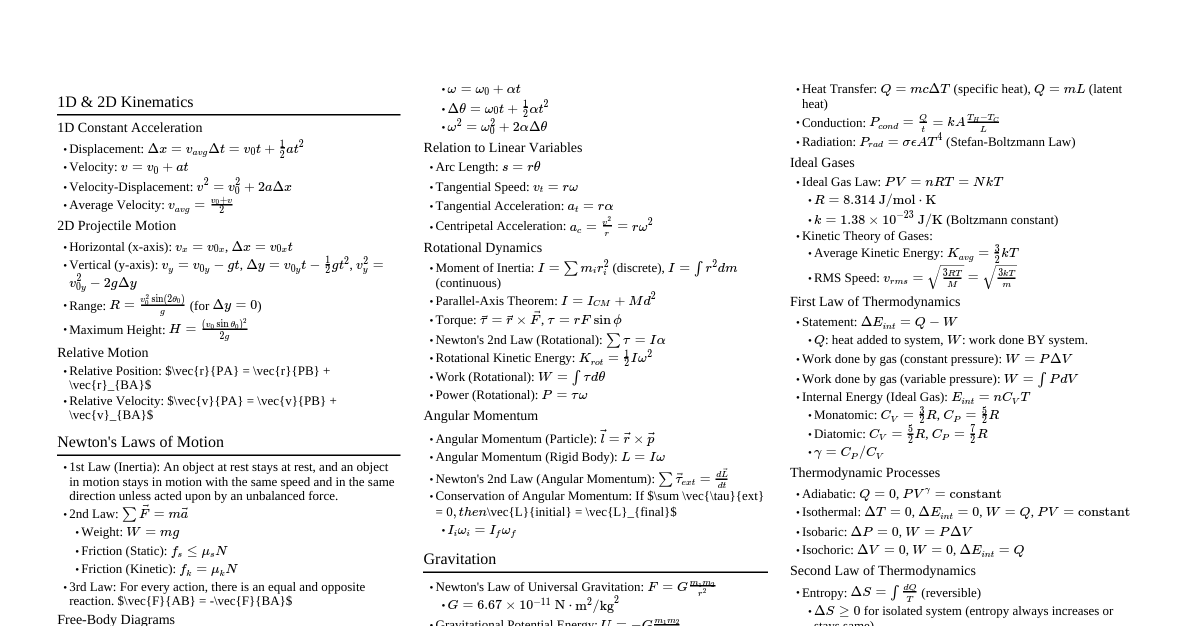
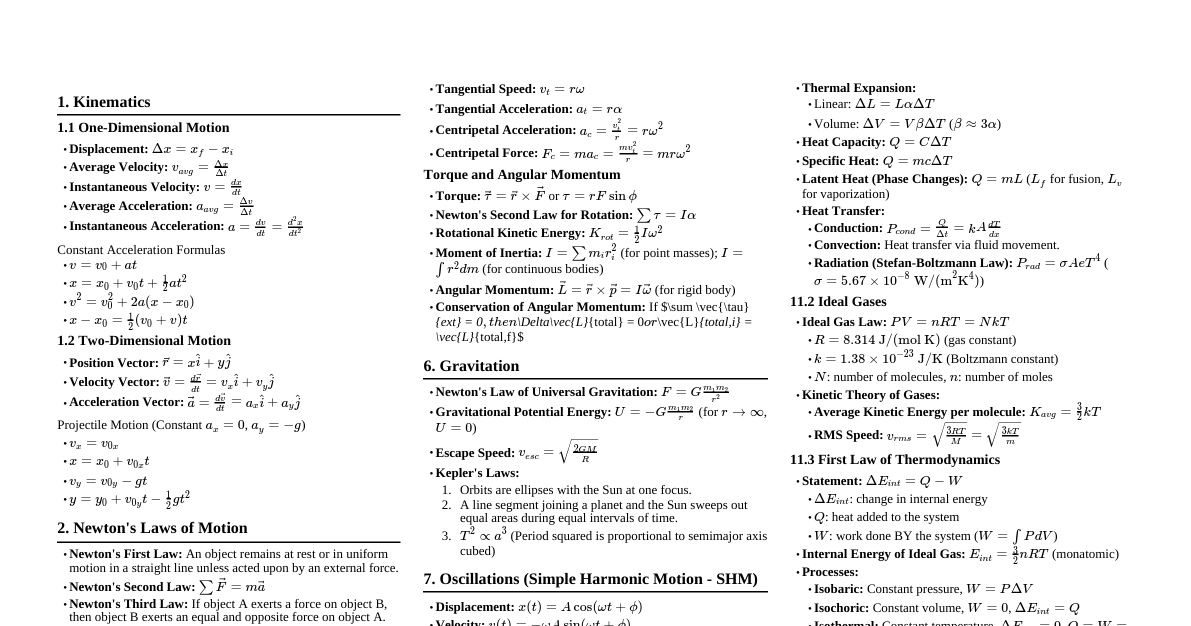
### Kinematics #### 1D Motion - **Position:** $x(t)$ - **Velocity:** $v = \frac{dx}{dt}$ - **Acceleration:** $a = \frac{dv}{dt} = \frac{d^2x}{dt^2}$ - **Constant Acceleration Formulas:** - $v = v_0 + at$ - $x = x_0 + v_0t + \frac{1}{2}at^2$ - $v^2 = v_0^2 + 2a(x - x_0)$ - $x - x_0 = \frac{1}{2}(v_0 + v)t$ #### 2D/3D Motion (Vectors) - **Position Vector:** $\vec{r} = x\hat{i} + y\hat{j} + z\hat{k}$ - **Velocity Vector:** $\vec{v} = \frac{d\vec{r}}{dt} = v_x\hat{i} + v_y\hat{j} + v_z\hat{k}$ - **Acceleration Vector:** $\vec{a} = \frac{d\vec{v}}{dt} = a_x\hat{i} + a_y\hat{j} + a_z\hat{k}$ - **Projectile Motion (Ignoring Air Resistance):** - $v_{0x} = v_0 \cos\theta_0$, $v_{0y} = v_0 \sin\theta_0$ - $x = (v_0 \cos\theta_0)t$ - $y = (v_0 \sin\theta_0)t - \frac{1}{2}gt^2$ - $v_x = v_{0x}$ - $v_y = v_{0y} - gt$ - **Centripetal Acceleration:** $a_c = \frac{v^2}{r}$ (magnitude), directed towards center ### Newton's Laws of Motion - **First Law (Inertia):** An object at rest stays at rest, and an object in motion stays in motion with the same speed and in the same direction unless acted upon by an unbalanced force. - **Second Law:** $\sum \vec{F} = m\vec{a}$ - **Third Law:** If object A exerts a force $\vec{F}_{AB}$ on object B, then object B exerts a force $\vec{F}_{BA} = -\vec{F}_{AB}$ on object A. - **Weight:** $W = mg$ (force due to gravity) - **Normal Force:** $\vec{F}_N$ (perpendicular to surface) - **Friction:** - **Static:** $f_s \le \mu_s F_N$ - **Kinetic:** $f_k = \mu_k F_N$ - **Drag Force (at high speeds):** $D = \frac{1}{2}C\rho Av^2$ ### Work & Energy - **Work done by a constant force:** $W = \vec{F} \cdot \Delta\vec{r} = F \Delta r \cos\theta$ - **Work done by a variable force:** $W = \int \vec{F} \cdot d\vec{r}$ - **Kinetic Energy:** $K = \frac{1}{2}mv^2$ - **Work-Kinetic Energy Theorem:** $W_{net} = \Delta K$ - **Gravitational Potential Energy:** $U_g = mgh$ (near Earth's surface) - **Elastic Potential Energy (Spring):** $U_s = \frac{1}{2}kx^2$ - **Conservation of Mechanical Energy (Conservative Forces Only):** $E_{mech} = K + U = \text{constant}$ - $K_1 + U_1 = K_2 + U_2$ - **Power:** $P = \frac{dW}{dt} = \vec{F} \cdot \vec{v}$ ### Momentum & Collisions - **Linear Momentum:** $\vec{p} = m\vec{v}$ - **Impulse:** $\vec{J} = \int \vec{F} dt = \Delta\vec{p}$ - **Conservation of Linear Momentum (Closed, Isolated System):** $\sum \vec{p}_i = \sum \vec{p}_f$ - **Center of Mass:** - $\vec{r}_{com} = \frac{1}{M}\sum m_i \vec{r}_i$ - $\vec{v}_{com} = \frac{1}{M}\sum m_i \vec{v}_i$ - **Collisions:** - **Elastic:** Both momentum and kinetic energy are conserved. - **Inelastic:** Momentum is conserved, but kinetic energy is NOT conserved. - **Completely Inelastic:** Objects stick together after collision. ### Rotational Motion - **Angular Position:** $\theta$ (radians) - **Angular Velocity:** $\omega = \frac{d\theta}{dt}$ - **Angular Acceleration:** $\alpha = \frac{d\omega}{dt}$ - **Constant Angular Acceleration Formulas:** - $\omega = \omega_0 + \alpha t$ - $\theta = \theta_0 + \omega_0 t + \frac{1}{2}\alpha t^2$ - $\omega^2 = \omega_0^2 + 2\alpha(\theta - \theta_0)$ - **Relating Linear & Angular Variables:** - $s = r\theta$ - $v_t = r\omega$ (tangential speed) - $a_t = r\alpha$ (tangential acceleration) - $a_c = r\omega^2 = \frac{v^2}{r}$ (centripetal acceleration) - **Moment of Inertia:** $I = \sum m_i r_i^2 = \int r^2 dm$ - **Torque:** $\vec{\tau} = \vec{r} \times \vec{F}$ - **Newton's Second Law for Rotation:** $\sum \tau = I\alpha$ - **Rotational Kinetic Energy:** $K_{rot} = \frac{1}{2}I\omega^2$ - **Angular Momentum:** $\vec{L} = \vec{r} \times \vec{p} = I\vec{\omega}$ (for rigid body) - **Conservation of Angular Momentum:** If net external torque is zero, $\vec{L} = \text{constant}$ ### Gravitation - **Newton's Law of Universal Gravitation:** $F = G\frac{m_1 m_2}{r^2}$ - $G = 6.67 \times 10^{-11} \text{ N}\cdot\text{m}^2/\text{kg}^2$ - **Gravitational Potential Energy:** $U = -G\frac{m_1 m_2}{r}$ - **Escape Speed:** $v_{esc} = \sqrt{\frac{2GM}{R}}$ - **Kepler's Laws:** 1. Orbits are ellipses with the Sun at one focus. 2. A line segment joining a planet and the Sun sweeps out equal areas during equal intervals of time. 3. $T^2 \propto a^3$ (period squared proportional to semi-major axis cubed). For circular orbits: $T^2 = (\frac{4\pi^2}{GM})r^3$ ### Fluids - **Density:** $\rho = \frac{m}{V}$ - **Pressure:** $P = \frac{F}{A}$ - **Pressure in a fluid at depth h:** $P = P_0 + \rho gh$ - **Pascal's Principle:** A change in pressure applied to an enclosed fluid is transmitted undiminished to every portion of the fluid and to the walls of the containing vessel. - **Archimedes' Principle:** Buoyant Force $F_b = \rho_{fluid} V_{displaced} g$ - **Equation of Continuity:** $A_1v_1 = A_2v_2$ (for incompressible fluid) - **Bernoulli's Equation:** $P_1 + \frac{1}{2}\rho v_1^2 + \rho gh_1 = P_2 + \frac{1}{2}\rho v_2^2 + \rho gh_2$ ### Oscillations & Waves #### Simple Harmonic Motion (SHM) - **Displacement:** $x(t) = A \cos(\omega t + \phi)$ - **Angular Frequency:** $\omega = \sqrt{\frac{k}{m}}$ (mass-spring system), $\omega = \sqrt{\frac{g}{L}}$ (simple pendulum for small angles) - **Period:** $T = \frac{2\pi}{\omega} = 2\pi\sqrt{\frac{m}{k}}$ (mass-spring), $T = 2\pi\sqrt{\frac{L}{g}}$ (simple pendulum) - **Frequency:** $f = \frac{1}{T}$ - **Velocity:** $v(t) = -A\omega \sin(\omega t + \phi)$ - **Acceleration:** $a(t) = -A\omega^2 \cos(\omega t + \phi) = -\omega^2 x(t)$ #### Waves - **Wave Speed:** $v = \lambda f$ - **Speed on a stretched string:** $v = \sqrt{\frac{\tau}{\mu}}$ ($\tau$ = tension, $\mu$ = linear mass density) - **Sound Speed in a fluid:** $v = \sqrt{\frac{B}{\rho}}$ ($B$ = bulk modulus) - **Intensity:** $I = \frac{P}{A}$ - **Intensity Level (Decibels):** $\beta = 10 \log_{10}(\frac{I}{I_0})$, where $I_0 = 10^{-12} \text{ W/m}^2$ - **Doppler Effect:** $f' = f \frac{v \pm v_D}{v \mp v_S}$ (top signs for detector/source moving toward each other) - **Standing Waves:** - **String fixed at both ends:** $\lambda_n = \frac{2L}{n}$, $f_n = n\frac{v}{2L}$ ($n=1,2,3,...$) - **Open-open pipe or closed-closed pipe:** Same as string. - **Open-closed pipe:** $\lambda_n = \frac{4L}{n}$, $f_n = n\frac{v}{4L}$ ($n=1,3,5,...$) ### Thermodynamics - **Temperature Scales:** - $T_F = \frac{9}{5}T_C + 32^\circ$ - $T_K = T_C + 273.15$ - **Thermal Expansion:** - **Linear:** $\Delta L = L_0 \alpha \Delta T$ - **Volume:** $\Delta V = V_0 \beta \Delta T$, where $\beta = 3\alpha$ - **Heat Capacity & Specific Heat:** $Q = C\Delta T = mc\Delta T$ - **Latent Heat (Phase Change):** $Q = mL$ - **Heat Transfer Mechanisms:** - **Conduction:** $P_{cond} = kA\frac{dT}{dx}$ - **Convection:** Heat transfer by fluid motion. - **Radiation:** $P_{rad} = \sigma A e T^4$ (Stefan-Boltzmann Law) - **Ideal Gas Law:** $PV = nRT = NkT$ - $R = 8.314 \text{ J/(mol}\cdot\text{K)}$ - $k = 1.38 \times 10^{-23} \text{ J/K}$ (Boltzmann constant) - **First Law of Thermodynamics:** $\Delta E_{int} = Q - W$ - $Q > 0$ (heat added to system) - $W > 0$ (work done BY system) - **Work done by a gas:** $W = \int P dV$ - **Internal Energy of an Ideal Gas:** $E_{int} = \frac{3}{2}nRT$ (monatomic) - **Molar Specific Heats of Ideal Gas:** - $C_V = \frac{3}{2}R$ (monatomic) - $C_P = C_V + R = \frac{5}{2}R$ (monatomic) - **Adiabatic Process:** $PV^\gamma = \text{constant}$, where $\gamma = C_P/C_V$ - **Second Law of Thermodynamics:** - **Heat Engines Efficiency:** $e = \frac{|W|}{|Q_H|} = 1 - \frac{|Q_C|}{|Q_H|}$ - **Carnot Engine Efficiency (Max):** $e_C = 1 - \frac{T_C}{T_H}$ - **Entropy:** $\Delta S = \int \frac{dQ}{T}$ (for reversible process) - $\Delta S \ge 0$ for isolated systems. ### Electromagnetism #### Electric Fields - **Coulomb's Law:** $F = k\frac{|q_1 q_2|}{r^2}$ - $k = \frac{1}{4\pi\epsilon_0} = 8.99 \times 10^9 \text{ N}\cdot\text{m}^2/\text{C}^2$ - $\epsilon_0 = 8.85 \times 10^{-12} \text{ C}^2/(\text{N}\cdot\text{m}^2)$ - **Electric Field:** $\vec{E} = \frac{\vec{F}}{q_0}$ - **Field of a point charge:** $\vec{E} = k\frac{q}{r^2}\hat{r}$ - **Electric Flux:** $\Phi_E = \int \vec{E} \cdot d\vec{A}$ - **Gauss' Law:** $\oint \vec{E} \cdot d\vec{A} = \frac{Q_{enc}}{\epsilon_0}$ #### Electric Potential - **Potential Energy:** $\Delta U = -W = -q_0 \int \vec{E} \cdot d\vec{l}$ - **Electric Potential:** $V = \frac{U}{q_0}$ - **Potential from point charge:** $V = k\frac{q}{r}$ - **Relation E and V:** $\vec{E} = -\nabla V$ (in 1D, $E_x = -\frac{dV}{dx}$) #### Capacitance - **Capacitance:** $C = \frac{Q}{V}$ - **Parallel Plate Capacitor:** $C = \frac{\epsilon_0 A}{d}$ - **Energy Stored:** $U = \frac{1}{2}CV^2 = \frac{1}{2}\frac{Q^2}{C} = \frac{1}{2}QV$ - **Dielectric:** $C = \kappa C_0$ #### Current & Resistance - **Current:** $I = \frac{dQ}{dt}$ - **Current Density:** $\vec{J} = nq\vec{v}_d$ - **Ohm's Law:** $V = IR$ - **Resistance:** $R = \rho \frac{L}{A}$ - **Power in Circuits:** $P = IV = I^2R = \frac{V^2}{R}$ #### DC Circuits - **Resistors in Series:** $R_{eq} = R_1 + R_2 + ...$ - **Resistors in Parallel:** $\frac{1}{R_{eq}} = \frac{1}{R_1} + \frac{1}{R_2} + ...$ - **Kirchhoff's Rules:** - **Junction Rule:** $\sum I_{in} = \sum I_{out}$ - **Loop Rule:** $\sum \Delta V = 0$ - **RC Circuits (Charging Capacitor):** $Q(t) = Q_{max}(1 - e^{-t/RC})$ - **Time Constant:** $\tau = RC$ #### Magnetic Fields - **Magnetic Force on a moving charge:** $\vec{F}_B = q\vec{v} \times \vec{B}$ - **Magnetic Force on a current-carrying wire:** $\vec{F}_B = I\vec{L} \times \vec{B}$ - **Biot-Savart Law:** $d\vec{B} = \frac{\mu_0}{4\pi}\frac{I d\vec{l} \times \hat{r}}{r^2}$ - $\mu_0 = 4\pi \times 10^{-7} \text{ T}\cdot\text{m/A}$ - **Ampere's Law:** $\oint \vec{B} \cdot d\vec{s} = \mu_0 I_{enc}$ - **Magnetic Field of Solenoid:** $B = \mu_0 n I$ ($n$ = turns per unit length) - **Magnetic Flux:** $\Phi_B = \int \vec{B} \cdot d\vec{A}$ #### Induction & Inductance - **Faraday's Law of Induction:** $\mathcal{E} = -\frac{d\Phi_B}{dt}$ - **Lenz's Law:** Induced current opposes the change in magnetic flux that produced it. - **Motional EMF:** $\mathcal{E} = BLv$ - **Inductance:** $L = \frac{N\Phi_B}{I}$ - **Energy Stored in Inductor:** $U_L = \frac{1}{2}LI^2$ - **RL Circuits (Current buildup):** $I(t) = \frac{\mathcal{E}}{R}(1 - e^{-t/\tau})$ - **Time Constant:** $\tau = L/R$ - **LC Oscillations:** $\omega = \frac{1}{\sqrt{LC}}$ #### AC Circuits - **RMS Values:** $V_{rms} = \frac{V_{max}}{\sqrt{2}}$, $I_{rms} = \frac{I_{max}}{\sqrt{2}}$ - **Reactance:** - **Capacitive:** $X_C = \frac{1}{\omega C}$ - **Inductive:** $X_L = \omega L$ - **Impedance (RLC Series):** $Z = \sqrt{R^2 + (X_L - X_C)^2}$ - **Phase Angle:** $\tan\phi = \frac{X_L - X_C}{R}$ - **Resonance Frequency:** $\omega_0 = \frac{1}{\sqrt{LC}}$ - **Average Power:** $P_{avg} = I_{rms}V_{rms}\cos\phi$ (Power Factor: $\cos\phi$) #### Maxwell's Equations (Integral Form - Simplified) 1. $\oint \vec{E} \cdot d\vec{A} = \frac{Q_{enc}}{\epsilon_0}$ (Gauss' Law for Electric Fields) 2. $\oint \vec{B} \cdot d\vec{A} = 0$ (Gauss' Law for Magnetic Fields - no magnetic monopoles) 3. $\oint \vec{E} \cdot d\vec{s} = -\frac{d\Phi_B}{dt}$ (Faraday's Law) 4. $\oint \vec{B} \cdot d\vec{s} = \mu_0 I_{enc} + \mu_0 \epsilon_0 \frac{d\Phi_E}{dt}$ (Ampere-Maxwell Law) ### Light & Optics - **Speed of Light:** $c = \frac{1}{\sqrt{\mu_0 \epsilon_0}} = 3 \times 10^8 \text{ m/s}$ - **Electromagnetic Waves:** $c = \lambda f$ - **Index of Refraction:** $n = \frac{c}{v}$ - **Snell's Law (Refraction):** $n_1 \sin\theta_1 = n_2 \sin\theta_2$ - **Total Internal Reflection:** Occurs when $\theta_1 > \theta_c$, where $\sin\theta_c = \frac{n_2}{n_1}$ ($n_1 > n_2$) #### Mirrors & Lenses - **Mirror/Lens Equation:** $\frac{1}{f} = \frac{1}{p} + \frac{1}{i}$ - $f > 0$ for converging (concave mirror, convex lens) - $f 0$ for real object - $i > 0$ for real image (opposite side of lens, same side of mirror) - $i 1$ (larger), $|m| 0$ (upright), $m ### Modern Physics #### Special Relativity - **Postulates:** 1. The laws of physics are the same for all inertial reference frames. 2. The speed of light in vacuum is the same for all inertial observers. - **Lorentz Factor:** $\gamma = \frac{1}{\sqrt{1 - (v/c)^2}}$ - **Length Contraction:** $L = L_0/\gamma$ - **Time Dilation:** $\Delta t = \gamma \Delta t_0$ - **Relativistic Momentum:** $\vec{p} = \gamma m \vec{v}$ - **Relativistic Energy:** $E = \gamma mc^2 = K + mc^2$ - **Rest Energy:** $E_0 = mc^2$ - **Kinetic Energy:** $K = (\gamma - 1)mc^2$ #### Quantum Physics - **Planck's Hypothesis:** $E = hf$ - $h = 6.626 \times 10^{-34} \text{ J}\cdot\text{s}$ (Planck's constant) - **Photoelectric Effect:** $K_{max} = hf - \Phi$ ($\Phi$ = work function) - **Photon Momentum:** $p = \frac{h}{\lambda}$ - **De Broglie Wavelength:** $\lambda = \frac{h}{p}$ - **Heisenberg Uncertainty Principle:** - $\Delta x \Delta p_x \ge \frac{\hbar}{2}$ - $\Delta E \Delta t \ge \frac{\hbar}{2}$ - $\hbar = h/(2\pi)$ - **Schrödinger Equation (Time-Independent 1D):** $-\frac{\hbar^2}{2m}\frac{d^2\psi}{dx^2} + U(x)\psi = E\psi$ - **Particle in a Box (1D):** - **Energy Levels:** $E_n = n^2 \frac{h^2}{8mL^2}$ ($n=1,2,3,...$) - **Wavefunctions:** $\psi_n(x) = \sqrt{\frac{2}{L}}\sin(\frac{n\pi x}{L})$ #### Atomic Physics - **Bohr Model (Hydrogen Atom):** - **Quantized Radii:** $r_n = a_0 n^2$ ($a_0 = 0.0529 \text{ nm}$ Bohr radius) - **Quantized Energy Levels:** $E_n = -\frac{13.6 \text{ eV}}{n^2}$ - **Photon Energy (Transitions):** $\Delta E = E_f - E_i = hf$ - **Quantum Numbers:** - **Principal (n):** Energy level ($1, 2, 3, ...$) - **Orbital (l):** Shape of orbital ($0, 1, ..., n-1$) - **Magnetic ($m_l$):** Orientation of orbital ($-l, ..., 0, ..., +l$) - **Spin ($m_s$):** Electron spin ($\pm \frac{1}{2}$) - **Pauli Exclusion Principle:** No two electrons in an atom can have the same set of four quantum numbers. #### Nuclear Physics - **Nucleus Composition:** Protons (Z), Neutrons (N), Mass Number (A = Z + N) - **Nuclear Radius:** $R \approx R_0 A^{1/3}$ ($R_0 \approx 1.2 \text{ fm}$) - **Mass Defect & Binding Energy:** $\Delta m = (Z m_p + N m_n) - m_{nucleus}$ - $E_B = \Delta m c^2$ - **Radioactive Decay:** $N(t) = N_0 e^{-\lambda t}$ - **Half-life:** $T_{1/2} = \frac{\ln 2}{\lambda}$