Halliday Physics - 2 Pages
Cheatsheet Content
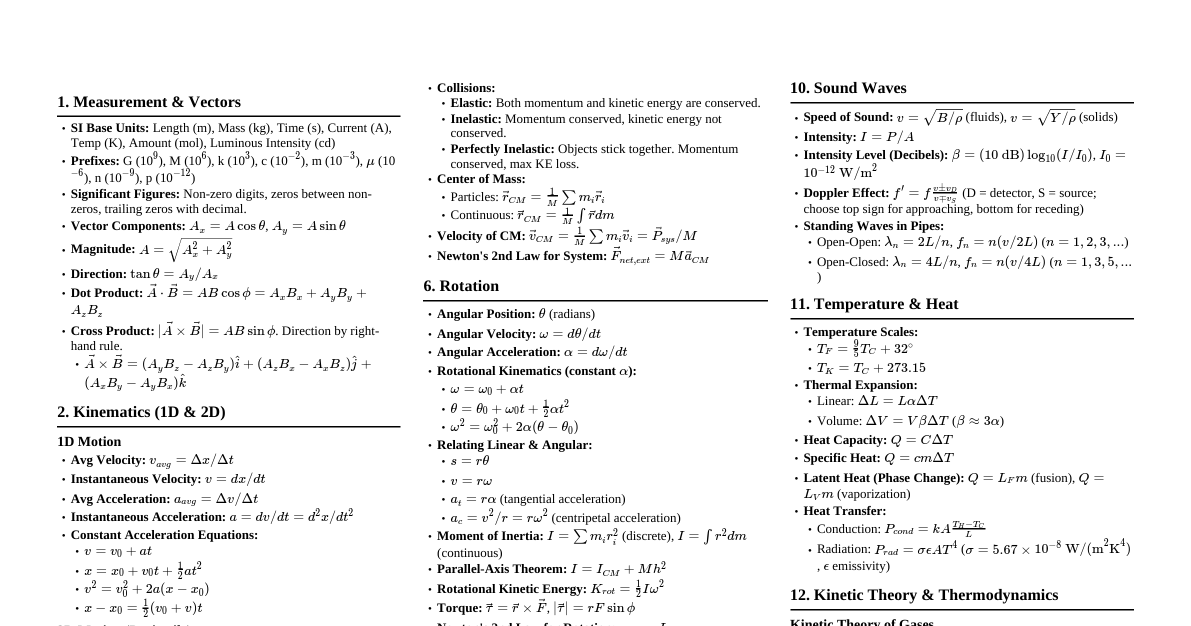
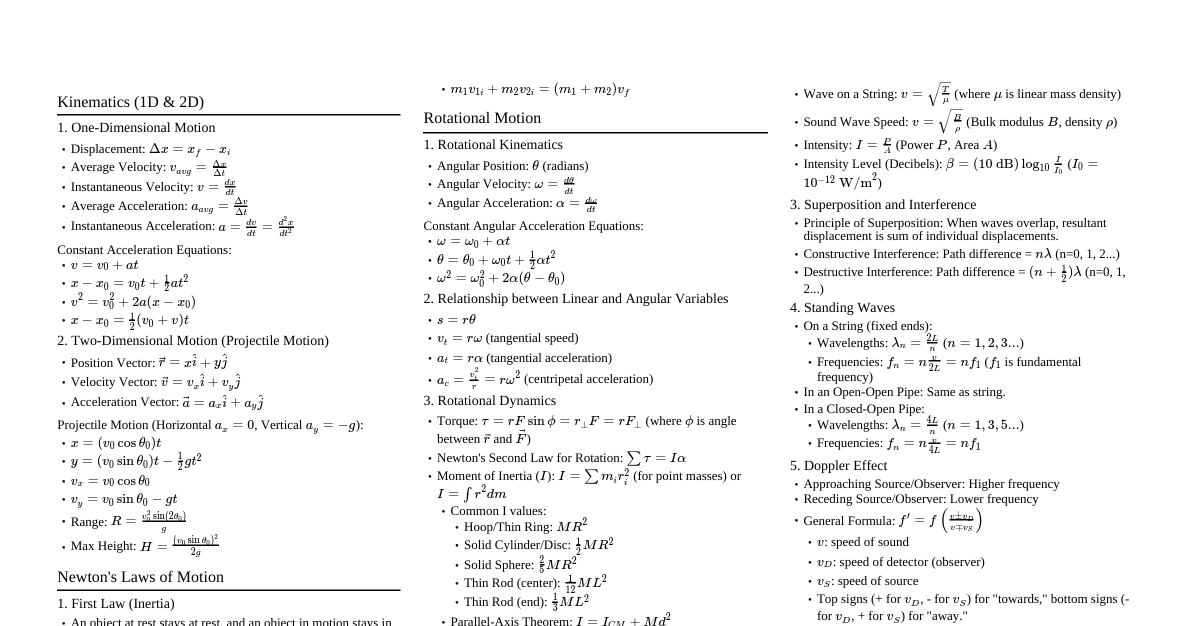
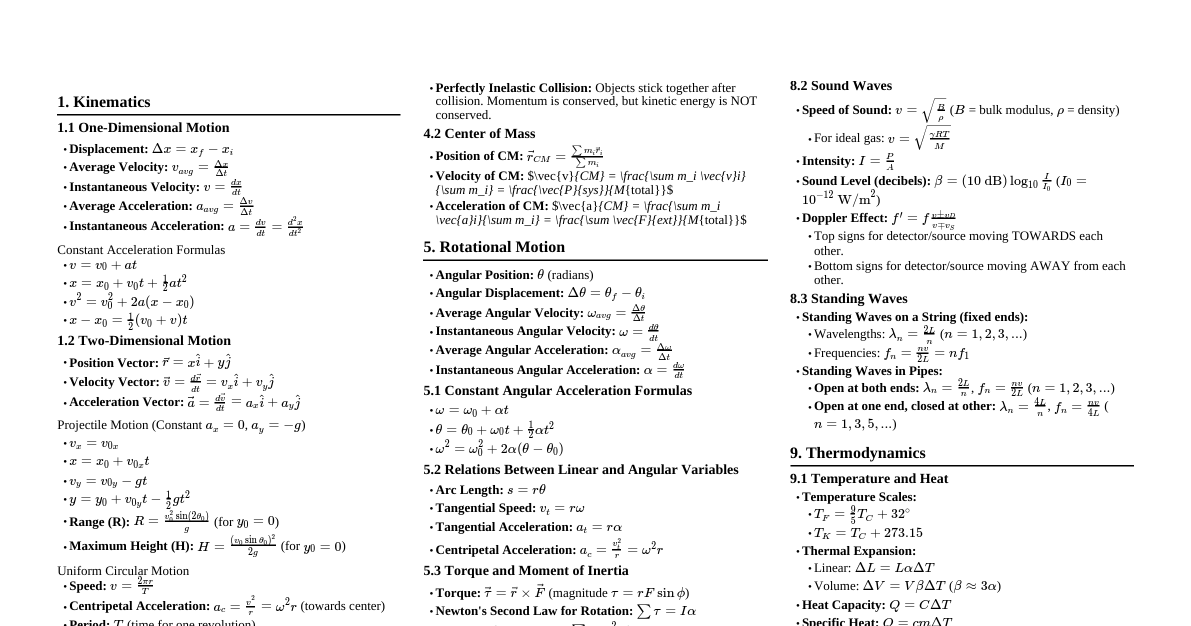
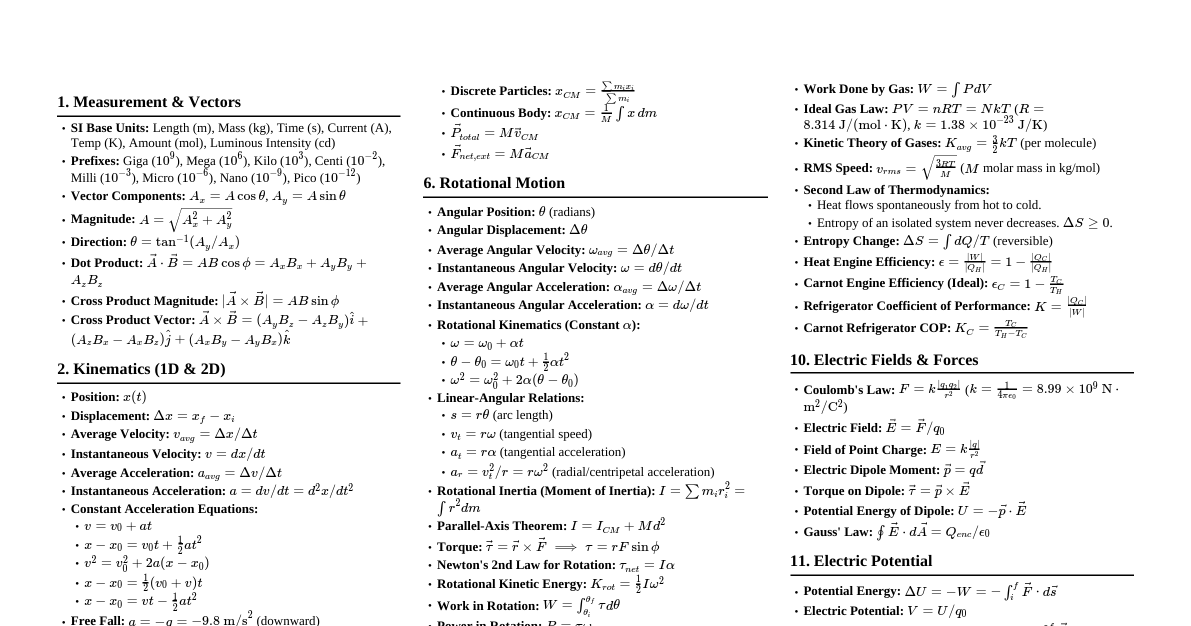
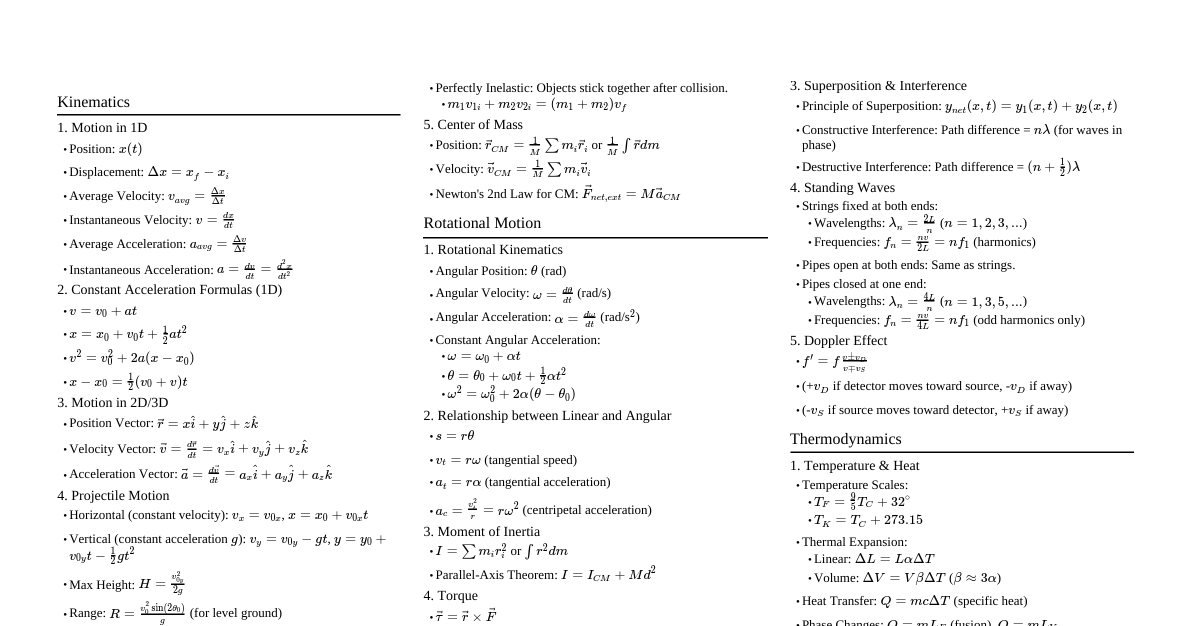
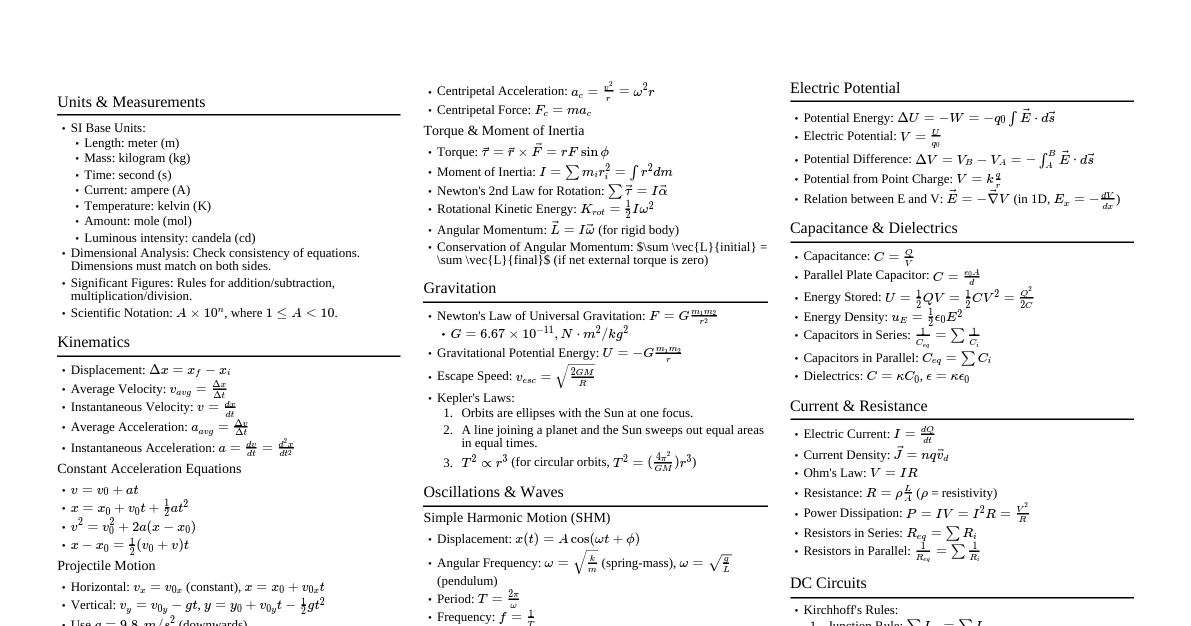
### 1. Kinematics (운동학) #### 1.1 One-Dimensional Motion (1차원 운동) - **Position (위치):** $x(t)$ - **Displacement (변위):** $\Delta x = x_f - x_i$ - **Average Velocity (평균 속도):** $v_{avg} = \frac{\Delta x}{\Delta t}$ - **Instantaneous Velocity (순간 속도):** $v = \frac{dx}{dt}$ - **Average Acceleration (평균 가속도):** $a_{avg} = \frac{\Delta v}{\Delta t}$ - **Instantaneous Acceleration (순간 가속도):** $a = \frac{dv}{dt} = \frac{d^2x}{dt^2}$ #### 1.2 Constant Acceleration (등가속도 운동) - $v = v_0 + at$ - $x = x_0 + v_0 t + \frac{1}{2}at^2$ - $v^2 = v_0^2 + 2a(x - x_0)$ - $x - x_0 = \frac{1}{2}(v_0 + v)t$ #### 1.3 Two-Dimensional Motion (2차원 운동) - **Position Vector (위치 벡터):** $\vec{r} = x\hat{i} + y\hat{j}$ - **Velocity Vector (속도 벡터):** $\vec{v} = \frac{d\vec{r}}{dt} = v_x\hat{i} + v_y\hat{j}$ - **Acceleration Vector (가속도 벡터):** $\vec{a} = \frac{d\vec{v}}{dt} = a_x\hat{i} + a_y\hat{j}$ - **Projectile Motion (포물선 운동):** - Horizontal: $v_x = v_{0x}$, $x = x_0 + v_{0x}t$ - Vertical: $v_y = v_{0y} - gt$, $y = y_0 + v_{0y}t - \frac{1}{2}gt^2$, $v_y^2 = v_{0y}^2 - 2g(y - y_0)$ ### 2. Newton's Laws of Motion (뉴턴 운동 법칙) - **First Law (제1법칙 - 관성의 법칙):** An object at rest stays at rest, and an object in motion stays in motion with the same speed and in the same direction unless acted upon by an unbalanced force. ($\sum \vec{F} = 0 \Rightarrow \vec{v} = \text{constant}$) - **Second Law (제2법칙 - 가속도의 법칙):** $\sum \vec{F} = m\vec{a}$ - **Third Law (제3법칙 - 작용-반작용 법칙):** If object A exerts a force on object B, then object B must exert a force of equal magnitude and opposite direction on object A. ($\vec{F}_{AB} = -\vec{F}_{BA}$) #### 2.1 Important Forces (주요 힘) - **Gravitational Force (중력):** $\vec{F}_g = m\vec{g}$ (near Earth's surface) - **Normal Force (수직항력):** Perpendicular to surface - **Tension Force (장력):** Along a cord/rope - **Friction Force (마찰력):** - **Static (정지 마찰):** $f_s \le \mu_s N$ - **Kinetic (운동 마찰):** $f_k = \mu_k N$ ### 3. Work & Energy (일과 에너지) #### 3.1 Work (일) - **Constant Force (일정한 힘):** $W = \vec{F} \cdot \vec{d} = Fd\cos\theta$ - **Variable Force (변하는 힘):** $W = \int \vec{F} \cdot d\vec{r}$ - **Work-Kinetic Energy Theorem (일-운동 에너지 정리):** $W_{net} = \Delta K = K_f - K_i$ #### 3.2 Kinetic Energy (운동 에너지) - $K = \frac{1}{2}mv^2$ #### 3.3 Potential Energy (위치 에너지) - **Gravitational (중력 위치 에너지):** $U_g = mgh$ - **Elastic (탄성 위치 에너지):** $U_s = \frac{1}{2}kx^2$ (for a spring) - **Relationship between Force and Potential Energy:** $F_x = -\frac{dU}{dx}$ #### 3.4 Conservation of Energy (에너지 보존) - **Mechanical Energy (역학적 에너지):** $E_{mech} = K + U$ - **Conservation of Mechanical Energy (역학적 에너지 보존):** If only conservative forces do work, $E_{mech,f} = E_{mech,i}$ - **General Conservation of Energy (일반 에너지 보존):** $W_{ext} = \Delta E_{mech} + \Delta E_{thermal} + \Delta E_{int}$ - $W_{ext}$ is work done by external forces. - $\Delta E_{thermal} = f_k d$ (work done by kinetic friction) #### 3.5 Power (일률) - **Average Power (평균 일률):** $P_{avg} = \frac{\Delta W}{\Delta t}$ - **Instantaneous Power (순간 일률):** $P = \frac{dW}{dt} = \vec{F} \cdot \vec{v}$ ### 4. Momentum & Collisions (운동량과 충돌) #### 4.1 Momentum (운동량) - **Linear Momentum (선 운동량):** $\vec{p} = m\vec{v}$ - **Newton's Second Law in terms of Momentum:** $\sum \vec{F}_{net} = \frac{d\vec{p}}{dt}$ #### 4.2 Impulse (충격량) - **Impulse (충격량):** $\vec{J} = \int \vec{F}(t)dt = \Delta \vec{p} = \vec{p}_f - \vec{p}_i$ #### 4.3 Conservation of Momentum (운동량 보존) - If net external force is zero, total momentum is conserved: $\sum \vec{p}_f = \sum \vec{p}_i$ #### 4.4 Collisions (충돌) - **Elastic Collision (탄성 충돌):** Both momentum and kinetic energy are conserved. - **Inelastic Collision (비탄성 충돌):** Momentum is conserved, but kinetic energy is not. - **Perfectly Inelastic Collision (완전 비탄성 충돌):** Objects stick together after collision. ### 5. Rotation (회전) #### 5.1 Rotational Kinematics (회전 운동학) - **Angular Position (각 위치):** $\theta$ (radians) - **Angular Displacement (각 변위):** $\Delta \theta = \theta_f - \theta_i$ - **Average Angular Velocity (평균 각속도):** $\omega_{avg} = \frac{\Delta \theta}{\Delta t}$ - **Instantaneous Angular Velocity (순간 각속도):** $\omega = \frac{d\theta}{dt}$ - **Average Angular Acceleration (평균 각가속도):** $\alpha_{avg} = \frac{\Delta \omega}{\Delta t}$ - **Instantaneous Angular Acceleration (순간 각가속도):** $\alpha = \frac{d\omega}{dt}$ #### 5.2 Constant Angular Acceleration (등각가속도 운동) - $\omega = \omega_0 + \alpha t$ - $\theta = \theta_0 + \omega_0 t + \frac{1}{2}\alpha t^2$ - $\omega^2 = \omega_0^2 + 2\alpha(\theta - \theta_0)$ #### 5.3 Relation between Linear and Angular Variables (선형 및 각 변수 관계) - Arc length (호의 길이): $s = r\theta$ - Tangential speed (접선 속도): $v_t = r\omega$ - Tangential acceleration (접선 가속도): $a_t = r\alpha$ - Centripetal acceleration (구심 가속도): $a_c = \frac{v^2}{r} = r\omega^2$ #### 5.4 Torque (토크) - $\vec{\tau} = \vec{r} \times \vec{F}$ - Magnitude: $\tau = rF\sin\phi$ #### 5.5 Newton's Second Law for Rotation (회전에 대한 뉴턴 제2법칙) - $\sum \tau = I\alpha$ - **Moment of Inertia (관성 모멘트):** $I = \sum m_i r_i^2$ (for point masses) or $I = \int r^2 dm$ #### 5.6 Rotational Kinetic Energy (회전 운동 에너지) - $K_{rot} = \frac{1}{2}I\omega^2$ #### 5.7 Angular Momentum (각운동량) - **For a particle (점 입자):** $\vec{l} = \vec{r} \times \vec{p}$ - **For a rigid body (강체):** $\vec{L} = I\vec{\omega}$ - **Conservation of Angular Momentum (각운동량 보존):** If net external torque is zero, $\vec{L}_{total} = \text{constant}$. ### 6. Oscillations (진동) #### 6.1 Simple Harmonic Motion (단순 조화 운동, SHM) - **Displacement (변위):** $x(t) = x_m \cos(\omega t + \phi)$ - **Velocity (속도):** $v(t) = -\omega x_m \sin(\omega t + \phi)$ - **Acceleration (가속도):** $a(t) = -\omega^2 x_m \cos(\omega t + \phi) = -\omega^2 x(t)$ - **Angular Frequency (각진동수):** $\omega = \sqrt{\frac{k}{m}}$ (spring-mass system) - **Period (주기):** $T = \frac{2\pi}{\omega} = 2\pi\sqrt{\frac{m}{k}}$ - **Frequency (진동수):** $f = \frac{1}{T}$ #### 6.2 Pendulums (단진자) - **Simple Pendulum (단순 진자):** $T = 2\pi\sqrt{\frac{L}{g}}$ (for small angles) - **Physical Pendulum (물리 진자):** $T = 2\pi\sqrt{\frac{I}{mgd}}$ ### 7. Waves (파동) #### 7.1 Transverse and Longitudinal Waves (횡파 및 종파) - **Wave Speed (파동 속도):** $v = \lambda f$ - **Wave Equation (파동 방정식):** $y(x,t) = y_m \sin(kx - \omega t + \phi)$ - **Angular Wave Number (각 파수):** $k = \frac{2\pi}{\lambda}$ #### 7.2 Speed of a Wave (파동 속도) - **On a string (줄에서):** $v = \sqrt{\frac{\tau}{\mu}}$ ($\tau$ = tension, $\mu$ = linear density) - **Sound in a fluid (유체 내 소리):** $v = \sqrt{\frac{B}{\rho}}$ ($B$ = bulk modulus, $\rho$ = density) #### 7.3 Superposition and Interference (중첩과 간섭) - **Principle of Superposition (중첩의 원리):** $y'(x,t) = y_1(x,t) + y_2(x,t)$ - **Standing Waves (정상파):** Result from interference of two waves traveling in opposite directions. - **On a string fixed at both ends:** $\lambda_n = \frac{2L}{n}$, $f_n = n\frac{v}{2L}$ ($n=1,2,3...$) ### 8. Thermodynamics (열역학) #### 8.1 Temperature and Heat (온도와 열) - **Temperature Scales (온도 스케일):** $T_F = \frac{9}{5}T_C + 32$, $T_K = T_C + 273.15$ - **Thermal Expansion (열팽창):** - Linear: $\Delta L = L\alpha\Delta T$ - Volume: $\Delta V = V\beta\Delta T$ ($\beta = 3\alpha$) - **Heat Capacity (열용량):** $Q = C\Delta T$ - **Specific Heat (비열):** $Q = cm\Delta T$ - **Latent Heat (잠열):** $Q = mL$ (for phase change) - **Heat Transfer (열 전달):** - **Conduction (전도):** $P_{cond} = kA\frac{T_H - T_C}{L}$ - **Radiation (복사):** $P_{rad} = \sigma\epsilon A T^4$ (Stefan-Boltzmann Law) #### 8.2 First Law of Thermodynamics (열역학 제1법칙) - $\Delta E_{int} = Q - W$ - $\Delta E_{int}$: Change in internal energy - $Q$: Heat added to the system - $W$: Work done *by* the system #### 8.3 Work done by a Gas (기체가 하는 일) - $W = \int P dV$ - **Isobaric (등압):** $W = P\Delta V$ - **Isothermal (등온):** $W = nRT \ln(\frac{V_f}{V_i})$ - **Adiabatic (단열):** $PV^\gamma = \text{constant}$ #### 8.4 Kinetic Theory of Gases (기체 운동론) - **Ideal Gas Law (이상 기체 법칙):** $PV = nRT = NkT$ - **Internal Energy of Monatomic Ideal Gas (단원자 이상 기체 내부 에너지):** $E_{int} = \frac{3}{2}nRT$ - **Average Kinetic Energy per Molecule (분자당 평균 운동 에너지):** $K_{avg} = \frac{3}{2}kT$ - **RMS Speed (제곱근 평균 제곱 속력):** $v_{rms} = \sqrt{\frac{3RT}{M}}$ #### 8.5 Second Law of Thermodynamics (열역학 제2법칙) - **Entropy (엔트로피):** $\Delta S = \int \frac{dQ}{T}$ - **Carnot Engine (카르노 기관):** - **Efficiency (효율):** $\epsilon = 1 - \frac{T_C}{T_H}$ - $\frac{|Q_H|}{T_H} = \frac{|Q_C|}{T_C}$ - **Coefficient of Performance (성능 계수):** - **Refrigerator (냉장고):** $K = \frac{|Q_C|}{|W|} = \frac{T_C}{T_H - T_C}$ - **Heat Pump (열펌프):** $K = \frac{|Q_H|}{|W|} = \frac{T_H}{T_H - T_C}$ ### 9. Electricity (전기) #### 9.1 Electric Charge and Coulomb's Law (전하와 쿨롱 법칙) - **Quantization of Charge (전하의 양자화):** $q = ne$ - **Coulomb's Law (쿨롱 법칙):** $F = k\frac{|q_1 q_2|}{r^2}$ ($k = \frac{1}{4\pi\epsilon_0}$) #### 9.2 Electric Field (전기장) - **Definition (정의):** $\vec{E} = \frac{\vec{F}}{q_0}$ - **Point Charge (점 전하):** $\vec{E} = k\frac{q}{r^2}\hat{r}$ - **Electric Dipole (전기 쌍극자):** $\vec{p} = q\vec{d}$ - **Electric Flux (전기 선속):** $\Phi_E = \int \vec{E} \cdot d\vec{A}$ - **Gauss' Law (가우스 법칙):** $\oint \vec{E} \cdot d\vec{A} = \frac{Q_{enc}}{\epsilon_0}$ #### 9.3 Electric Potential (전기 퍼텐셜) - **Definition (정의):** $\Delta V = -\int_i^f \vec{E} \cdot d\vec{s}$ - **Point Charge (점 전하):** $V = k\frac{q}{r}$ - **Electric Potential Energy (전기 퍼텐셜 에너지):** $U = qV$ - **Relationship between E and V:** $\vec{E} = -\nabla V$ (for 1D: $E_x = -\frac{dV}{dx}$) #### 9.4 Capacitance (전기 용량) - **Definition (정의):** $C = \frac{Q}{V}$ - **Parallel Plate Capacitor (평행판 축전기):** $C = \frac{\epsilon_0 A}{d}$ - **Energy Stored (저장 에너지):** $U = \frac{1}{2}CV^2 = \frac{Q^2}{2C} = \frac{1}{2}QV$ - **Dielectrics (유전체):** $C = \kappa C_{air}$ - **Capacitors in Series (직렬):** $\frac{1}{C_{eq}} = \sum \frac{1}{C_i}$ - **Capacitors in Parallel (병렬):** $C_{eq} = \sum C_i$ ### 10. DC Circuits (직류 회로) #### 10.1 Current and Resistance (전류와 저항) - **Current (전류):** $I = \frac{dQ}{dt}$ - **Ohm's Law (옴의 법칙):** $V = IR$ - **Resistance (저항):** $R = \rho\frac{L}{A}$ - **Resistivity (비저항):** $\rho = \rho_0(1 + \alpha(T - T_0))$ #### 10.2 Electrical Power (전력) - $P = IV = I^2R = \frac{V^2}{R}$ #### 10.3 Resistors in Series and Parallel (직렬 및 병렬 저항) - **Series (직렬):** $R_{eq} = \sum R_i$ - **Parallel (병렬):** $\frac{1}{R_{eq}} = \sum \frac{1}{R_i}$ #### 10.4 Kirchhoff's Rules (키르히호프 법칙) - **Junction Rule (접합점 법칙):** $\sum I_{in} = \sum I_{out}$ (conservation of charge) - **Loop Rule (고리 법칙):** $\sum \Delta V = 0$ (conservation of energy) #### 10.5 RC Circuits (RC 회로) - **Charging Capacitor (축전기 충전):** $q(t) = Q_{max}(1 - e^{-t/RC})$, $I(t) = I_{max}e^{-t/RC}$ - **Discharging Capacitor (축전기 방전):** $q(t) = Q_0 e^{-t/RC}$, $I(t) = I_0 e^{-t/RC}$ - **Time Constant (시정수):** $\tau = RC$ ### 11. Magnetism (자기) #### 11.1 Magnetic Fields and Forces (자기장과 자기력) - **Magnetic Force on a Moving Charge (움직이는 전하에 대한 자기력):** $\vec{F}_B = q\vec{v} \times \vec{B}$ - **Magnetic Force on a Current-Carrying Wire (전류가 흐르는 도선에 대한 자기력):** $\vec{F}_B = I\vec{L} \times \vec{B}$ - **Torque on a Current Loop (전류 고리에 대한 토크):** $\vec{\tau} = \vec{\mu} \times \vec{B}$ (where $\vec{\mu} = IA\hat{n}$ is magnetic dipole moment) #### 11.2 Sources of Magnetic Field (자기장 원천) - **Biot-Savart Law (비오-사바르 법칙):** $d\vec{B} = \frac{\mu_0}{4\pi}\frac{I d\vec{s} \times \hat{r}}{r^2}$ - **Magnetic Field of a Long Straight Wire (긴 직선 도선의 자기장):** $B = \frac{\mu_0 I}{2\pi r}$ - **Magnetic Field at Center of a Circular Loop (원형 고리 중심의 자기장):** $B = \frac{\mu_0 I}{2R}$ - **Ampere's Law (앙페르 법칙):** $\oint \vec{B} \cdot d\vec{s} = \mu_0 I_{enc}$ - **Solenoid (솔레노이드):** $B = \mu_0 nI$ ($n$ = turns per unit length) ### 12. Electromagnetic Induction (전자기 유도) #### 12.1 Faraday's Law of Induction (패러데이 유도 법칙) - $\mathcal{E} = -\frac{d\Phi_B}{dt}$ - **Magnetic Flux (자기 선속):** $\Phi_B = \int \vec{B} \cdot d\vec{A}$ #### 12.2 Lenz's Law (렌츠의 법칙) - The induced current will flow in a direction that opposes the change in magnetic flux that caused it. #### 12.3 Motional EMF (운동 기전력) - $\mathcal{E} = BLv$ (for a conductor moving in a uniform B-field) #### 12.4 Inductance (유도 용량) - **Self-Inductance (자기 유도 용량):** $L = \frac{N\Phi_B}{I}$ - **Solenoid (솔레노이드):** $L = \mu_0 n^2 A l$ - **Energy Stored in an Inductor (인덕터에 저장된 에너지):** $U_B = \frac{1}{2}LI^2$ #### 12.5 LR Circuits (LR 회로) - **Current growth (전류 증가):** $I(t) = \frac{\mathcal{E}}{R}(1 - e^{-t/\tau_L})$ - **Current decay (전류 감소):** $I(t) = I_0 e^{-t/\tau_L}$ - **Time Constant (시정수):** $\tau_L = \frac{L}{R}$ ### 13. EM Waves (전자기파) #### 13.1 Maxwell's Equations (맥스웰 방정식) 1. **Gauss' Law for Electricity (전기에 대한 가우스 법칙):** $\oint \vec{E} \cdot d\vec{A} = \frac{Q_{enc}}{\epsilon_0}$ 2. **Gauss' Law for Magnetism (자기에 대한 가우스 법칙):** $\oint \vec{B} \cdot d\vec{A} = 0$ 3. **Faraday's Law (패러데이 법칙):** $\oint \vec{E} \cdot d\vec{s} = -\frac{d\Phi_B}{dt}$ 4. **Ampere-Maxwell Law (앙페르-맥스웰 법칙):** $\oint \vec{B} \cdot d\vec{s} = \mu_0 I_{enc} + \mu_0\epsilon_0\frac{d\Phi_E}{dt}$ #### 13.2 Properties of EM Waves (전자기파의 특성) - **Speed of Light (빛의 속도):** $c = \frac{1}{\sqrt{\mu_0\epsilon_0}} \approx 3 \times 10^8 \text{ m/s}$ - **Wave Speed (파동 속도):** $c = \lambda f$ - **Relationship between E and B:** $E = cB$ - **Poynting Vector (포인팅 벡터):** $\vec{S} = \frac{1}{\mu_0}(\vec{E} \times \vec{B})$ (direction of energy flow) - **Intensity (강도):** $I = S_{avg} = \frac{1}{c\mu_0}E_{rms}^2 = \frac{c}{\mu_0}B_{rms}^2$