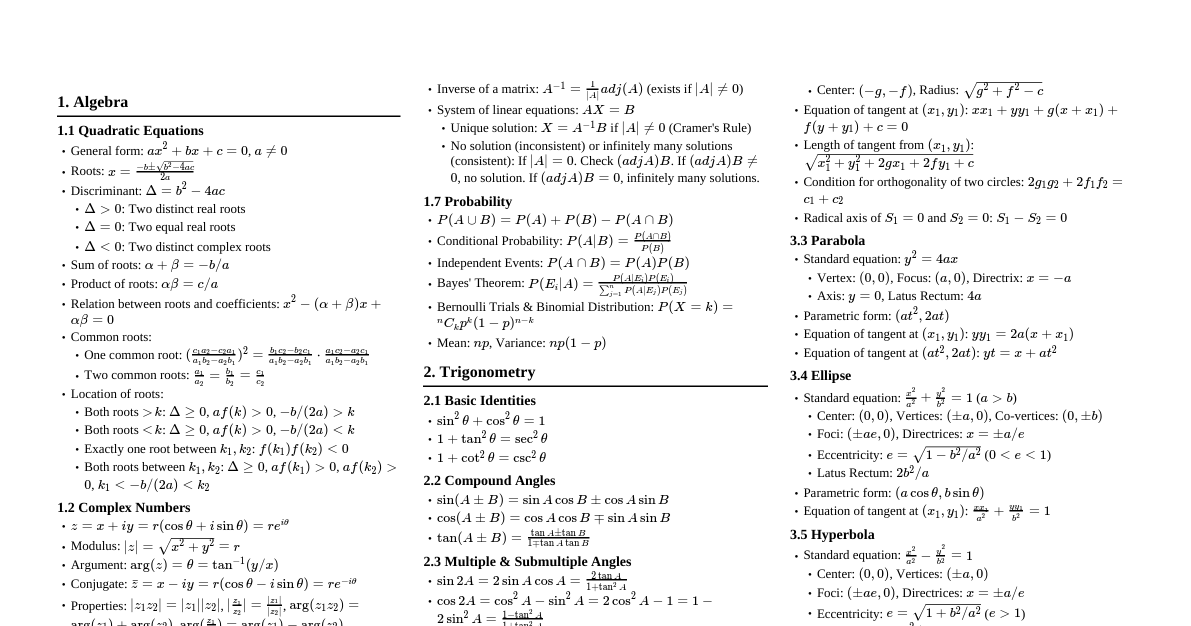
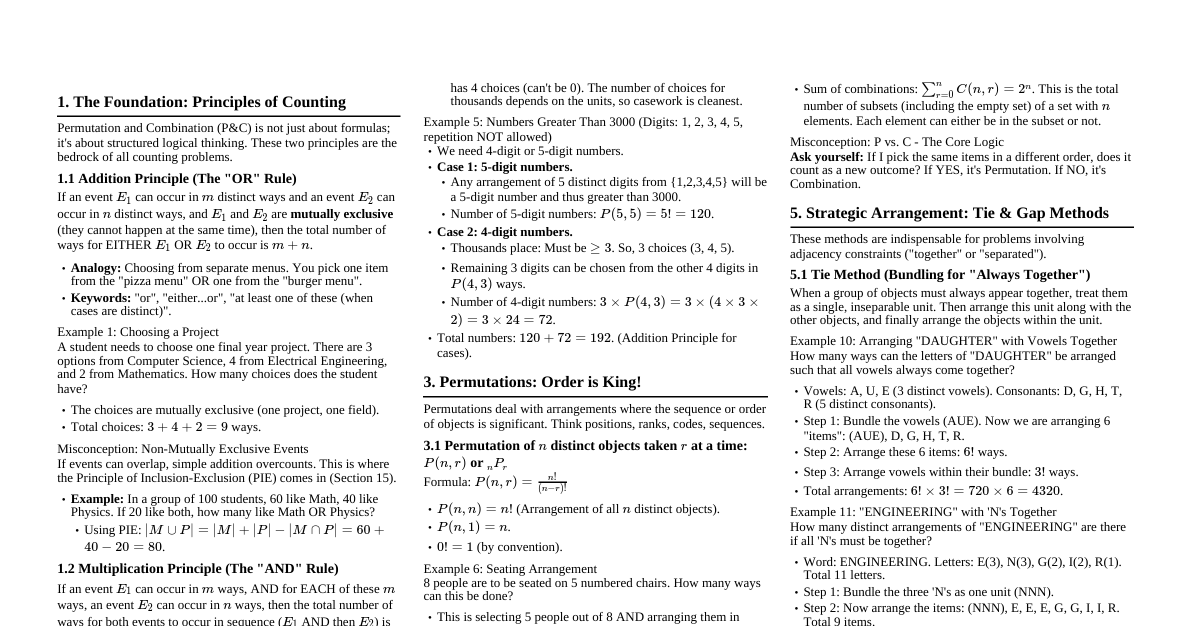
JEE Advanced Math Cheatsheet
Cheatsheet Content
1. Algebra Quadratic Equations General form: $ax^2 + bx + c = 0$, $a \neq 0$ Roots: $x = \frac{-b \pm \sqrt{b^2 - 4ac}}{2a}$ Discriminant: $\Delta = b^2 - 4ac$ $\Delta > 0$: Two distinct real roots $\Delta = 0$: Two equal real roots $\Delta Sum of roots ($\alpha + \beta = -b/a$) and Product of roots ($\alpha\beta = c/a$) Condition for common roots: One common root: $(c_1a_2 - c_2a_1)^2 = (a_1b_2 - a_2b_1)(b_1c_2 - b_2c_1)$ Both roots common: $a_1/a_2 = b_1/b_2 = c_1/c_2$ Location of roots: Both roots $>\! k$: $\Delta \ge 0$, $a f(k) > 0$, $-b/(2a) > k$ Both roots $ 0$, $-b/(2a) One root $>\! k$, other $ Complex Numbers $z = x + iy = r(\cos\theta + i\sin\theta) = re^{i\theta}$ Modulus: $|z| = \sqrt{x^2 + y^2}$ Argument: $\arg(z) = \theta$ Conjugate: $\bar{z} = x - iy$ Properties: $|z_1z_2| = |z_1||z_2|$, $\arg(z_1z_2) = \arg(z_1) + \arg(z_2)$ De Moivre's Theorem: $(\cos\theta + i\sin\theta)^n = \cos(n\theta) + i\sin(n\theta)$ $n^{th}$ roots of unity: $e^{i(2k\pi/n)}$, $k=0,1,...,n-1$ Cube roots of unity: $1, \omega, \omega^2$ where $\omega = e^{i2\pi/3}$, $1+\omega+\omega^2=0$, $\omega^3=1$ Progressions and Series Arithmetic Progression (AP): $a, a+d, a+2d, ...$ $n^{th}$ term: $a_n = a + (n-1)d$ Sum of $n$ terms: $S_n = \frac{n}{2}(2a + (n-1)d) = \frac{n}{2}(a + a_n)$ Geometric Progression (GP): $a, ar, ar^2, ...$ $n^{th}$ term: $a_n = ar^{n-1}$ Sum of $n$ terms: $S_n = \frac{a(r^n - 1)}{r-1}$, $r \neq 1$ Sum to infinity: $S_{\infty} = \frac{a}{1-r}$, $|r| Harmonic Progression (HP): Reciprocals are in AP. Arithmetic-Geometric Progression (AGP): $a, (a+d)r, (a+2d)r^2, ...$ Sums of special series: $\sum n = \frac{n(n+1)}{2}$ $\sum n^2 = \frac{n(n+1)(2n+1)}{6}$ $\sum n^3 = \left(\frac{n(n+1)}{2}\right)^2$ Permutations and Combinations Permutations: $^nP_r = \frac{n!}{(n-r)!}$ (arrangement) Combinations: $^nC_r = \frac{n!}{r!(n-r)!}$ (selection) Properties: $^nC_r = ^nC_{n-r}$, $^nC_r + ^nC_{r-1} = ^{n+1}C_r$ Circular Permutations: $(n-1)!$ for distinct items. If clockwise/anticlockwise are same, $\frac{(n-1)!}{2}$. Binomial Theorem $(x+y)^n = \sum_{k=0}^n \binom{n}{k} x^{n-k} y^k$ General term: $T_{k+1} = \binom{n}{k} x^{n-k} y^k$ Number of terms: $n+1$ Middle term(s): If $n$ is even, $T_{n/2+1}$ If $n$ is odd, $T_{(n+1)/2}$ and $T_{(n+3)/2}$ Binomial Theorem for any index: $(1+x)^n = 1 + nx + \frac{n(n-1)}{2!}x^2 + \dots$ (valid for $|x| Matrices and Determinants Determinant of $2 \times 2$: $\begin{vmatrix} a & b \\ c & d \end{vmatrix} = ad - bc$ Determinant of $3 \times 3$: $\begin{vmatrix} a & b & c \\ d & e & f \\ g & h & i \end{vmatrix} = a(ei-fh) - b(di-fg) + c(dh-eg)$ Properties: $|AB| = |A||B|$, $|A^T| = |A|$, $|kA| = k^n|A|$ (for $n \times n$ matrix) Adjoint of A: $adj(A) = (C_{ij})^T$ where $C_{ij}$ is cofactor of $a_{ij}$ Inverse of A: $A^{-1} = \frac{1}{|A|} adj(A)$ (if $|A| \neq 0$) System of linear equations: $AX = B$ Unique solution: $|A| \neq 0$, $X=A^{-1}B$ No solution: $|A|=0$ and $(adj A)B \neq 0$ Infinite solutions: $|A|=0$ and $(adj A)B = 0$ Rank of a matrix: Max order of a non-zero minor. Probability $P(A \cup B) = P(A) + P(B) - P(A \cap B)$ Conditional Probability: $P(A|B) = \frac{P(A \cap B)}{P(B)}$ Independent Events: $P(A \cap B) = P(A)P(B)$ Bayes' Theorem: $P(B_i|A) = \frac{P(A|B_i)P(B_i)}{\sum_j P(A|B_j)P(B_j)}$ Bernoulli Trials & Binomial Distribution: $P(X=k) = \binom{n}{k} p^k (1-p)^{n-k}$ 2. Calculus Functions Domain and Range Even Function: $f(-x) = f(x)$ (symmetric about y-axis) Odd Function: $f(-x) = -f(x)$ (symmetric about origin) Periodic Function: $f(x+T) = f(x)$ for smallest $T>0$ (period) Monotonicity: Increasing if $f'(x) > 0$, Decreasing if $f'(x) Injectivity (One-to-one): $f(x_1) = f(x_2) \implies x_1 = x_2$ Surjectivity (Onto): Range = Codomain Bijectivity: Both injective and surjective Inverse Function: $f^{-1}(y)=x$ if $f(x)=y$. Graph is reflection about $y=x$. Limits, Continuity and Differentiability Limit: $\lim_{x \to a} f(x) = L$ if $\lim_{x \to a^-} f(x) = \lim_{x \to a^+} f(x) = L$ L'Hopital's Rule: If $\lim_{x \to a} \frac{f(x)}{g(x)}$ is of form $\frac{0}{0}$ or $\frac{\infty}{\infty}$, then $\lim_{x \to a} \frac{f(x)}{g(x)} = \lim_{x \to a} \frac{f'(x)}{g'(x)}$ Standard Limits: $\lim_{x \to 0} \frac{\sin x}{x} = 1$ $\lim_{x \to 0} \frac{\tan x}{x} = 1$ $\lim_{x \to 0} \frac{e^x - 1}{x} = 1$ $\lim_{x \to 0} \frac{\ln(1+x)}{x} = 1$ $\lim_{x \to 0} (1+x)^{1/x} = e$ $\lim_{x \to \infty} (1 + \frac{1}{x})^x = e$ $\lim_{x \to a} \frac{x^n - a^n}{x - a} = na^{n-1}$ Continuity: $f$ is continuous at $a$ if $\lim_{x \to a} f(x) = f(a)$ Differentiability: $f$ is differentiable at $a$ if $\lim_{h \to 0} \frac{f(a+h) - f(a)}{h}$ exists. Implies continuity. Differentiation Product Rule: $(uv)' = u'v + uv'$ Quotient Rule: $(\frac{u}{v})' = \frac{u'v - uv'}{v^2}$ Chain Rule: $\frac{dy}{dx} = \frac{dy}{du} \frac{du}{dx}$ Implicit Differentiation Derivatives of standard functions: $\frac{d}{dx}(x^n) = nx^{n-1}$ $\frac{d}{dx}(\sin x) = \cos x$ $\frac{d}{dx}(\cos x) = -\sin x$ $\frac{d}{dx}(\tan x) = \sec^2 x$ $\frac{d}{dx}(e^x) = e^x$ $\frac{d}{dx}(\ln x) = \frac{1}{x}$ $\frac{d}{dx}(\sin^{-1} x) = \frac{1}{\sqrt{1-x^2}}$ $\frac{d}{dx}(\tan^{-1} x) = \frac{1}{1+x^2}$ Applications of Derivatives Tangent and Normal: Slope of tangent $m = f'(x_1, y_1)$. Equation: $y-y_1 = m(x-x_1)$. Normal slope: $-1/m$. Monotonicity: $f'(x) > 0 \implies$ strictly increasing; $f'(x) Maxima and Minima: First Derivative Test: Change of sign of $f'(x)$ Second Derivative Test: $f''(x) > 0 \implies$ local minimum; $f''(x) Rolle's Theorem: If $f$ is continuous on $[a,b]$, differentiable on $(a,b)$ and $f(a)=f(b)$, then $\exists c \in (a,b)$ s.t. $f'(c)=0$. Lagrange's Mean Value Theorem: If $f$ is continuous on $[a,b]$, differentiable on $(a,b)$, then $\exists c \in (a,b)$ s.t. $f'(c) = \frac{f(b)-f(a)}{b-a}$. Indefinite Integrals $\int x^n dx = \frac{x^{n+1}}{n+1} + C$, $n \neq -1$ $\int \frac{1}{x} dx = \ln|x| + C$ $\int \sin x dx = -\cos x + C$ $\int \cos x dx = \sin x + C$ $\int e^x dx = e^x + C$ $\int \frac{1}{\sqrt{a^2-x^2}} dx = \sin^{-1}\left(\frac{x}{a}\right) + C$ $\int \frac{1}{a^2+x^2} dx = \frac{1}{a}\tan^{-1}\left(\frac{x}{a}\right) + C$ Integration by Parts: $\int u dv = uv - \int v du$ Partial Fractions Definite Integrals $\int_a^b f(x) dx = F(b) - F(a)$ where $F'(x) = f(x)$ Properties: $\int_a^b f(x) dx = \int_a^b f(a+b-x) dx$ $\int_0^a f(x) dx = \int_0^a f(a-x) dx$ $\int_{-a}^a f(x) dx = 2\int_0^a f(x) dx$ if $f$ is even, $0$ if $f$ is odd. $\int_0^{2a} f(x) dx = 2\int_0^a f(x) dx$ if $f(2a-x)=f(x)$, $0$ if $f(2a-x)=-f(x)$. Area Under Curves Area bounded by $y=f(x)$, x-axis, $x=a$, $x=b$: $\int_a^b |f(x)| dx$ Area between $y=f(x)$ and $y=g(x)$ from $x=a$ to $x=b$: $\int_a^b |f(x) - g(x)| dx$ Differential Equations Order: highest derivative present. Degree: power of highest derivative. Variable Separable: $\frac{dy}{dx} = f(x)g(y) \implies \int \frac{dy}{g(y)} = \int f(x) dx$ Homogeneous: $\frac{dy}{dx} = f(\frac{y}{x})$. Substitute $y=vx$. Linear: $\frac{dy}{dx} + P(x)y = Q(x)$. Integrating factor: $IF = e^{\int P(x) dx}$. Solution: $y \cdot IF = \int Q(x) \cdot IF dx + C$. 3. Coordinate Geometry Straight Lines Distance formula: $D = \sqrt{(x_2-x_1)^2 + (y_2-y_1)^2}$ Section formula: $(x,y) = \left(\frac{m x_2 + n x_1}{m+n}, \frac{m y_2 + n y_1}{m+n}\right)$ (internal division) Midpoint: $\left(\frac{x_1+x_2}{2}, \frac{y_1+y_2}{2}\right)$ Slope: $m = \frac{y_2-y_1}{x_2-x_1} = \tan\theta$ Equation of line: Slope-intercept form: $y = mx+c$ Point-slope form: $y-y_1 = m(x-x_1)$ Two-point form: $y-y_1 = \frac{y_2-y_1}{x_2-x_1}(x-x_1)$ Intercept form: $\frac{x}{a} + \frac{y}{b} = 1$ Normal form: $x\cos\alpha + y\sin\alpha = p$ General form: $Ax+By+C=0$ Angle between two lines with slopes $m_1, m_2$: $\tan\theta = |\frac{m_1-m_2}{1+m_1m_2}|$ Parallel lines: $m_1=m_2$. Perpendicular lines: $m_1m_2=-1$. Distance of point $(x_1, y_1)$ from $Ax+By+C=0$: $\frac{|Ax_1+By_1+C|}{\sqrt{A^2+B^2}}$ Distance between parallel lines $Ax+By+C_1=0$ and $Ax+By+C_2=0$: $\frac{|C_1-C_2|}{\sqrt{A^2+B^2}}$ Family of lines passing through intersection of $L_1=0$ and $L_2=0$: $L_1 + \lambda L_2 = 0$ Circles Standard form: $(x-h)^2 + (y-k)^2 = r^2$ (center $(h,k)$, radius $r$) General form: $x^2+y^2+2gx+2fy+c=0$. Center $(-g,-f)$, radius $\sqrt{g^2+f^2-c}$. Parametric form: $x = h+r\cos\theta, y = k+r\sin\theta$ Equation of tangent at $(x_1,y_1)$: $xx_1+yy_1+g(x+x_1)+f(y+y_1)+c=0$ Condition for tangency of $y=mx+c$ to $x^2+y^2=a^2$: $c^2=a^2(1+m^2)$ Length of tangent from $(x_1,y_1)$ to $S=0$: $\sqrt{S_1}$ where $S_1 = x_1^2+y_1^2+2gx_1+2fy_1+c$ Radical Axis of $S_1=0$ and $S_2=0$: $S_1-S_2=0$ Parabola Standard equation: $y^2 = 4ax$ Vertex: $(0,0)$, Focus: $(a,0)$, Directrix: $x=-a$ Axis: $y=0$, Latus Rectum length: $4a$ Parametric form: $(at^2, 2at)$ Tangent at $(x_1,y_1)$: $yy_1 = 2a(x+x_1)$ Condition for tangency of $y=mx+c$: $c = a/m$ Ellipse Standard equation: $\frac{x^2}{a^2} + \frac{y^2}{b^2} = 1$, $a>b$ Center: $(0,0)$, Foci: $(\pm ae, 0)$, Vertices: $(\pm a, 0)$ Directrices: $x = \pm a/e$, Eccentricity: $e = \sqrt{1 - b^2/a^2}$ Latus Rectum length: $2b^2/a$ Parametric form: $(a\cos\theta, b\sin\theta)$ Tangent at $(x_1,y_1)$: $\frac{xx_1}{a^2} + \frac{yy_1}{b^2} = 1$ Condition for tangency of $y=mx+c$: $c^2 = a^2m^2 + b^2$ Hyperbola Standard equation: $\frac{x^2}{a^2} - \frac{y^2}{b^2} = 1$ Center: $(0,0)$, Foci: $(\pm ae, 0)$, Vertices: $(\pm a, 0)$ Directrices: $x = \pm a/e$, Eccentricity: $e = \sqrt{1 + b^2/a^2}$ Latus Rectum length: $2b^2/a$ Parametric form: $(a\sec\theta, b\tan\theta)$ Asymptotes: $\frac{x}{a} \pm \frac{y}{b} = 0$ Tangent at $(x_1,y_1)$: $\frac{xx_1}{a^2} - \frac{yy_1}{b^2} = 1$ Condition for tangency of $y=mx+c$: $c^2 = a^2m^2 - b^2$ Rectangular Hyperbola: $xy=c^2$ 3D Geometry Distance between $(x_1, y_1, z_1)$ and $(x_2, y_2, z_2)$: $\sqrt{(x_2-x_1)^2 + (y_2-y_1)^2 + (z_2-z_1)^2}$ Direction Cosines: $l=\cos\alpha, m=\cos\beta, n=\cos\gamma$. $l^2+m^2+n^2=1$. Direction Ratios: $a,b,c$. $l = \frac{a}{\sqrt{a^2+b^2+c^2}}$, etc. Equation of a line: Through $(x_1,y_1,z_1)$ with DRs $(a,b,c)$: $\frac{x-x_1}{a} = \frac{y-y_1}{b} = \frac{z-z_1}{c}$ Vector form: $\vec{r} = \vec{a} + \lambda\vec{b}$ Equation of a plane: Normal form: $lx+my+nz=p$ General form: $Ax+By+Cz+D=0$ Through $(x_1,y_1,z_1)$ with normal DRs $(A,B,C)$: $A(x-x_1)+B(y-y_1)+C(z-z_1)=0$ Vector form: $\vec{r} \cdot \vec{n} = d$ Distance of a point $(x_1,y_1,z_1)$ from plane $Ax+By+Cz+D=0$: $\frac{|Ax_1+By_1+Cz_1+D|}{\sqrt{A^2+B^2+C^2}}$ Angle between two planes: $\cos\theta = \frac{|\vec{n_1} \cdot \vec{n_2}|}{|\vec{n_1}||\vec{n_2}|}$ Angle between line and plane: $\sin\theta = \frac{|\vec{b} \cdot \vec{n}|}{|\vec{b}||\vec{n}|}$ Shortest distance between skew lines: $\frac{|(\vec{a_2}-\vec{a_1}) \cdot (\vec{b_1} \times \vec{b_2})|}{|\vec{b_1} \times \vec{b_2}|}$ 4. Vectors Scalar (Dot) Product: $\vec{a} \cdot \vec{b} = |\vec{a}||\vec{b}|\cos\theta = a_xb_x + a_yb_y + a_zb_z$ Vector (Cross) Product: $\vec{a} \times \vec{b} = |\vec{a}||\vec{b}|\sin\theta \hat{n} = \begin{vmatrix} \hat{i} & \hat{j} & \hat{k} \\ a_x & a_y & a_z \\ b_x & b_y & b_z \end{vmatrix}$ Properties: $\vec{a} \cdot \vec{a} = |\vec{a}|^2$, $\vec{a} \times \vec{a} = \vec{0}$, $\vec{a} \times \vec{b} = -\vec{b} \times \vec{a}$ Scalar Triple Product: $[\vec{a} \vec{b} \vec{c}] = \vec{a} \cdot (\vec{b} \times \vec{c}) = \begin{vmatrix} a_x & a_y & a_z \\ b_x & b_y & b_z \\ c_x & c_y & c_z \end{vmatrix}$ Volume of parallelepiped formed by $\vec{a}, \vec{b}, \vec{c}$ is $|[\vec{a} \vec{b} \vec{c}]|$ Vectors are coplanar if $[\vec{a} \vec{b} \vec{c}] = 0$ Vector Triple Product: $\vec{a} \times (\vec{b} \times \vec{c}) = (\vec{a} \cdot \vec{c})\vec{b} - (\vec{a} \cdot \vec{b})\vec{c}$ 5. Trigonometry Trigonometric Ratios and Identities $\sin^2\theta + \cos^2\theta = 1$ $1 + \tan^2\theta = \sec^2\theta$ $1 + \cot^2\theta = \csc^2\theta$ Sum/Difference Formulas: $\sin(A \pm B) = \sin A \cos B \pm \cos A \sin B$ $\cos(A \pm B) = \cos A \cos B \mp \sin A \sin B$ $\tan(A \pm B) = \frac{\tan A \pm \tan B}{1 \mp \tan A \tan B}$ Double Angle Formulas: $\sin 2A = 2\sin A \cos A = \frac{2\tan A}{1+\tan^2 A}$ $\cos 2A = \cos^2 A - \sin^2 A = 2\cos^2 A - 1 = 1 - 2\sin^2 A = \frac{1-\tan^2 A}{1+\tan^2 A}$ $\tan 2A = \frac{2\tan A}{1-\tan^2 A}$ Half Angle Formulas: $\sin A = \frac{2\tan(A/2)}{1+\tan^2(A/2)}$ $\cos A = \frac{1-\tan^2(A/2)}{1+\tan^2(A/2)}$ $\tan A = \frac{2\tan(A/2)}{1-\tan^2(A/2)}$ Product-to-Sum Formulas: $2\sin A \cos B = \sin(A+B) + \sin(A-B)$ $2\cos A \sin B = \sin(A+B) - \sin(A-B)$ $2\cos A \cos B = \cos(A+B) + \cos(A-B)$ $2\sin A \sin B = \cos(A-B) - \cos(A+B)$ Sum-to-Product Formulas: $\sin C + \sin D = 2\sin\left(\frac{C+D}{2}\right)\cos\left(\frac{C-D}{2}\right)$ $\sin C - \sin D = 2\cos\left(\frac{C+D}{2}\right)\sin\left(\frac{C-D}{2}\right)$ $\cos C + \cos D = 2\cos\left(\frac{C+D}{2}\right)\cos\left(\frac{C-D}{2}\right)$ $\cos C - \cos D = -2\sin\left(\frac{C+D}{2}\right)\sin\left(\frac{C-D}{2}\right)$ Inverse Trigonometric Functions Principal values of: $\sin^{-1} x \in [-\pi/2, \pi/2]$ $\cos^{-1} x \in [0, \pi]$ $\tan^{-1} x \in (-\pi/2, \pi/2)$ Properties: $\sin^{-1} x + \cos^{-1} x = \pi/2$ $\tan^{-1} x + \cot^{-1} x = \pi/2$ $\sec^{-1} x + \csc^{-1} x = \pi/2$ $\tan^{-1} x + \tan^{-1} y = \tan^{-1}\left(\frac{x+y}{1-xy}\right)$ (if $xy Solutions of Triangles Sine Rule: $\frac{a}{\sin A} = \frac{b}{\sin B} = \frac{c}{\sin C} = 2R$ (R = circumradius) Cosine Rule: $a^2 = b^2+c^2 - 2bc\cos A$, etc. Projection Rule: $a = b\cos C + c\cos B$, etc. Area of Triangle: $\frac{1}{2}bc\sin A = \sqrt{s(s-a)(s-b)(s-c)}$ (Heron's formula, $s = (a+b+c)/2$) Half-angle formulas: $\sin(A/2) = \sqrt{\frac{(s-b)(s-c)}{bc}}$, etc. Inradius ($r$): $r = \frac{\Delta}{s} = 4R\sin(A/2)\sin(B/2)\sin(C/2)$ Exradii ($r_a, r_b, r_c$): $r_a = \frac{\Delta}{s-a} = 4R\sin(A/2)\cos(B/2)\cos(C/2)$ 6. Mathematical Reasoning Statements: Declarative sentences that are either true or false, but not both. Connectives: AND ($\land$): True if both are true. OR ($\lor$): True if at least one is true. NOT ($\sim$): Negation. Implies ($\implies$): $P \implies Q$ is false only if $P$ is true and $Q$ is false. If and only if ($\iff$): $P \iff Q$ is true if $P$ and $Q$ have the same truth value. Tautology: Always true. Contradiction: Always false. Converse of $P \implies Q$: $Q \implies P$ Contrapositive of $P \implies Q$: $\sim Q \implies \sim P$ 7. Statistics Mean: $\bar{x} = \frac{\sum x_i}{n}$ (for ungrouped data) Variance: $\sigma^2 = \frac{\sum (x_i - \bar{x})^2}{n} = \frac{\sum x_i^2}{n} - (\bar{x})^2$ Standard Deviation: $\sigma = \sqrt{\sigma^2}$ Mean Deviation about mean: $\frac{\sum |x_i - \bar{x}|}{n}$ Mean Deviation about median: $\frac{\sum |x_i - M|}{n}$