Dying Declaration (BSA 2023)
Cheatsheet Content
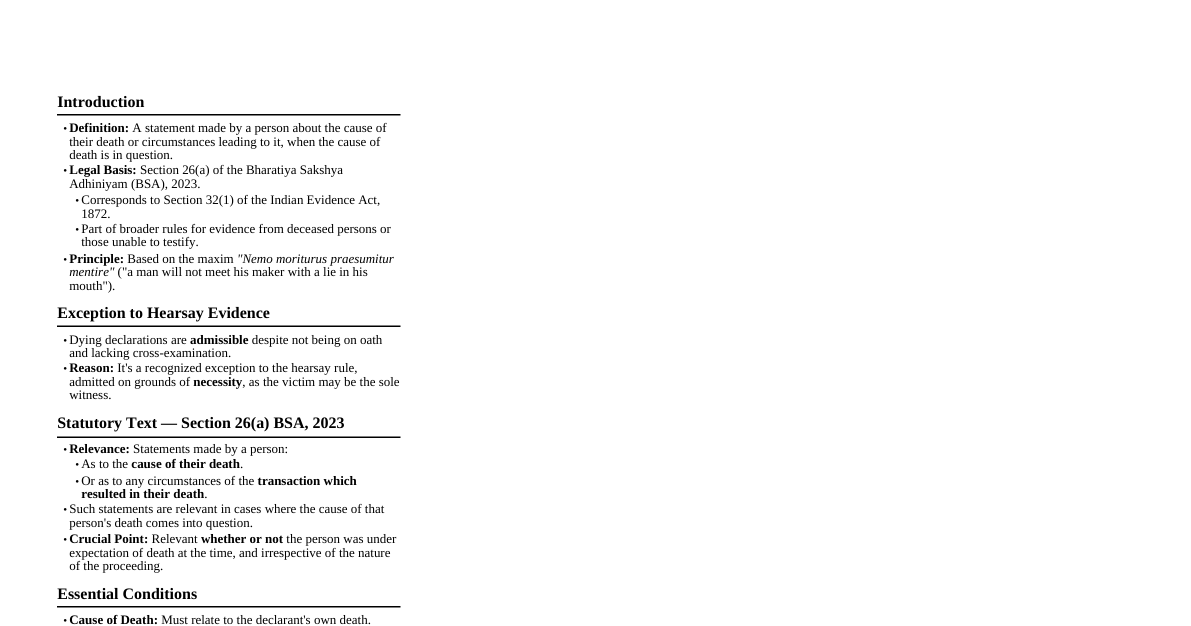
### Introduction A **dying declaration** is a statement made by a person while they are dying, explaining the reason for their death. - It can be direct or indirect, revealing the cause of death. - Only statements given shortly before death qualify. - Statements by the deceased are treated as evidence. **Principle:** Rooted in the legal maxim "Nemo moriturus praesumitur mentire" — no person will lie on their deathbed. A person about to die is presumed to speak the truth, making the declaration admissible as evidence. **Legal Basis:** Under the **Bharatiya Sakshya Adhiniyam (BSA), 2023**, dying declarations are governed by **Section 26(a)**, which replaced Section 32 of the Indian Evidence Act, 1872 (effective July 1, 2024). ### Section 26(a) of BSA, 2023 Section 26 of the BSA deals with evidence from persons who are dead, cannot be found, are incapable of giving evidence, or whose attendance cannot be procured without unreasonable delay or expense. The aim is to ensure justice despite witness unavailability. **Clause (a) specifics:** - Makes admissible any statement made by a person as to the **cause of his death**, or as to any of the **circumstances of the transaction which resulted in his death**. - Applies when the cause of that person's death comes into question. - **Relevance:** Such statements are relevant whether or not the person was under expectation of death at the time of making them. - **Scope:** Applies in both civil and criminal cases. **Illustrations:** - If A, before dying, states "B stabbed me," it's admissible. - If a rape victim names her attacker before succumbing, it's admissible. - Even if A did not believe they were going to die, the statement is valid. - **Limitation:** If the statement is about the cause of death of *another person*, it cannot be treated as a dying declaration under Section 26(a). ### Exception to Hearsay Evidence A dying declaration is a well-recognized exception to the rule against **hearsay evidence**. - It is admissible even though not made on oath. - The person making it cannot be cross-examined. - **Ground for admissibility:** Necessity, as the victim may be the sole witness and cannot be produced in court. ### Conditions for Admissibility - **Competency of the Declarant:** Must possess mental capacity, be sound-minded, and able to communicate clearly. - **Awareness of Death:** (Note: BSA 2023 clarifies *no expectation of death is required*, but traditional understanding often included this). The context of the statement (e.g., physical condition, medical statements) might still be relevant for credibility. - **Voluntariness:** Must be made freely and voluntarily, without threat, coercion, or undue influence. - **Content of the Statement:** Must relate to the cause of death or the circumstances surrounding it (perpetrator, events leading to death). - **Important:** No expectation of death is strictly required under BSA 2023. - **Limited to Cases Where Cause of Death is in Question:** Relevant only when the cause of the *declarant's own death* comes into question. Not admissible for the death of another person. - **Consistency:** Should be consistent with other evidence. Inconsistencies may reduce reliability and require corroboration. - **Fit Mental Condition:** Must be made while the deceased was in a fit mental state. This is crucial for reliability. ### Kinds of Dying Declaration There is no particular form prescribed; all forms are equally recognized. - **Oral Declaration:** Victim narrates to an authority or witness. The witness can then depose in court. - **Gestures and Signs:** Valid when a person cannot speak. - *Example:* In *Queen Empress v. Abdullah*, victim's gestures identifying the accused were accepted. - **Question and Answer Form:** Recorded by asking questions and noting answers. This form often carries high evidentiary weight due to structured recording. ### Who Can Record Dying Declaration Any person can record a dying declaration, but credibility varies: - **Magistrates:** Highest credibility due to their judicial office. - **Police Officers:** May record during FIR and investigation. - **Doctors:** May record through medical reports and certify mental fitness. - **Ordinary Citizens:** Can record when no authority is available. ### Admissibility to Police Officer A notable feature under Section 26 of the BSA is that dying declarations are admissible even when made to a police officer. - This contrasts with **confessions** (under Section 23 of BSA), which cannot be proved if made to a police officer. - **Reason:** A dying declaration is not a confession but a statement explaining the cause of death. - **Practical Importance:** In cases of sudden violence or burn injuries, a statement made to the first-responding police officer is fully admissible, provided the declarant was in a fit mental state and the statement was voluntary. ### Evidentiary Value A dying declaration is **substantive evidence** in law and can be the sole basis of conviction. - **Corroboration:** Not mandatory by rule of law. - **Preference for Corroboration:** Preferred when the statement appears suspicious, tutored, or influenced. Courts may require supporting evidence in such cases. ### Factors Increasing Credibility - **Recorded by Magistrate:** Carries greatest weight. - **Proximity to Incident:** Statement made soon after the incident is more reliable. - **Mental Fitness:** Declarant must have been mentally fit. - **Verbatim Recording:** Recording in the declarant's own words adds trustworthiness. - **Question-and-Answer Format:** Additionally preferred for its structured nature.