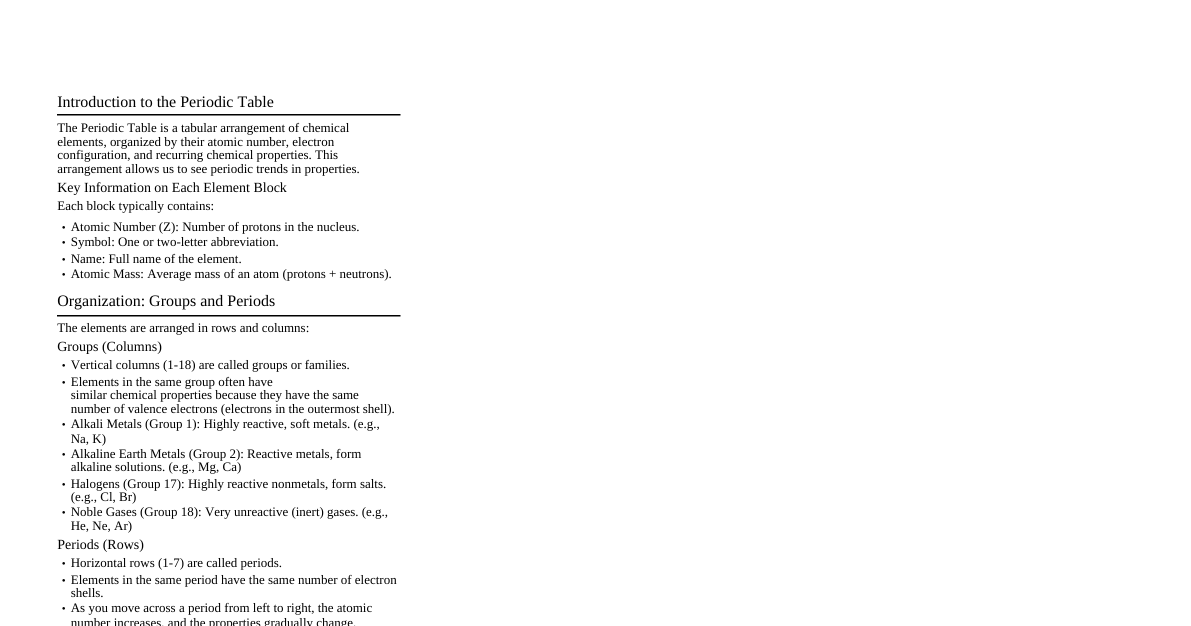
Defects of Long Form Periodic Table
Cheatsheet Content
Preparation of Copper Oxide (CuO and $Cu_2O$) 1. Introduction to Copper Oxides Copper forms two main stable oxides: Copper(II) Oxide (CuO): Black solid, also known as cupric oxide. Copper is in the $+2$ oxidation state. Copper(I) Oxide ($Cu_2O$): Reddish-brown solid, also known as cuprous oxide. Copper is in the $+1$ oxidation state. Their preparation methods depend on the desired oxidation state. 2. Preparation of Copper(II) Oxide (CuO) a. From Copper Metal (Direct Oxidation) Method: Heating copper metal in air or oxygen. $$2Cu(s) + O_2(g) \xrightarrow{\text{heat}} 2CuO(s)$$ Conditions: Copper turnings or powder are heated strongly in a crucible. This is a common laboratory method. Observations: The reddish-brown copper metal turns black as CuO is formed. Limitations: If heating is very prolonged or at extremely high temperatures, there's a possibility of forming some $Cu_2O$ or even melting the copper. b. From Copper(II) Hydroxide ($Cu(OH)_2$) Method: Thermal decomposition of copper(II) hydroxide. $$Cu(OH)_2(s) \xrightarrow{\text{heat}} CuO(s) + H_2O(g)$$ Preparation of $Cu(OH)_2$: Reacting a soluble copper(II) salt (e.g., copper(II) sulfate) with a strong base (e.g., sodium hydroxide). $$CuSO_4(aq) + 2NaOH(aq) \rightarrow Cu(OH)_2(s) + Na_2SO_4(aq)$$ Conditions: The blue precipitate of $Cu(OH)_2$ is collected (filtered and washed) and then heated gently. Observations: The blue $Cu(OH)_2$ turns black upon heating. c. From Copper(II) Carbonate ($CuCO_3$) Method: Thermal decomposition of copper(II) carbonate. $$CuCO_3(s) \xrightarrow{\text{heat}} CuO(s) + CO_2(g)$$ Preparation of $CuCO_3$: Reacting a soluble copper(II) salt with a carbonate solution. $$CuSO_4(aq) + Na_2CO_3(aq) \rightarrow CuCO_3(s) + Na_2SO_4(aq)$$ Conditions: The green precipitate of $CuCO_3$ is collected and then heated gently. Observations: The green $CuCO_3$ turns black upon heating, and carbon dioxide gas is evolved. d. From Copper(II) Nitrate ($Cu(NO_3)_2$) Method: Thermal decomposition of copper(II) nitrate. $$2Cu(NO_3)_2(s) \xrightarrow{\text{heat}} 2CuO(s) + 4NO_2(g) + O_2(g)$$ Conditions: Heating solid copper(II) nitrate. Observations: Blue copper(II) nitrate turns black, and reddish-brown nitrogen dioxide gas ($NO_2$) is evolved along with oxygen. 3. Preparation of Copper(I) Oxide ($Cu_2O$) a. Reduction of Copper(II) Compounds (Fehling's/Benedict's Test) Method: Reduction of copper(II) ions in alkaline solution by a mild reducing agent, often an aldehyde or sugar. $$2Cu^{2+}(aq) + 2OH^-(aq) + \text{reducing agent} \rightarrow Cu_2O(s) + \text{oxidized product} + H_2O(l)$$ Example (Fehling's solution with glucose): $$2Cu^{2+}(aq) + 4OH^-(aq) + C_6H_{12}O_6(aq) \xrightarrow{\text{heat}} Cu_2O(s) + C_6H_{11}O_7^-(aq) + 2H_2O(l)$$ Conditions: Copper(II) ions are complexed in alkaline solution (e.g., with citrate in Benedict's or tartrate in Fehling's) to prevent precipitation of $Cu(OH)_2$. The solution is then heated with the reducing sugar. Observations: The blue solution turns green, then yellow, and finally a brick-red precipitate of $Cu_2O$ forms. This is a classic test for reducing sugars. b. From Copper(II) Oxide (Reduction) Method: Controlled reduction of black $CuO$ using a strong reducing agent like carbon or hydrogen at high temperatures. $$2CuO(s) + C(s) \xrightarrow{\text{heat}} Cu_2O(s) + CO(g)$$ $$2CuO(s) + H_2(g) \xrightarrow{\text{heat}} Cu_2O(s) + H_2O(g)$$ Conditions: High temperatures and careful control of the reducing agent. Over-reduction can lead to metallic copper. Observations: Black CuO turns reddish-brown. c. Electrolytic Reduction Method: Electrolysis of an aqueous solution containing copper(II) ions, often with a copper anode and an inert cathode. $$2Cu^{2+}(aq) + 2H_2O(l) + 2e^- \rightarrow Cu_2O(s) + 4H^+(aq)$$ Conditions: Careful control of pH and current density. Observations: Reddish-brown $Cu_2O$ deposits at the cathode.