Periodic Table & Trends (JEE + Class 11)
Cheatsheet Content
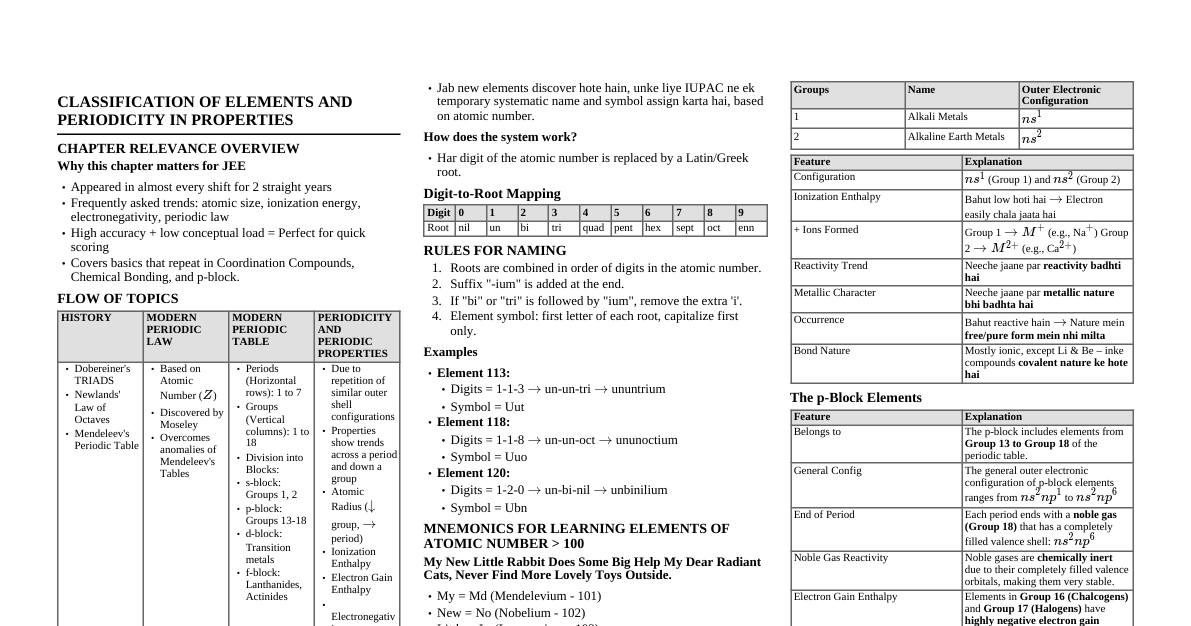
1. Historical Development of the Periodic Table 1.1 Döbereiner's Triads Grouped elements in sets of three based on similar properties. Middle element's atomic mass $\approx$ average of first and third. Limitations: Couldn't classify all elements. Worked for only a few triads. 1.2 Proust (Law of Constant Proportions) Tried relating elements with atomic weights based on hydrogen. Not accurate for classifying all elements. 1.3 Newlands' Law of Octaves Arranged elements in increasing atomic mass. Every 8th element had similar properties (like musical octaves). Drawbacks: Worked only up to Calcium (Ca). After discovery of noble gases, the pattern broke. 1.4 Mendeleev's Periodic Table Mendeleev's Periodic Law: Physical and chemical properties of elements are periodic functions of atomic mass. Features: 7 periods, 8 groups (each group had A and B subgroups). Corrected incorrect atomic masses. Left gaps for undiscovered elements and predicted: Eka-boron $\rightarrow$ Scandium Eka-aluminium $\rightarrow$ Gallium Eka-silicon $\rightarrow$ Germanium Demerits: Wrong position of H. Couldn't explain isotopes. Anomalous pairs: Ar-K, Co-Ni, Te-I, etc. Atomic mass was not a fundamental property. 1.5 Moseley's Experiment Using X-ray spectra, proved atomic number (Z) is the fundamental property. Modern periodic law: Properties of elements are periodic functions of their atomic number. This gave rise to the modern periodic table. 1.6 Modern Periodic Table 7 periods, 18 groups. s-, p-, d-, f-block elements. Lanthanides and actinides placed separately as f-block. Hydrogen still has uncertain placement. 1.7 Lothar Meyer Curve Graph of atomic volume vs atomic mass. Peaks correspond to alkali metals. Validated Mendeleev's periodicity. Ascending to the peak - halogens Descending to the peak - alkaline earth metals minima (bottom) - metalloids and transition metals 2. Block Classification 2.1 s-block Groups 1 and 2. (Group 2 - alkaline earth metals except Beryllium because it is amphoteric in nature). Group 2 forms alkaline oxides and hydroxides (abundant in earth crust). Strongly electropositive, highly reactive metals. Form alkaline hydroxide on reaction with water (Group 1). 2.2 p-block Groups 13 to 18. Includes metalloids, pnictogens (poisonous) (15), halogens (salt forming) (17), chalcogens (ore forming) (16), noble gases (18). For noble gases: Monoatomic Zero EN Highest IE No EA Stable configuration 2.3 d-block (Transition Metals) Groups 3 to 12. Variable oxidation states, colored ions, catalysts. 2.4 f-block (Inner Transition Metals) Lanthanides (4f) and Actinides (5f). { 58-71} High atomic/ionic sizes, poor shielding. { 90-103} 3. Important Periodic Effects 3.1 Lanthanide Contraction Poor shielding by 4f electrons causes gradual decrease in size. Leads to: Zr and Hf having almost identical radii. Chemical twins 3.2 Inert Pair Effect In heavier p-block elements, the $ns^2$ electrons resist participation in bonding. Stabilizes lower oxidation states. Example: Sn (IV) vs Sn (II), Pb (IV) vs Pb (II). 3.3 Diagonal Relationship Li $\sim$ Mg, Be $\sim$ Al Due to similar charge/radius ratio. 3.4 Anomalous Behavior of First Elements Li, Be, B, C, N, O, F show: Small size, high IE, strong covalent bonding. 3.5 Atomic radius in group 13 B Ga 4. Determining Position of an Element Group & Period Period $\rightarrow$ highest $n$ value in configuration. Block $\rightarrow$ last electron enters s/p/d/f orbital. Group Calculation s-block $\rightarrow$ group 1 or 2. p-block $\rightarrow$ group = 12 + electrons in p-sublevel. d-block $\rightarrow$ group = $(n-1)d$ electrons + $ns$ electrons. 5. Trends in the Periodic Table 5.1 Screening Effect (Shielding Effect) Inner electrons block nuclear charge from outer electron. $s > p > d > f$ (penetration). Poor shielding by f causes lanthanide contraction. 5.2 Effective Nuclear Charge ($Z_{eff}$) $Z_{eff} = Z - \sigma$ Shielding constant depends on electron type: Same group electrons $\rightarrow$ 0.35 each n-1 electrons $\rightarrow$ 0.85 d/f $\rightarrow \sim$1.00 Higher $Z_{eff}$ $\rightarrow$ smaller size, higher IE. 5.3 Penetration Effect Closer to nucleus = higher penetration. Order: $s > p > d > f$ 5.4 Atomic Radius Increases down a group (more shells). Decreases across a period (greater $Z_{eff}$). Order: Covalent Directly proportional to $Z_{eff}$ -ve charge Inversely proportional to Screening effect +ve charge Bond multiplicity Hydrated radius Atomic radius = internucleus distance/2 Stevenson Schomaker equation: $d(ab) = r(a) + r(b) - 0.09 | \chi(a) - \chi(b) |$ Increases down the group. Decreases left to right of a period. Isoelectronic species: More nuclear charge = smaller size $\rightarrow$ follows +ve charge e.g., $O^{2-} > F^{-} > Ne > Na^{+} > Mg^{2+}$ 5.5 Ionic Radius Cations smaller than atoms. Anions larger than atoms. 5.6 Ionization Energy (IE) Energy needed to remove an electron. Trends: Increases across a period. Decreases down a group. Directly proportional to +ve charge $Z_{eff}$ Inversely proportional to Screening effect $\pm$ve charge Atomic size Important Exceptions: Be > B N > O Half-filled and filled orbitals are more stable. B > Tl > Ga > Al > In C > Si > Ge > Pb > Sn $ns^1 For successive I.E: $I.E_1 If the nth ionization energy shows a very sharp jump in the value it means the atom has (n-1) valence electrons. Highest IE: He Lowest IE: Cs 5.7 Electron Affinity (EA) Energy released when an atom gains an electron. Trends: More negative across a period. Less negative down a group. Directly proportional to +ve charge $Z_{eff}$ Inversely proportional to Stability -ve charge Electron repulsion Exceptions: N Noble gases have positive EA. 3RD PERIOD > 2ND PERIOD Cl > F > Br > I S > Se > Te > Po > O Electron Gain Enthalpy Exothermic: $\Delta H_{EG}$ negative (cation + e) Endothermic: $\Delta H_{EG}$ positive (anion + e) Closely tied to size & stability 5.8 Electronegativity Ability to attract bonded electrons. Trends: Increases across a period. Decreases down a group. Directly proportional to $Z_{eff}$ Bond multiplicity Non metallic character +ve charge Inversely proportional to SIZE -ve charge Metallic character Screening effect 1. Mulliken Scale $\chi = (IE + EA) / 2$ 2. Pauling Scale $\chi_A - \chi_B = 0.208 \sqrt{(\Delta E_{AB} - \sqrt{E_{AA} E_{BB}})}$ 3. Allred-Rochow Scale Correct formula: $\chi = (0.359 Z_{eff}) / r^2 + 0.744$ $Z_{eff}$ = effective nuclear charge $r$ = atomic radius in angstrom F > O > N > Cl > Br > I > S > C 5.9 Metallic & Non-metallic Character Metallic character: Increases down a group. Decreases across a period. Non-metallic character behaves oppositely. 5.10 Oxide Nature Metals: basic oxides (oxidation no. less than 5) Non-metals: acidic oxides (oxidation no. greater than or equal to 5) Metalloids: amphoteric Neutral oxides: NO, $NO_2$, CO Basic: $Na_2O$, CaO Acidic: $SO_3$, $P_4O_{10}$ Amphoteric: ZnO, $Al_2O_3$ Down a group: basicity $\uparrow$ Across a period: acidity $\uparrow$ 5.11 Reactivity Trends Metals: Down group: reactivity $\uparrow$ (lose electrons easily) Across period: $\downarrow$ Non-metals: Down group: reactivity $\downarrow$ Across period: $\uparrow$ 5.12 Melting & Boiling Points Middle of the period (transition metals) $\rightarrow$ highest Alkali metals $\rightarrow$ low Halogens $\rightarrow$ low Noble gases $\rightarrow$ extremely low (weak London forces) Transition metals have high MP because of strong metallic bonding Alkali metals weak because of large size + one valence electron 5.13 Density Generally increases down a group. Depends on atomic mass + packing efficiency. 5.14 Oxidation States s-block: fixed (+1, +2) p-block: multiple oxidation states d-block: variable, due to d-orbital participation 5.15 Hydration Enthalpy Higher charge and smaller ion $\rightarrow$ greater hydration. Order: $Li^{+} > Na^{+} > K^{+}$ $Mg^{2+} > Ca^{2+} > Sr^{2+} > Ba^{2+}$ 5.16 Electron Gain Enthalpy & Thermodynamics Exothermic $\rightarrow$ negative EGE Endothermic $\rightarrow$ positive EGE Affect stability, bond formation, reactivity. 5.17 Transuranic Elements Z > 92 (after Uranium). Synthetic, radioactive. 5.18 Nomenclature of Elements 100+ 0 = Nil 1 = Un 2 = Bi 3 = Tri 4 = Quad 5 = Pent 6 = Hex 7 = Sept 8 = Oct 9 = Enn "-ium" at end. Example: Element 118 $\rightarrow$ Ununoctium (Uuo) 5.19 Typical Elements Meaning: These are second and third period elements (especially second period) that show regular, predictable periodic trends without any weird exceptions. Why they're called "typical": Their size is small. They have no d-orbitals. They follow expected trends in IE, EN, EA, radius, bonding. Examples: Second period: Li, Be, B, C, N, O, F, Ne Third period: Na, Mg, Al, Si, P, S, Cl, Ar Why second period is most "typical": Small atomic size High electronegativity Strong covalent bonding No vacant d-orbitals Strong tendency for multiple bonds 5.20 Bridge Elements Meaning: Elements of the third period show unexpected similarities with the elements diagonally placed in the second period. This diagonal similarity is called the Diagonal Relationship . Reason: Elements diagonally placed have: Similar charge-to-radius ratio Similar electronegativity Comparable atomic and ionic sizes Similar bond strengths Bridge Pairs (VERY IMPORTANT): 2nd Period 3rd Period (Bridge Element) Why Similar Li Mg Similar ionic radius, polarizing power, both form nitrides, both show covalent character Be Al Both amphoteric, form covalent compounds, similar EN B Si Both are semiconductors, form covalent networks, form hydrides $BH_3/SiH_4$ C P Both show catenation, form oxoacids N S Similar electronegativity, form multiple oxoacids O Cl Strong oxidizing behaviour F Ar Size similarity (weird but true) Main diagonal relationships you MUST remember (JEE): Li $\leftrightarrow$ Mg Be $\leftrightarrow$ Al B $\leftrightarrow$ Si These three are the most scoring. Key Differences Between Typical & Bridge Elements Typical Elements Bridge Elements Follow normal periodic trends Show diagonal similarities Usually from 2nd and 3rd period Mainly from 3rd period No exceptional behavior Show unusual resemblance with 2nd period