COM GG
Cheatsheet Content
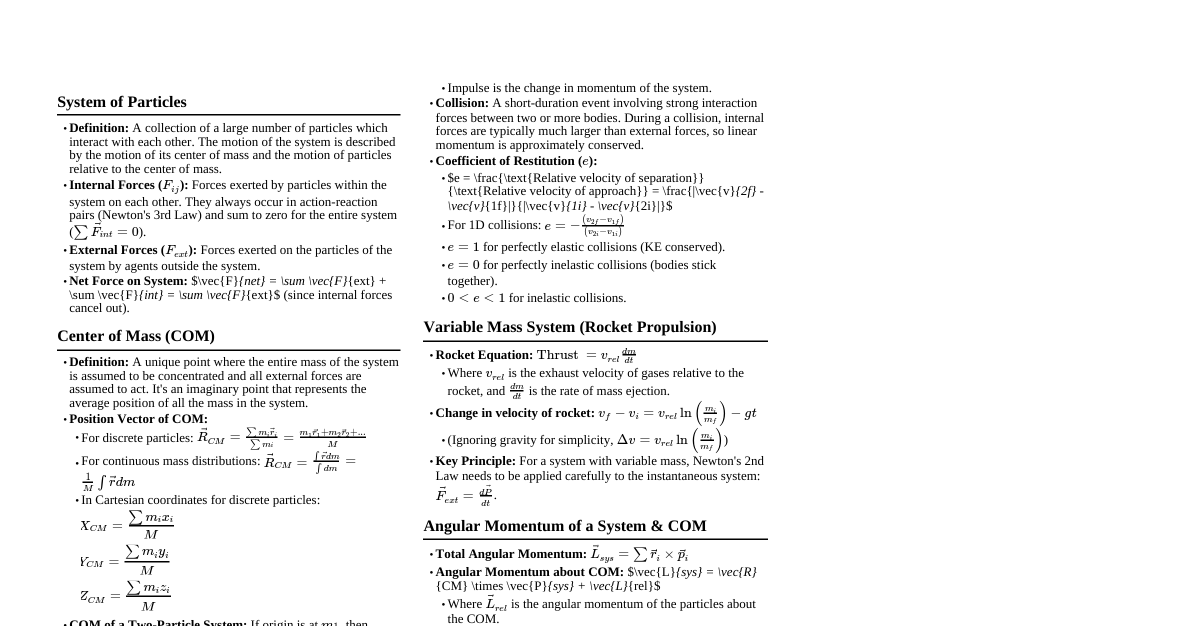
A. Center of Mass (CM) Definition and Formulas The Center of Mass (CM) is a unique point representing the average position of all the mass in a system. It behaves as if the entire mass of the system is concentrated there, and all external forces act on it. Its motion is purely translational, even if the system is rotating or deforming. For a system of discrete particles: Formula: $\vec{r}_{CM} = \frac{\sum_{i=1}^{n} m_i \vec{r}_i}{\sum_{i=1}^{n} m_i} = \frac{m_1\vec{r}_1 + m_2\vec{r}_2 + \dots + m_n\vec{r}_n}{M_{total}}$ Key Idea: Position vector of the CM, weighted by individual masses. When to Use: When dealing with a collection of distinct point masses. Components: $x_{CM} = \frac{\sum m_i x_i}{M_{total}}$, $y_{CM} = \frac{\sum m_i y_i}{M_{total}}$, $z_{CM} = \frac{\sum m_i z_i}{M_{total}}$ For a continuous body: Formula: $\vec{r}_{CM} = \frac{\int \vec{r} dm}{\int dm} = \frac{1}{M_{total}} \int \vec{r} dm$ Key Idea: Integral form for extended objects, summing infinitesimal mass elements. When to Use: For objects with distributed mass (e.g., rods, disks, spheres), often involving calculus. Components: $x_{CM} = \frac{1}{M_{total}} \int x dm$, $y_{CM} = \frac{1}{M_{total}} \int y dm$, $z_{CM} = \frac{1}{M_{total}} \int z dm$ Velocity of CM: Formula: $\vec{v}_{CM} = \frac{d\vec{r}_{CM}}{dt} = \frac{\sum m_i \vec{v}_i}{M_{total}}$ Key Idea: Average velocity of the system, reflecting its overall translational motion. When to Use: To describe the translational motion of the entire system, especially for systems with moving parts or after collisions. Acceleration of CM: Formula: $\vec{a}_{CM} = \frac{d\vec{v}_{CM}}{dt} = \frac{\sum m_i \vec{a}_i}{M_{total}} = \frac{\sum \vec{F}_{ext}}{M_{total}}$ Key Idea: Newton's Second Law for the system as a whole, showing that only external forces affect the CM's motion. When to Use: To find the acceleration of the system's CM; internal forces do not affect $\vec{a}_{CM}$. C. Moment of Inertia ($I$) B. Rotational Kinematics Definition and Formulas Rotational Motion describes the movement of a rigid body around a fixed axis or point. It is distinct from Circular Motion , which describes the path of a point particle in a circle. In rotational motion, all points in the rigid body move in circles, but about the same axis. Angular Displacement ($\theta$): Formula: $\theta$ (in radians) Key Idea: The angle swept by a rotating object. When to Use: To quantify how much an object has rotated. Angular Velocity ($\vec{\omega}$): Formula: $\vec{\omega} = \frac{d\theta}{dt}$ (instantaneous); $\omega_{avg} = \frac{\Delta\theta}{\Delta t}$ Key Idea: Rate of change of angular displacement. Direction is given by the right-hand rule along the axis of rotation. When to Use: To describe how fast and in what direction an object is rotating. Relation to Linear Velocity: $\vec{v} = \vec{\omega} \times \vec{r}$ Key Idea: Linear velocity of a point at position $\vec{r}$ from the axis of rotation. When to Use: To find the linear velocity of any point on a rotating rigid body. Angular Acceleration ($\vec{\alpha}$): Formula: $\vec{\alpha} = \frac{d\vec{\omega}}{dt}$ (instantaneous); $\alpha_{avg} = \frac{\Delta\omega}{\Delta t}$ Key Idea: Rate of change of angular velocity. When to Use: When the rotational speed of an object is changing. Tangential Acceleration: $\vec{a}_t = \vec{\alpha} \times \vec{r}$ Key Idea: Component of linear acceleration tangent to the circular path. When to Use: To find the acceleration responsible for changing the magnitude of linear velocity of a point on the rotating body. Centripetal (Radial) Acceleration: $\vec{a}_c = \vec{\omega} \times \vec{v} = -\omega^2 \vec{r}$ Key Idea: Component of linear acceleration directed towards the center of rotation, responsible for changing the direction of linear velocity. When to Use: Always present in rotational motion, directs towards the center of the circular path. Net Linear Acceleration: $\vec{a} = \vec{a}_t + \vec{a}_c$ Key Idea: Vector sum of tangential and centripetal accelerations. When to Use: To find the total linear acceleration of a point on a rotating body. Kinematic Equations for Constant Angular Acceleration ($\alpha$): Formula: $\omega = \omega_0 + \alpha t$ Key Idea: Final angular velocity based on initial velocity, acceleration, and time. When to Use: When time is a factor and final angular displacement is not required. Formula: $\theta = \omega_0 t + \frac{1}{2}\alpha t^2$ Key Idea: Angular displacement based on initial velocity, acceleration, and time. When to Use: When angular displacement needs to be calculated over a time interval. Formula: $\omega^2 = \omega_0^2 + 2\alpha\theta$ Key Idea: Final angular velocity based on initial velocity, acceleration, and displacement. When to Use: When time is not given or not required. Formula: $\theta = \left(\frac{\omega_0+\omega}{2}\right)t$ Key Idea: Angular displacement based on average angular velocity and time. When to Use: When acceleration is not given or not required. Formula: $\theta_n = \omega_0 + \frac{\alpha}{2}(2n-1)$ (Angular displacement in the $n^{th}$ second) Key Idea: Displacement in a specific unit of time. When to Use: To find the angular displacement ONLY in the $n^{th}$ second. Period ($T$) and Frequency ($f$): Formula: $T = \frac{2\pi}{\omega}$; $f = \frac{1}{T} = \frac{\omega}{2\pi}$ Key Idea: Time for one full rotation and number of rotations per unit time. When to Use: To relate angular velocity to rotational cycles. Definition and Formulas The Moment of Inertia (I) is a scalar quantity that quantifies an object's resistance to angular acceleration. It depends on the mass of the object and its distribution relative to the axis of rotation. It is the rotational analogue of mass in linear motion. Definition (Discrete System): $I = \sum_{i} m_i r_i^2$ Key Idea: Sum of (mass $\times$ square of perpendicular distance to axis) for each particle. When to Use: For systems composed of point masses. Definition (Continuous Body): $I = \int r^2 dm$ Key Idea: Integral of (infinitesimal mass $\times$ square of its perpendicular distance to axis) over the entire body. When to Use: For solid, extended objects, often requiring integration. Radius of Gyration ($k$): $I = Mk^2 \implies k = \sqrt{\frac{I}{M}}$ Key Idea: An effective distance from the axis where the entire mass could be concentrated to yield the same moment of inertia. When to Use: To characterize the mass distribution of a body for rotational analysis, or to simplify moment of inertia calculations when $I$ is known. Theorems of Moment of Inertia These theorems simplify the calculation of moment of inertia about various axes. 1. Parallel Axis Theorem: $I = I_{CM} + Md^2$ Key Idea: Relates moment of inertia about an arbitrary axis to that about a parallel axis passing through the center of mass. When to Use: When the moment of inertia about the CM is known, and you need to find it about any other parallel axis. $I_{CM}$ is the moment of inertia about an axis through the center of mass, $M$ is the total mass of the body, and $d$ is the perpendicular distance between the two parallel axes. 2. Perpendicular Axis Theorem: $I_z = I_x + I_y$ Key Idea: For a planar lamina, the moment of inertia about an axis perpendicular to its plane equals the sum of moments of inertia about two perpendicular axes lying in its plane, all intersecting at a common point. When to Use: Exclusively for planar (2D) objects when moments of inertia about two axes in the plane are known, and the moment of inertia about an axis perpendicular to the plane (through their intersection) is required. Standard Moments of Inertia (about specified axes) Shape Axis of Rotation Moment of Inertia (I) Thin Ring/Hollow Cylinder Mass $M$, Radius $R$ Perpendicular to plane, through center $MR^2$ Any diameter $\frac{1}{2}MR^2$ Tangent in its plane $\frac{3}{2}MR^2$ Tangent perpendicular to its plane $2MR^2$ Solid Disk/Solid Cylinder Mass $M$, Radius $R$ Perpendicular to plane, through center $\frac{1}{2}MR^2$ Any diameter $\frac{1}{4}MR^2$ Tangent in its plane $\frac{5}{4}MR^2$ Tangent perpendicular to its plane $\frac{3}{2}MR^2$ Solid Sphere Mass $M$, Radius $R$ Any diameter $\frac{2}{5}MR^2$ Any tangent $\frac{7}{5}MR^2$ Hollow Sphere (Spherical Shell) Mass $M$, Radius $R$ Any diameter $\frac{2}{3}MR^2$ Any tangent $\frac{5}{3}MR^2$ Thin Rod Mass $M$, Length $L$ Perpendicular to rod, through center $\frac{1}{12}ML^2$ Perpendicular to rod, through one end $\frac{1}{3}ML^2$ Rectangular Lamina Mass $M$, Length $L$, Width $W$ Perpendicular to plane, through center $\frac{1}{12}M(L^2 + W^2)$ Through center, parallel to length $L$ $\frac{1}{12}MW^2$ Through center, parallel to width $W$ $\frac{1}{12}ML^2$ Solid Cuboid (Rectangular Prism) Mass $M$, sides $a, b, c$ Through center, perpendicular to face $a \times b$ $\frac{1}{12}M(a^2 + b^2)$ D. Rotational Dynamics Definition and Formulas Rotational Dynamics studies the causes of rotational motion, primarily focusing on torque and its effect on angular acceleration and angular momentum. Newton's Second Law for Rotation: $\sum \vec{\tau}_{ext} = I\vec{\alpha}$ Key Idea: The net external torque acting on a rigid body is directly proportional to its angular acceleration and inversely proportional to its moment of inertia. This is the rotational analogue of $\sum \vec{F}_{ext} = m\vec{a}$. When to Use: To find the angular acceleration of a rigid body under the influence of torques, or to determine the required torque for a given angular acceleration. Torque and Angular Momentum: $\vec{\tau}_{ext} = \frac{d\vec{L}}{dt}$ Key Idea: Net external torque equals the rate of change of angular momentum. When to Use: A more general form of Newton's Second Law for rotation, useful when the moment of inertia might change, or to understand how torque influences angular momentum. E. Work and Energy in Rotation Definition and Formulas Work and Energy in Rotation describe how energy is transferred and stored in rotating systems, analogous to their linear counterparts. Work Done by Torque: $W = \int_{\theta_1}^{\theta_2} \tau d\theta$ Key Idea: The integral of torque with respect to angular displacement. When to Use: To calculate the energy transferred to or from a rotating body by a torque. For constant torque, $W = \tau(\theta_2 - \theta_1)$. Rotational Kinetic Energy ($KE_R$): $KE_R = \frac{1}{2}I\omega^2$ Key Idea: Energy possessed by an object due to its rotation. Rotational analogue of $\frac{1}{2}mv^2$. When to Use: To calculate the kinetic energy stored in a rotating object. Work-Energy Theorem for Rotation: $W_{net,rot} = \Delta KE_R = \frac{1}{2}I\omega_f^2 - \frac{1}{2}I\omega_i^2$ Key Idea: The net work done by all external torques on a rigid body equals the change in its rotational kinetic energy. When to Use: To relate work done by torques to changes in rotational speed. Power Delivered by Torque: $P = \vec{\tau} \cdot \vec{\omega}$ Key Idea: Rate at which work is done by a torque, or the rate at which rotational kinetic energy is changing. When to Use: To calculate the instantaneous power for a rotating system. F. Angular Momentum ($\vec{L}$) Definition and Formulas Angular Momentum is a vector quantity that measures the "amount of rotational motion" an object has. It's a conserved quantity under specific conditions. For a single particle: $\vec{L} = \vec{r} \times \vec{p} = \vec{r} \times (m\vec{v})$ Key Idea: Cross product of position vector (from origin/pivot) and linear momentum vector. When to Use: For individual particles or when calculating angular momentum about a point not on the axis of rotation. For a rigid body rotating about a fixed axis: $\vec{L} = I\vec{\omega}$ Key Idea: Product of moment of inertia and angular velocity, directed along the axis of rotation. When to Use: For rigid bodies rotating about a clearly defined axis. Total Angular Momentum of a System: $\vec{L}_{total} = \sum \vec{L}_i$ (vector sum) Key Idea: The total angular momentum is the vector sum of angular momenta of all constituent particles/bodies. When to Use: For multi-body systems or when a system's parts have different angular momenta. Conservation of Angular Momentum: If $\sum \vec{\tau}_{ext} = 0 \implies \vec{L}_{total} = \text{constant}$ Key Idea: In the absence of external torques, the total angular momentum of a system remains unchanged. When to Use: Crucial for problems involving changing moments of inertia (e.g., figure skater spinning), collisions without external torques, or systems where the axis of rotation changes. G. Angular Impulse-Momentum Theorem Definition and Formulas The Angular Impulse-Momentum Theorem is the rotational analogue of the linear impulse-momentum theorem, relating the change in angular momentum to the angular impulse. Formula: $\int_{t_1}^{t_2} \vec{\tau}_{ext} dt = \Delta \vec{L} = \vec{L}_f - \vec{L}_i$ Key Idea: The total angular impulse (time integral of net external torque) acting on a system equals the change in its total angular momentum. When to Use: Particularly useful in situations involving impulsive torques (large torques acting for a very short duration, like a sudden kick or impact), or when the torque is a function of time and angular momentum change is needed. H. Rolling Motion (The Grand Synthesis) Definition and Formulas Rolling Motion is a complex motion combining both translation and rotation. A common type is pure rolling, where there is no slipping at the point of contact. Pure Rolling Condition: $v_{CM} = R\omega$ and $a_{CM} = R\alpha$ Key Idea: The linear speed/acceleration of the center of mass is directly related to the angular speed/acceleration of the body. This implies the point of contact is instantaneously at rest. When to Use: Whenever a problem states "rolls without slipping" or implies sufficient friction for no slip. Total Kinetic Energy in Pure Rolling: $K_{total} = \frac{1}{2}Mv_{CM}^2 + \frac{1}{2}I_{CM}\omega^2$ Key Idea: Total kinetic energy is the sum of translational kinetic energy of the CM and rotational kinetic energy about the CM. When to Use: To apply energy conservation principles to rolling objects. Total Kinetic Energy (via IAR): $K_{total} = \frac{1}{2}I_{IAR}\omega^2$ Key Idea: Total kinetic energy expressed as pure rotational energy about the Instantaneous Axis of Rotation (IAR), which for pure rolling on a surface, is the point of contact. When to Use: Often simplifies calculations, especially when using Parallel Axis Theorem to find $I_{IAR} = I_{CM} + MR^2$. Analysis of Forces in Rolling: Friction: For pure rolling, friction is static friction . It acts to prevent relative motion at the point of contact. Its direction depends on whether it's trying to speed up or slow down the rolling. For a body rolling down an incline, static friction acts up the incline . When to Use: Always draw a Free Body Diagram (FBD) and apply Newton's laws. Acceleration of a body rolling down an inclined plane (without slipping): $a_{CM} = \frac{g\sin\theta}{1 + \frac{I_{CM}}{MR^2}}$ Key Idea: The acceleration is reduced compared to sliding ($g\sin\theta$) due to the rotational inertia. When to Use: To find the linear acceleration of the CM for any symmetric body (sphere, cylinder, ring) rolling down an incline. Minimum Coefficient of