Islamic Pillars & Worship
Cheatsheet Content
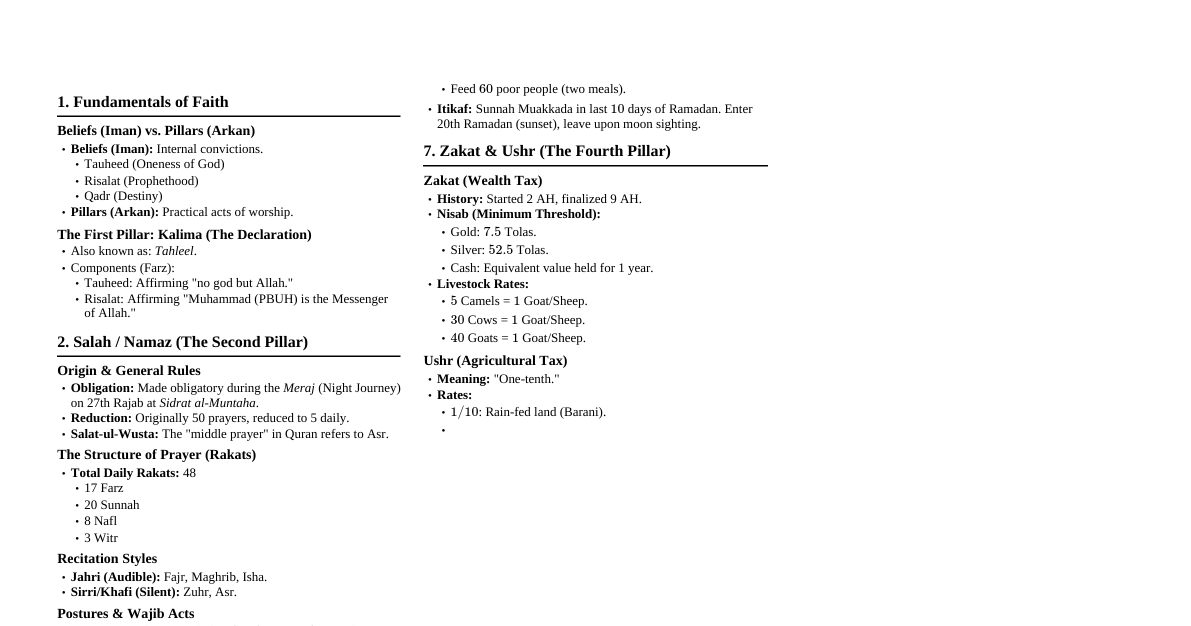
1. The First Pillar: Kalima (Faith) Beliefs vs. Pillars: Concepts like Tauheed (Oneness of God), Risalat (Prophethood), and Qadr (destiny) are part of Iman (Beliefs). These are distinct from the "Arkan" (Pillars) themselves. The First Pillar: The Kalima ($La ilaha illallah$). Terminology: Also known as Tahleel . Components (Farz - Obligatory parts): Affirming the Oneness of Allah (Tauheed). Affirming the Prophethood of Muhammad (Risalat). 2. The Second Pillar: Namaz (Prayer) Origins & Structure Obligation: Prescribed during the Night of Meraj (27th Rajab) at Sidrat al-Muntaha . Reduced from 50 to 5 daily prayers. Total Daily Rakats: 48 total rakats in a day: 17 Farz (Obligatory) 20 Sunnah 8 Nafl (Voluntary) 3 Witr (Essential/Wajib) Recitation Types: Jahri (Loud): Fajr, Maghrib, and Isha. Sirri/Khafi (Silent): Zuhr and Asr. Salat-ul-Wusta: The "middle prayer" mentioned in the Quran refers to the Asr prayer. Azan: The phrase $As-salatu khairum-min-an-nawm$ ("Prayer is better than sleep") was added to the Fajr Azan during the era of Hazrat Umar . Key Postures & Wudu Jalsa: The pause sitting between two Sujoods (prostrations). It is Wajib . Qauma: Standing up straight after Ruku. It is Wajib . Wudu (Ablution): Mentioned in Surah Maidah . 4 Farz: Face, Arms to elbows, 1/4th Head Masah, Feet. 13 Sunnahs. Types of Worshipers (Muqtadi) Mudrik: Joins congregation from the beginning ( Takbir-e-Tahrimah ) and completes the full prayer with the Imam. Masbuq: Joins late and misses one or more rakats at the start. Lahiq: Joins at the start, but leaves (e.g., wudu breaks), purifies, and rejoins to complete without speaking. Special Prayers Qasr (Shortened Prayer): For travelers moving 57 miles or more. Condition: Intention to stay less than 15 days . (If staying 15+ days, full prayer is offered). Only 4-rakat prayers are shortened to 2. Maghrib (3) and Fajr (2) are never shortened. Jummah (Friday): First led by Mus'ab bin Umair in Medina. Prophet (PBUH) led first Jummah at Bani Salim bin Auf . Conditions: Must be in a city/town, Zuhr time, congregation, and Azan-e-Aam (general call). Exemptions: Not obligatory for women, travelers, slaves, the sick, or the insane. If missed, one must pray Zuhr; there is no Qaza for Jummah. Janaza (Funeral): Farz-e-Kifaya . Contains 4 Takbeers , no Ruku or Sajda. Kafan: Men = 3 pieces; Women = 5 pieces. Eid Prayers: Obligatory in 2 AH . Contains 6 extra Takbeers (3 in first rakat, 3 in second). Sajda Sahw: Two prostrations performed to correct unintentional omission of a Wajib or Sunnah . Cannot fix omission of a Farz . Voluntary (Nafl) Prayers Tahajjud: Pre-dawn, after waking from sleep. Ishraq: Approx. 10-15 mins after sunrise. Chasht: Mid-morning (approx. 8:00–8:30 AM). Awwabin: Performed after Maghrib. Tarawih: Sunnah Muakkada . Established as a congregation by Hazrat Umar, led by Ubayy bin Ka'b. Usually 20 rakats (8 and 12 also discussed). Other Prayers: Istisqa (Rain), Kusoof (Solar Eclipse), Khusoof (Lunar Eclipse), Istikhara (Guidance). 3. The Third Pillar: Roza (Fasting) Title: Fasting is called a "Shield" ( Dhal ). Timeline: Commandments came in 2 AH. Prohibited Days: Eid days and Ayyam-e-Tashreeq (11, 12, 13 Dhul-Hijjah). Kaffara (Expiation): If a fast is broken intentionally: Fast for 60 consecutive days OR Feed 60 poor people (two full meals). Differences: Jews/Christians have 40 fasts without Suhoor; Muslims have 29-30 fasts with Suhoor. Itikaf: Sunnah Muakkada (Last 10 days of Ramadan). Timing: Enter mosque on 20th Ramadan at sunset; leave when Eid moon is sighted. 4. The Fourth Pillar: Zakat & Ushr Timeline: Commandments started in 2 AH , fully implemented/finalized around 9 AH . Nisab (Threshold): Gold: 7.5 Tolas. Silver: 52.5 Tolas. Cash: Equivalent value held for one year (free of debt). Livestock Zakat Rates: 5 Camels = 1 Goat/Sheep. 30 Cows/Buffaloes = 1 Goat/Sheep. 40 Goats/Sheep = 1 Goat/Sheep. Ushr (Agricultural Tax): Means "one-tenth". Rain-fed land (Barani): 1/10th of produce. Irrigated land (Canals/Tube wells): 1/20th of produce. Threshold: Applied on produce exceeding approx. 948 kg . Analogy for Prayers Farz prayers: The compulsory subjects in an exam; you must pass them. Nafl prayers: The optional subjects ; they increase your total marks, raise your rank (merit), and elevate your spiritual status ( Taqwa ), but you won't fail solely for missing them.