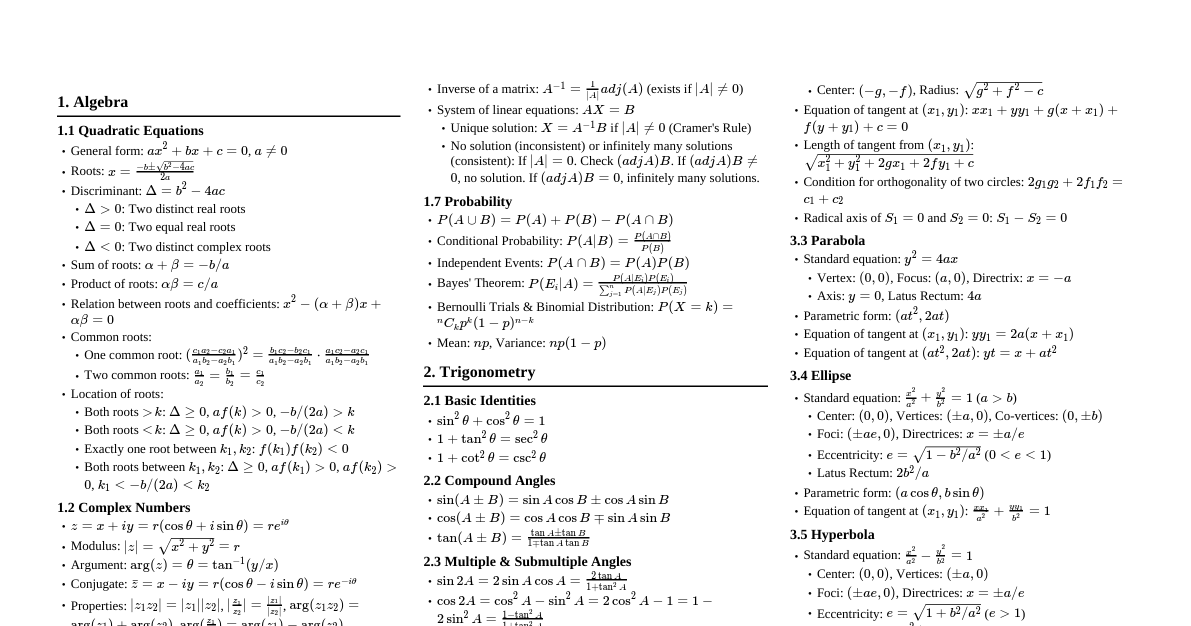
JEE/B.Tech Math Formula & Tricks
Cheatsheet Content
1. Sets, Relations and Functions Golden Formula Table Concept Formula/Definition Conditions Union $|A \cup B| = |A| + |B| - |A \cap B|$ Finite sets A, B Intersection (3 sets) $|A \cup B \cup C| = \sum |A| - \sum |A \cap B| + |A \cap B \cap C|$ Finite sets A, B, C Number of subsets $2^n$ Set with $n$ elements Number of relations $2^{|A| \cdot |B|}$ Relation from set A to set B Number of functions $|B|^{|A|}$ Function from set A to set B Composite function $(g \circ f)(x) = g(f(x))$ Range of $f$ must be subset of domain of $g$ Short Tricks & Substitution Hacks To check if a function is one-one, assume $f(x_1) = f(x_2)$ and show $x_1 = x_2$. For onto, assume $y$ in codomain and show there exists $x$ s.t. $f(x)=y$. For inverse functions, swap $x$ and $y$ and solve for $y$ in terms of $x$. Always check domain/range validity. PYQ Trend Analysis (2021–2024) Top 3 Subtopics: Types of functions (one-one, onto, inverse), Domain & Range of complex functions, Operations on sets. Time-killer: Problems involving multiple compositions of functions or complex domain/range calculations without proper algebraic simplification. Must-Do Question Profiles Q1: Let $f: R \to R$ be a function defined by $f(x) = \frac{x^2 - 8x + 7}{x^2 + 4x + 4}$. Find the range of $f(x)$. Q2: If $A = \{1, 2, 3, 4, 5\}$, and $R$ is a relation on $A$ defined as $R = \{(x, y) : x^2 - y^2$ is divisible by $3\}$. Show that $R$ is an equivalence relation. Q3: Let $f(x) = |x-1|$ and $g(x) = |x+1|$. Find the value of $(f \circ g)(-2) + (g \circ f)(3)$. Common Trap Alerts Forgetting to check the domain and codomain when commenting on injectivity/surjectivity of functions. Incorrectly finding the range of functions involving quadratics or rational expressions (e.g., $y = \frac{ax+b}{cx+d}$). Mistakes in applying set operations, especially with complements or differences. 2. Complex Numbers and Quadratic Equations Golden Formula Table Concept Formula/Definition Conditions Standard form $z = a + ib$ $a, b \in R$, $i = \sqrt{-1}$ Modulus $|z| = \sqrt{a^2 + b^2}$ Argument $\arg(z) = \tan^{-1}\left(\frac{b}{a}\right)$ Quadrant dependent, $-\pi Euler form $z = r(\cos\theta + i\sin\theta) = re^{i\theta}$ $r = |z|$, $\theta = \arg(z)$ De Moivre's Theorem $( \cos\theta + i\sin\theta )^n = \cos(n\theta) + i\sin(n\theta)$ $n \in Z$ Quadratic roots $x = \frac{-b \pm \sqrt{b^2 - 4ac}}{2a}$ For $ax^2 + bx + c = 0$, $a \ne 0$ Sum of roots $\alpha + \beta = -b/a$ Product of roots $\alpha \beta = c/a$ Discriminant $D = b^2 - 4ac$ $D>0$: real & distinct; $D=0$: real & equal; $D Common roots If $a_1x^2+b_1x+c_1=0$ and $a_2x^2+b_2x+c_2=0$ have common root(s), use $\frac{x^2}{b_1c_2-b_2c_1} = \frac{x}{c_1a_2-c_2a_1} = \frac{1}{a_1b_2-a_2b_1}$ Short Tricks & Substitution Hacks For $n$-th roots of unity, their sum is $0$ if $n>1$. Roots form a regular $n$-gon on the complex plane. To find max/min value of a quadratic $ax^2+bx+c$, use $-\frac{D}{4a}$ at $x = -\frac{b}{2a}$. If $a+ib$ is a root of a polynomial with real coefficients, then $a-ib$ is also a root. PYQ Trend Analysis (2021–2024) Top 3 Subtopics: Properties of modulus and argument, Roots of unity, Nature of roots and common roots in quadratic equations. Time-killer: Problems requiring extensive algebraic manipulation of complex numbers before reaching the final form. Must-Do Question Profiles Q1: If $z$ is a complex number such that $|z-1| = |z+i|$, prove that $z$ lies on a line. Find the equation of the line. Q2: If $\alpha, \beta$ are the roots of $x^2 + x + 1 = 0$, find the value of $\alpha^{2023} + \beta^{2023}$. Q3: Let $P(x) = x^2 + bx + c$, where $b$ and $c$ are real constants. If $P(x)$ has roots $\alpha$ and $\beta$ such that $\alpha + \beta = 4$ and $\alpha^2 + \beta^2 = 10$, find the value of $c$. Common Trap Alerts Incorrectly determining the argument of a complex number based on its quadrant. Forgetting that $i^2 = -1$ and $i^4 = 1$ when simplifying powers of $i$. Errors in applying Vieta's formulas for sum/product of roots, especially with signs. 3. Matrices and Determinants Golden Formula Table Concept Formula/Definition Conditions Determinant of $2 \times 2$ $\begin{vmatrix} a & b \\ c & d \end{vmatrix} = ad - bc$ Determinant of $3 \times 3$ $\begin{vmatrix} a & b & c \\ d & e & f \\ g & h & i \end{vmatrix} = a(ei-fh) - b(di-fg) + c(dh-eg)$ $(AB)^T$ $B^T A^T$ Matrices A, B conformable for multiplication $(AB)^{-1}$ $B^{-1} A^{-1}$ A, B are invertible square matrices $|kA|$ $k^n |A|$ A is $n \times n$ matrix Adj(A) Transpose of cofactor matrix A is square matrix $A \cdot \text{Adj}(A)$ $|A| \cdot I$ A is square matrix $A^{-1}$ $\frac{1}{|A|} \text{Adj}(A)$ $|A| \ne 0$ (A is non-singular) $|\text{Adj}(A)|$ $|A|^{n-1}$ A is $n \times n$ matrix $|\text{Adj}(\text{Adj}(A))|$ $|A|^{(n-1)^2}$ A is $n \times n$ matrix Cramer's Rule $x = \frac{|D_x|}{|D|}$, $y = \frac{|D_y|}{|D|}$, $z = \frac{|D_z|}{|D|}$ System of linear equations $AX=B$, $|D| \ne 0$ Short Tricks & Substitution Hacks To quickly check if a matrix is symmetric/skew-symmetric, check $A=A^T$ or $A=-A^T$. If $A$ is a square matrix, $A^2 - (\text{trace}(A))A + |A|I = 0$ (Cayley-Hamilton Theorem for $2 \times 2$). For problems involving properties of determinants, try with simple $2 \times 2$ or $3 \times 3$ matrices with small integer entries. PYQ Trend Analysis (2021–2024) Top 3 Subtopics: Inverse of a matrix, Properties of determinants, Solving systems of linear equations (Cramer's rule/Matrix method). Time-killer: Large matrix multiplications or finding inverse of $3 \times 3$ matrix by cofactor method without careful calculation. Must-Do Question Profiles Q1: If $A = \begin{pmatrix} 2 & -3 \\ 1 & 4 \end{pmatrix}$, find $A^2 - 6A + 11I$. Q2: If $A = \begin{pmatrix} 1 & \sin\theta & 1 \\ -\sin\theta & 1 & \sin\theta \\ -1 & -\sin\theta & 1 \end{pmatrix}$, for $\theta \in [0, 2\pi]$, then find the value of $|A|$. Q3: Solve the system of equations: $x+y+z=6$, $x-y+z=2$, $2x+y-z=1$ using matrix method. Common Trap Alerts Matrix multiplication is not commutative ($AB \ne BA$). Forgetting to transpose the cofactor matrix to get the adjoint matrix. Mistakes in signs when calculating cofactors. 4. Permutations and Combinations Golden Formula Table Concept Formula/Definition Conditions Permutations ($n$ distinct items) $P(n, r) = \frac{n!}{(n-r)!}$ $0 \le r \le n$, order matters Combinations ($n$ distinct items) $C(n, r) = \binom{n}{r} = \frac{n!}{r!(n-r)!}$ $0 \le r \le n$, order does not matter Circular Permutations $(n-1)!$ $n$ distinct items, arrangements in a circle Permutations with repetition $\frac{n!}{n_1! n_2! \dots n_k!}$ $n$ items, $n_1$ identical of type 1, etc. Combination with repetition $C(n+r-1, r)$ Selecting $r$ items from $n$ types with replacement Pascal's Identity $\binom{n}{r} + \binom{n}{r-1} = \binom{n+1}{r}$ Short Tricks & Substitution Hacks "And" implies multiplication, "Or" implies addition. For 'at least' problems, consider using the complement method: Total - 'None'. When items must be together, treat them as a single block and arrange the block and then the items within the block. PYQ Trend Analysis (2021–2024) Top 3 Subtopics: Problems involving "selection and arrangement", Restricted permutations/combinations (e.g., specific items always together/apart), Division into groups. Time-killer: Overcounting or undercounting due to misinterpretation of "distinct" vs "identical" or "order matters" vs "order doesn't matter". Must-Do Question Profiles Q1: In how many ways can the letters of the word 'ASSASSINATION' be arranged so that all the 'S's are together? Q2: A committee of 5 is to be formed from 6 men and 4 women. In how many ways can this be done if the committee is to have at least 3 men? Q3: Find the number of positive integer solutions to the equation $x+y+z=10$. Common Trap Alerts Confusing permutation with combination, especially in word problems. Read carefully if order matters. Not accounting for identical items when calculating permutations. Double-counting in complex scenarios or failing to subtract unwanted cases. 5. Binomial Theorem and Its Applications Golden Formula Table Concept Formula/Definition Conditions Binomial Expansion $(x+y)^n = \sum_{r=0}^n \binom{n}{r} x^{n-r} y^r$ $n \in N$ General Term $T_{r+1} = \binom{n}{r} x^{n-r} y^r$ $(x+y)^n$ expansion Term independent of $x$ Set power of $x$ to $0$ in $T_{r+1}$ Middle Term(s) If $n$ is even, $T_{n/2 + 1}$. If $n$ is odd, $T_{(n+1)/2}$ and $T_{(n+3)/2}$. Sum of Binomial Coefficients $\sum_{r=0}^n \binom{n}{r} = 2^n$ Binomial Series (for any real $n$) $(1+x)^n = 1 + nx + \frac{n(n-1)}{2!}x^2 + \dots$ $|x| Short Tricks & Substitution Hacks To quickly verify binomial identities or find patterns, substitute small integer values for $n$ (e.g., $n=1, 2, 3$). For finding the largest coefficient, if $(1+x)^n$, then $\binom{n}{n/2}$ if $n$ is even, or $\binom{n}{(n-1)/2}$ and $\binom{n}{(n+1)/2}$ if $n$ is odd. For problems involving divisibility, expand using binomial theorem and identify terms. PYQ Trend Analysis (2021–2024) Top 3 Subtopics: General term and finding specific terms (independent of $x$, rational terms), Properties of binomial coefficients, Binomial theorem for negative/fractional indices. Time-killer: Complex calculations for finding the coefficient of a specific power of $x$ in multi-term expansions. Must-Do Question Profiles Q1: Find the coefficient of $x^7$ in the expansion of $\left(ax^2 + \frac{1}{bx}\right)^{11}$. Q2: If the coefficients of $x^2$ and $x^3$ in the expansion of $(3+ax)^9$ are the same, find the value of $a$. Q3: Find the number of terms in the expansion of $(1+2x+x^2)^5$. Common Trap Alerts Mistakes in calculating the value of $r$ for the general term, especially when $x$ and $y$ themselves contain powers of $x$. Forgetting the condition $|x| Errors in algebraic simplification of binomial coefficients. 6. Sequences and Series (A.P., G.P., and S.P.) Golden Formula Table Concept Formula/Definition Conditions A.P. $n$-th term $a_n = a + (n-1)d$ $a$: first term, $d$: common difference A.P. sum of $n$ terms $S_n = \frac{n}{2}[2a + (n-1)d]$ or $S_n = \frac{n}{2}(a + a_n)$ G.P. $n$-th term $a_n = ar^{n-1}$ $a$: first term, $r$: common ratio G.P. sum of $n$ terms $S_n = a\frac{(r^n-1)}{r-1}$ $r \ne 1$ Infinite G.P. sum $S_\infty = \frac{a}{1-r}$ $|r| Harmonic Progression Reciprocals are in A.P. Arithmetic Mean (AM) $AM = \frac{a+b}{2}$ Geometric Mean (GM) $GM = \sqrt{ab}$ $a, b > 0$ Harmonic Mean (HM) $HM = \frac{2ab}{a+b}$ $a, b > 0$ AM-GM-HM inequality $AM \ge GM \ge HM$ Equality holds if $a=b$ Arithmetico-Geometric Series $S = a + (a+d)r + (a+2d)r^2 + \dots$ Multiply by $r$, subtract, solve. Sum of first $n$ natural numbers $\sum n = \frac{n(n+1)}{2}$ Sum of squares of first $n$ natural numbers $\sum n^2 = \frac{n(n+1)(2n+1)}{6}$ Sum of cubes of first $n$ natural numbers $\sum n^3 = \left(\frac{n(n+1)}{2}\right)^2$ Short Tricks & Substitution Hacks For challenging series, try writing out the first few terms to identify the pattern (AP, GP, or AGP). To find sum of $n$ terms of a series whose $n$-th term is given (e.g., $T_n = An^2+Bn+C$), use $\sum T_n = A\sum n^2 + B\sum n + C\sum 1$. When given $S_n$, the $n$-th term $a_n = S_n - S_{n-1}$ (for $n>1$). $a_1 = S_1$. PYQ Trend Analysis (2021–2024) Top 3 Subtopics: Sum of special series ($\sum n, \sum n^2, \sum n^3$), Properties of AP/GP/HP, Arithmetico-Geometric Progression. Time-killer: Problems involving complex combinations of AP/GP/HP or infinite series where the common ratio is not immediately obvious. Must-Do Question Profiles Q1: If the sum of $n$ terms of an AP is $S_n = 3n^2 + 5n$, find its $k$-th term. Q2: The sum of an infinite GP is $3$ and the sum of the squares of its terms is $9/2$. Find the first term and the common ratio. Q3: Find the sum of the series $1 \cdot 2 + 2 \cdot 3 + 3 \cdot 4 + \dots + n(n+1)$. Common Trap Alerts Forgetting the condition $|r| Mistakes in calculating $a_n$ from $S_n$ (especially for $n=1$). Incorrectly identifying the type of progression in a given series. 7. Limits, Continuity and Differentiability Golden Formula Table Concept Formula/Definition Conditions Limit definition $\lim_{x \to a} f(x) = L$ if $\lim_{x \to a^-} f(x) = \lim_{x \to a^+} f(x) = L$ L'Hôpital's Rule $\lim_{x \to a} \frac{f(x)}{g(x)} = \lim_{x \to a} \frac{f'(x)}{g'(x)}$ If form $\frac{0}{0}$ or $\frac{\infty}{\infty}$ Standard Limit: $\frac{\sin x}{x}$ $\lim_{x \to 0} \frac{\sin x}{x} = 1$ Standard Limit: $\frac{\tan x}{x}$ $\lim_{x \to 0} \frac{\tan x}{x} = 1$ Standard Limit: $\frac{e^x-1}{x}$ $\lim_{x \to 0} \frac{e^x-1}{x} = 1$ Standard Limit: $\frac{\ln(1+x)}{x}$ $\lim_{x \to 0} \frac{\ln(1+x)}{x} = 1$ Standard Limit: $(1+x)^{1/x}$ $\lim_{x \to 0} (1+x)^{1/x} = e$ Standard Limit: $(1/x)^x$ $\lim_{x \to \infty} (1+\frac{1}{x})^x = e$ Continuity at $x=a$ $\lim_{x \to a^-} f(x) = \lim_{x \to a^+} f(x) = f(a)$ Function must be defined at $a$ Differentiability at $x=a$ LHD = RHD, i.e., $\lim_{h \to 0^-} \frac{f(a+h)-f(a)}{h} = \lim_{h \to 0^+} \frac{f(a+h)-f(a)}{h}$ Function must be continuous at $a$ Short Tricks & Substitution Hacks For limits of the form $1^\infty$, use $\lim_{x \to a} [f(x)]^{g(x)} = e^{\lim_{x \to a} g(x)[f(x)-1]}$. For functions involving $|x|$, check continuity/differentiability by evaluating LHL, RHL, LHD, RHD separately. When L'Hôpital's rule is applicable, differentiate numerator and denominator until the indeterminate form is resolved. PYQ Trend Analysis (2021–2024) Top 3 Subtopics: L'Hôpital's Rule, Continuity of piecewise functions, Differentiability of functions involving modulus. Time-killer: Limits that require multiple applications of L'Hôpital's rule or algebraic manipulation before applying standard formulas. Must-Do Question Profiles Q1: Evaluate $\lim_{x \to 0} \frac{x \tan 2x - 2x \tan x}{(1-\cos 2x)^2}$. Q2: For what values of $a$ and $b$ is the function $f(x)$ continuous and differentiable at $x=1$? $f(x) = \begin{cases} x^2+3x+a, & x \le 1 \\ bx+2, & x > 1 \end{cases}$ Q3: If $f(x) = \begin{cases} x^2 \sin(1/x), & x \ne 0 \\ 0, & x = 0 \end{cases}$, examine the differentiability of $f(x)$ at $x=0$. Common Trap Alerts Assuming differentiability implies continuity (it's the other way around). Incorrectly applying L'Hôpital's Rule when the limit form is not $\frac{0}{0}$ or $\frac{\infty}{\infty}$. Errors in evaluating limits involving trigonometric functions, especially when $x \to 0$. 8. Differentiation and Applications Golden Formula Table Concept Formula/Definition Conditions Power Rule $\frac{d}{dx}(x^n) = nx^{n-1}$ $n \in R$ Product Rule $\frac{d}{dx}(uv) = u'v + uv'$ Quotient Rule $\frac{d}{dx}\left(\frac{u}{v}\right) = \frac{u'v - uv'}{v^2}$ $v \ne 0$ Chain Rule $\frac{dy}{dx} = \frac{dy}{du} \cdot \frac{du}{dx}$ Implicit Diff. Differentiate both sides w.r.t. $x$, treat $y$ as $f(x)$ Logarithmic Diff. For $y = [f(x)]^{g(x)}$, take $\ln$ on both sides $f(x)>0$ Derivative of $\sin x$ $\cos x$ Derivative of $\cos x$ $-\sin x$ Derivative of $\tan x$ $\sec^2 x$ Derivative of $e^x$ $e^x$ Derivative of $\ln x$ $1/x$ $x>0$ Equation of Tangent $y - y_1 = m(x - x_1)$, where $m = f'(x_1)$ Equation of Normal $y - y_1 = -\frac{1}{m}(x - x_1)$, where $m = f'(x_1)$ $m \ne 0$ Increasing function $f'(x) > 0$ Decreasing function $f'(x) Local Maxima $f'(c)=0$ and $f''(c) Local Minima $f'(c)=0$ and $f''(c) > 0$ Rolle's Theorem If $f(x)$ cont. on $[a,b]$, diff. on $(a,b)$, $f(a)=f(b)$, then $\exists c \in (a,b)$ s.t. $f'(c)=0$. Mean Value Theorem If $f(x)$ cont. on $[a,b]$, diff. on $(a,b)$, then $\exists c \in (a,b)$ s.t. $f'(c)=\frac{f(b)-f(a)}{b-a}$. Short Tricks & Substitution Hacks To find max/min values, set $f'(x)=0$ and use the second derivative test. For boundary points, evaluate $f(x)$ directly. For derivatives of inverse trigonometric functions, use substitution to simplify (e.g., $x=\sin\theta, x=\tan\theta$). Remember that $\frac{d}{dx} (\text{constant}) = 0$. PYQ Trend Analysis (2021–2024) Top 3 Subtopics: Maxima and Minima (optimization problems), Tangents and Normals, Rate of Change problems. Time-killer: Optimization problems with complex functions or multiple variables requiring careful setup and differentiation. Must-Do Question Profiles Q1: Find the maximum area of a rectangle inscribed in the ellipse $\frac{x^2}{a^2} + \frac{y^2}{b^2} = 1$. Q2: If $y = \sin^{-1}\left(\frac{2x}{1+x^2}\right)$, then find $\frac{dy}{dx}$. Q3: The radius of a sphere is increasing at the rate of $0.5$ cm/s. At what rate is its volume increasing when its radius is $10$ cm? Common Trap Alerts Forgetting chain rule when differentiating composite functions. Incorrectly applying the product or quotient rule. Not checking boundary conditions or critical points when finding global maxima/minima. 9. Integration and Definite Integrals Golden Formula Table Concept Formula/Definition Conditions Power Rule $\int x^n dx = \frac{x^{n+1}}{n+1} + C$ $n \ne -1$ Integral of $1/x$ $\int \frac{1}{x} dx = \ln|x| + C$ $x \ne 0$ Integral of $e^x$ $\int e^x dx = e^x + C$ Integral of $\sin x$ $\int \sin x dx = -\cos x + C$ Integral of $\cos x$ $\int \cos x dx = \sin x + C$ Integration by Parts $\int u dv = uv - \int v du$ Use ILATE rule for $u$ Definite Integral $\int_a^b f(x) dx = F(b) - F(a)$ $F'(x) = f(x)$ (Fundamental Theorem of Calculus) Property: $\int_a^b f(x) dx$ $\int_a^b f(t) dt$ Property: $\int_a^b f(x) dx$ $-\int_b^a f(x) dx$ Property: $\int_a^b f(x) dx$ $\int_a^c f(x) dx + \int_c^b f(x) dx$ $a Property: $\int_0^a f(x) dx$ $\int_0^a f(a-x) dx$ King's Property Property: $\int_{-a}^a f(x) dx$ $2\int_0^a f(x) dx$ if $f$ is even; $0$ if $f$ is odd Area under curve $\int_a^b y dx$ or $\int_c^d x dy$ Area must be positive Short Tricks & Substitution Hacks For definite integrals, always check for symmetry properties ($f(a-x)$, even/odd functions) to simplify. For integrals of rational functions, use partial fractions. When integrating by parts, choose $u$ using the ILATE rule (Inverse, Logarithmic, Algebraic, Trigonometric, Exponential). PYQ Trend Analysis (2021–2024) Top 3 Subtopics: Properties of definite integrals, Integration by substitution, Area under curves. Time-killer: Indefinite integrals requiring multiple steps of substitution or integration by parts, or complex partial fraction decomposition. Must-Do Question Profiles Q1: Evaluate $\int_0^{\pi/2} \frac{\sin x - \cos x}{1 + \sin x \cos x} dx$. Q2: Find the area of the region bounded by the curves $y^2 = 4x$ and $x^2 = 4y$. Q3: Evaluate $\int \frac{dx}{x(x^n+1)}$. Common Trap Alerts Forgetting the constant of integration $C$ for indefinite integrals. Mistakes in applying integration by parts, especially with signs. Incorrectly applying limits for definite integrals or using wrong limits for area calculations. 10. Differential Equations Golden Formula Table Concept Formula/Definition Conditions Variable Separable $\int g(y) dy = \int f(x) dx$ for $\frac{dy}{dx} = f(x)g(y)$ Homogeneous Eq. If $\frac{dy}{dx} = f(y/x)$, substitute $y=vx$, then $\frac{dy}{dx} = v + x\frac{dv}{dx}$ Linear Diff. Eq. $\frac{dy}{dx} + Py = Q$ $P, Q$ are functions of $x$ or constants Integrating Factor (IF) $IF = e^{\int P dx}$ For linear differential equation Solution of Linear DE $y \cdot (IF) = \int Q \cdot (IF) dx + C$ Exact Diff. Eq. $M(x,y)dx + N(x,y)dy = 0$ is exact if $\frac{\partial M}{\partial y} = \frac{\partial N}{\partial x}$ Solution of Exact DE $\int M dx + \int (N - \frac{\partial}{\partial y} \int M dx) dy = C$ Short Tricks & Substitution Hacks Always check if a differential equation is variable separable first, as it's the simplest type. For homogeneous equations, the substitution $y=vx$ (or $x=vy$) is key. Recognize Bernoulli's equation ($\frac{dy}{dx} + Py = Qy^n$) and convert it to a linear differential equation by dividing by $y^n$ and substituting $z = y^{1-n}$. PYQ Trend Analysis (2021–2024) Top 3 Subtopics: Solving linear differential equations, Variable separable and homogeneous equations, Formation of differential equations. Time-killer: Complex integrals arising during the solution of differential equations, especially for linear DEs. Must-Do Question Profiles Q1: Solve the differential equation $\frac{dy}{dx} = \frac{x+y+1}{x+y-1}$. Q2: Find the particular solution of the differential equation $(1+e^{x/y})dx + e^{x/y}(1 - x/y)dy = 0$, given $y(1) = 1$. Q3: Find the general solution of the differential equation $x \frac{dy}{dx} + y = x \cos x + \sin x$. Common Trap Alerts Making algebraic errors during substitution or integration. Forgetting the constant of integration $C$ or incorrectly determining its value for particular solutions. Misidentifying the type of differential equation, leading to an incorrect solution method. 11. Coordinate Geometry (2D) Golden Formula Table Concept Formula/Definition Conditions Distance between $(x_1, y_1)$ and $(x_2, y_2)$ $\sqrt{(x_2-x_1)^2 + (y_2-y_1)^2}$ Section Formula (internal) $(\frac{m x_2 + n x_1}{m+n}, \frac{m y_2 + n y_1}{m+n})$ Divides segment in ratio $m:n$ Mid-point Formula $(\frac{x_1+x_2}{2}, \frac{y_1+y_2}{2})$ Ratio $1:1$ Slope of a line $m = \frac{y_2-y_1}{x_2-x_1}$ or $m = -\frac{A}{B}$ for $Ax+By+C=0$ $x_1 \ne x_2$ Equation of line (point-slope) $y - y_1 = m(x - x_1)$ Equation of line (slope-intercept) $y = mx + c$ Equation of line (two-point) $y - y_1 = \frac{y_2-y_1}{x_2-x_1}(x - x_1)$ Equation of line (intercept form) $\frac{x}{a} + \frac{y}{b} = 1$ $a,b$ are x,y intercepts Distance from $(x_0, y_0)$ to $Ax+By+C=0$ $\frac{|Ax_0 + By_0 + C|}{\sqrt{A^2+B^2}}$ Angle between two lines $m_1, m_2$ $\tan \theta = |\frac{m_1-m_2}{1+m_1m_2}|$ Parabola: $y^2=4ax$ Vertex $(0,0)$, Focus $(a,0)$, Directrix $x=-a$ Ellipse: $\frac{x^2}{a^2} + \frac{y^2}{b^2} = 1$ Foci $(\pm ae, 0)$, $b^2 = a^2(1-e^2)$, $e Assuming $a>b$ Hyperbola: $\frac{x^2}{a^2} - \frac{y^2}{b^2} = 1$ Foci $(\pm ae, 0)$, $b^2 = a^2(e^2-1)$, $e>1$ Circle: $(x-h)^2 + (y-k)^2 = r^2$ Center $(h,k)$, Radius $r$ Short Tricks & Substitution Hacks For conic sections, remember the definition: locus of a point whose distance from a fixed point (focus) to its distance from a fixed line (directrix) is a constant (eccentricity). To find the equation of a tangent to a conic at $(x_1, y_1)$, replace $x^2 \to x x_1$, $y^2 \to y y_1$, $x \to \frac{x+x_1}{2}$, $y \to \frac{y+y_1}{2}$, $xy \to \frac{xy_1+yx_1}{2}$. When dealing with families of lines, use $L_1 + \lambda L_2 = 0$ for a line passing through the intersection of $L_1=0$ and $L_2=0$. PYQ Trend Analysis (2021–2024) Top 3 Subtopics: Properties of circles (tangents, chords), Parabola (focus, directrix, tangents), Ellipse/Hyperbola (eccentricity, foci, tangents). Time-killer: Problems involving general equations of conics or rotation of axes, which are less common but can be lengthy. Must-Do Question Profiles Q1: Find the equation of the circle passing through the points $(1,1)$, $(2,2)$ and whose radius is $1$. Q2: Find the locus of the mid-point of the chord of the parabola $y^2 = 4ax$ which subtends a right angle at the vertex. Q3: Find the equation of the tangent to the hyperbola $2x^2 - 3y^2 = 6$ which is parallel to the line $x+2y=1$. Common Trap Alerts Sign errors when using distance or section formulas. Mistakes in determining the center/radius of a circle or properties of conics from their general equations. Confusing the conditions for parallel and perpendicular lines. 12. Three Dimensional Geometry Golden Formula Table Concept Formula/Definition Conditions Distance between $(x_1, y_1, z_1)$ and $(x_2, y_2, z_2)$ $\sqrt{(x_2-x_1)^2 + (y_2-y_1)^2 + (z_2-z_1)^2}$ Direction Cosines (DC) $l = \cos\alpha, m = \cos\beta, n = \cos\gamma$. $l^2+m^2+n^2=1$. $\alpha, \beta, \gamma$ are angles with axes Direction Ratios (DR) $a, b, c$. $(a,b,c)$ are proportional to $(l,m,n)$. $l = \frac{a}{\sqrt{a^2+b^2+c^2}}$, etc. Equation of Line (vector form) $\vec{r} = \vec{a} + \lambda \vec{b}$ Line passes through $\vec{a}$ and parallel to $\vec{b}$ Equation of Line (Cartesian form) $\frac{x-x_1}{a} = \frac{y-y_1}{b} = \frac{z-z_1}{c}$ Line passes through $(x_1,y_1,z_1)$ and has DRs $(a,b,c)$ Equation of Plane (normal form) $\vec{r} \cdot \vec{n} = d$ $\vec{n}$ is normal vector, $d$ is perpendicular distance from origin Equation of Plane (Cartesian form) $Ax+By+Cz=D$ $(A,B,C)$ are DRs of normal to plane Angle between two lines $\cos\theta = \frac{a_1a_2+b_1b_2+c_1c_2}{\sqrt{a_1^2+b_1^2+c_1^2}\sqrt{a_2^2+b_2^2+c_2^2}}$ DRs $(a_1,b_1,c_1)$ and $(a_2,b_2,c_2)$ Angle between two planes $\cos\theta = \frac{A_1A_2+B_1B_2+C_1C_2}{\sqrt{A_1^2+B_1^2+C_1^2}\sqrt{A_2^2+B_2^2+C_2^2}}$ Normal DRs $(A_1,B_1,C_1)$ and $(A_2,B_2,C_2)$ Angle between line and plane $\sin\theta = \frac{Aa+Bb+Cc}{\sqrt{A^2+B^2+C^2}\sqrt{a^2+b^2+c^2}}$ Line DRs $(a,b,c)$, Plane normal DRs $(A,B,C)$ Shortest distance between skew lines $\frac{|(\vec{a_2}-\vec{a_1}) \cdot (\vec{b_1} \times \vec{b_2})|}{|\vec{b_1} \times \vec{b_2}|}$ Lines $\vec{r}=\vec{a_1}+\lambda\vec{b_1}$, $\vec{r}=\vec{a_2}+\mu\vec{b_2}$ Short Tricks & Substitution Hacks Always visualize the problem in 3D space if possible, or draw a 2D projection. For problems involving distance of a point from a plane or line, use the respective formulas directly. When dealing with intersections, simultaneously solve the equations of the lines/planes. PYQ Trend Analysis (2021–2024) Top 3 Subtopics: Shortest distance between skew lines, Equation of plane (various forms), Image of a point/foot of perpendicular. Time-killer: Problems involving complex calculations for finding intersection points or distances in non-standard configurations. Must-Do Question Profiles Q1: Find the shortest distance between the lines $\frac{x-1}{2} = \frac{y-2}{3} = \frac{z-3}{4}$ and $\frac{x-2}{3} = \frac{y-4}{4} = \frac{z-5}{5}$. Q2: Find the equation of the plane passing through the point $(1,1,1)$ and perpendicular to the planes $x+2y-3z=0$ and $2x-3y+4z=0$. Q3: Find the image of the point $(1,2,3)$ in the plane $x+2y+4z=38$. Common Trap Alerts Confusing direction cosines with direction ratios. Sign errors when using formulas for distance or angle. Incorrectly forming the normal vector for a plane. 13. Vector Algebra Golden Formula Table Concept Formula/Definition Conditions Dot Product $\vec{a} \cdot \vec{b} = |\vec{a}| |\vec{b}| \cos\theta = a_xb_x + a_yb_y + a_zb_z$ $\vec{a} \cdot \vec{b} = 0 \implies \vec{a} \perp \vec{b}$ (if $\vec{a}, \vec{b} \ne 0$) Cross Product $\vec{a} \times \vec{b} = |\vec{a}| |\vec{b}| \sin\theta \hat{n}$ $\vec{a} \times \vec{b} = \vec{0} \implies \vec{a} || \vec{b}$ (if $\vec{a}, \vec{b} \ne 0$) Scalar Triple Product (STP) $[\vec{a} \ \vec{b} \ \vec{c}] = \vec{a} \cdot (\vec{b} \times \vec{c})$ Volume of parallelepiped. $[\vec{a} \ \vec{b} \ \vec{c}] = 0 \implies$ coplanar vectors Vector Triple Product (VTP) $\vec{a} \times (\vec{b} \times \vec{c}) = (\vec{a} \cdot \vec{c})\vec{b} - (\vec{a} \cdot \vec{b})\vec{c}$ BAC-CAB rule Projection of $\vec{a}$ on $\vec{b}$ $\frac{\vec{a} \cdot \vec{b}}{|\vec{b}|}$ Area of parallelogram $|\vec{a} \times \vec{b}|$ Adjacent sides $\vec{a}, \vec{b}$ Area of triangle $\frac{1}{2} |\vec{a} \times \vec{b}|$ Adjacent sides $\vec{a}, \vec{b}$ Short Tricks & Substitution Hacks Remember that $\vec{i} \times \vec{j} = \vec{k}$, $\vec{j} \times \vec{k} = \vec{i}$, $\vec{k} \times \vec{i} = \vec{j}$. For collinearity, check if $\vec{AB} = k \vec{BC}$ or if $\vec{AB} \times \vec{AC} = \vec{0}$. For coplanarity, compute the scalar triple product. If it's zero, the vectors are coplanar. PYQ Trend Analysis (2021–2024) Top 3 Subtopics: Scalar and vector triple product (coplanarity, volume), Dot and cross product (angle, perpendicularity, area), Projection of vectors. Time-killer: Problems involving complex algebraic manipulation of vectors or multiple applications of vector identities. Must-Do Question Profiles Q1: Find the value of $\lambda$ such that the vectors $\vec{a} = 2\hat{i} + \lambda\hat{j} + \hat{k}$, $\vec{b} = \hat{i} + 2\hat{j} - 3\hat{k}$, and $\vec{c} = 3\hat{i} + \hat{j} + 2\hat{k}$ are coplanar. Q2: If $\vec{a}, \vec{b}, \vec{c}$ are unit vectors such that $\vec{a} + \vec{b} + \vec{c} = \vec{0}$, then find the value of $\vec{a} \cdot \vec{b} + \vec{b} \cdot \vec{c} + \vec{c} \cdot \vec{a}$. Q3: Find the area of the parallelogram whose diagonals are $2\hat{i} - \hat{j} + \hat{k}$ and $3\hat{i} + 4\hat{j} - \hat{k}$. Common Trap Alerts Confusing dot product (scalar) with cross product (vector). Incorrectly calculating the determinant for the scalar triple product or cross product. Errors in applying the BAC-CAB rule for vector triple product. 14. Probability Golden Formula Table Concept Formula/Definition Conditions Probability of Event A $P(A) = \frac{\text{Number of favorable outcomes}}{\text{Total number of outcomes}}$ $0 \le P(A) \le 1$ Complementary Event $P(A') = 1 - P(A)$ Addition Theorem $P(A \cup B) = P(A) + P(B) - P(A \cap B)$ Conditional Probability $P(A|B) = \frac{P(A \cap B)}{P(B)}$ $P(B) > 0$ Multiplication Theorem $P(A \cap B) = P(B)P(A|B) = P(A)P(B|A)$ Independent Events $P(A \cap B) = P(A)P(B)$ $P(A|B) = P(A)$, $P(B|A) = P(B)$ Bayes' Theorem $P(E_i|A) = \frac{P(E_i)P(A|E_i)}{\sum_{j=1}^n P(E_j)P(A|E_j)}$ $E_i$ are mutually exclusive and exhaustive events Binomial Distribution $P(X=r) = \binom{n}{r} p^r q^{n-r}$ $n$ trials, $p$ success prob, $q=1-p$ failure prob Mean of Binomial Dist. $np$ Variance of Binomial Dist. $npq$ Short Tricks & Substitution Hacks For 'at least' problems, use complement rule: $P(\text{at least one}) = 1 - P(\text{none})$. When dealing with independent events, probabilities multiply. For mutually exclusive events, probabilities add. Visualize probability problems using Venn diagrams or tree diagrams to clarify conditional probabilities. PYQ Trend Analysis (2021–2024) Top 3 Subtopics: Conditional probability, Bayes' Theorem, Binomial distribution. Time-killer: Problems involving complex scenarios where identifying the correct events and their probabilities is tricky, often leading to misapplication of formulas. Must-Do Question Profiles Q1: A bag contains 4 red and 6 black balls. Two balls are drawn at random without replacement. What is the probability that both balls are red? Q2: A speaks truth in 75% cases and B in 80% cases. In what percentage of cases are they likely to contradict each other in stating the same fact? Q3: A factory has two machines A and B. Machine A produces 60% of the items and B produces 40%. 2% of items produced by A are defective, and 1% from B are defective. An item is chosen at random and found to be defective. What is the probability that it was produced by machine A? Common Trap Alerts Confusing independent events with mutually exclusive events. Errors in calculating combinations/permutations for total and favorable outcomes. Incorrectly applying Bayes' Theorem by mixing up $P(A|E_i)$ and $P(E_i|A)$. 15. Statistics Golden Formula Table Concept Formula/Definition Conditions Mean (ungrouped) $\bar{x} = \frac{\sum x_i}{n}$ Mean (grouped) $\bar{x} = \frac{\sum f_i x_i}{\sum f_i}$ $x_i$: class mark, $f_i$: frequency Median (ungrouped) Middle value(s) after sorting If $n$ odd, $(n+1)/2$-th term; if $n$ even, average of $n/2$-th and $(n/2+1)$-th terms Mode Value with highest frequency May be unimodal, bimodal, or no mode Variance (ungrouped) $\sigma^2 = \frac{\sum (x_i - \bar{x})^2}{n} = \frac{\sum x_i^2}{n} - (\bar{x})^2$ Standard Deviation $\sigma = \sqrt{\text{Variance}}$ Coefficient of Variation (CV) $CV = \frac{\sigma}{\bar{x}} \times 100\%$ Used for comparing variability Mean Deviation about Mean $MD(\bar{x}) = \frac{\sum |x_i - \bar{x}|}{n}$ Mean Deviation about Median $MD(\text{Median}) = \frac{\sum |x_i - \text{Median}|}{n}$ Short Tricks & Substitution Hacks For calculating variance, always use the formula $\frac{\sum x_i^2}{n} - (\bar{x})^2$ as it's less prone to calculation errors. If each observation is increased/decreased by a constant $k$, mean changes by $k$, but variance and standard deviation remain unchanged. If each observation is multiplied/divided by a constant $k$, mean is multiplied/divided by $k$, and variance is multiplied/divided by $k^2$. PYQ Trend Analysis (2021–2024) Top 3 Subtopics: Variance and standard deviation, Mean and median, Properties of measures of dispersion (effect of changing observations). Time-killer: Problems with large datasets requiring extensive calculations for mean, variance, etc., without providing simplified values. Must-Do Question Profiles Q1: The mean and variance of 7 observations are 8 and 16 respectively. If 5 of these observations are $2, 4, 10, 12, 14$, find the remaining two observations. Q2: If the standard deviation of numbers $2, 3, 21, x, y$ is $S$, and their mean is $10$, find $S^2$. Q3: For the following distribution: Class Frequency 0-10 5 10-20 8 20-30 15 30-40 16 40-50 6 Calculate the mean deviation about the mean. Common Trap Alerts Errors in calculating the mean, especially for grouped data (using frequencies incorrectly). Mistakes in squaring terms or summing deviations when calculating variance/standard deviation. Forgetting to take the square root for standard deviation (after calculating variance). 16. Trigonometry and Inverse Trigonometric Functions Golden Formula Table Concept Formula/Definition Conditions $\sin(A+B)$ $\sin A \cos B + \cos A \sin B$ $\cos(A+B)$ $\cos A \cos B - \sin A \sin B$ $\tan(A+B)$ $\frac{\tan A + \tan B}{1 - \tan A \tan B}$ $A, B, (A+B) \ne (n+1/2)\pi$ Double Angle: $\sin 2A$ $2\sin A \cos A = \frac{2\tan A}{1+\tan^2 A}$ Double Angle: $\cos 2A$ $\cos^2 A - \sin^2 A = 2\cos^2 A - 1 = 1 - 2\sin^2 A = \frac{1-\tan^2 A}{1+\tan^2 A}$ Triple Angle: $\sin 3A$ $3\sin A - 4\sin^3 A$ Triple Angle: $\cos 3A$ $4\cos^3 A - 3\cos A$ Sum to Product: $\sin C + \sin D$ $2\sin\left(\frac{C+D}{2}\right)\cos\left(\frac{C-D}{2}\right)$ Product to Sum: $2\sin A \cos B$ $\sin(A+B) + \sin(A-B)$ Inverse Trig: $\sin^{-1} x + \cos^{-1} x$ $\pi/2$ $x \in [-1, 1]$ Inverse Trig: $\tan^{-1} x + \tan^{-1} y$ $\tan^{-1}\left(\frac{x+y}{1-xy}\right)$ $xy Inverse Trig: $2\tan^{-1} x$ $\sin^{-1}\left(\frac{2x}{1+x^2}\right) = \cos^{-1}\left(\frac{1-x^2}{1+x^2}\right) = \tan^{-1}\left(\frac{2x}{1-x^2}\right)$ Conditions apply for each form Domain of $\sin^{-1} x$ $[-1, 1]$ Range $[-\pi/2, \pi/2]$ Domain of $\cos^{-1} x$ $[-1, 1]$ Range $[0, \pi]$ Domain of $\tan^{-1} x$ $(-\infty, \infty)$ Range $(-\pi/2, \pi/2)$ Short Tricks & Substitution Hacks For inverse trigonometric functions, use substitution like $x=\tan\theta$, $x=\sin\theta$, etc., to convert to simpler trigonometric forms. Remember the principal value branches for inverse trigonometric functions to avoid domain/range errors. Many trigonometric identities can be derived from Euler's formula $e^{i\theta} = \cos\theta + i\sin\theta$. PYQ Trend Analysis (2021–2024) Top 3 Subtopics: Inverse trigonometric identities, Trigonometric equations (general solutions), Sum/product identities. Time-killer: Problems requiring extensive manipulation of trigonometric identities or careful handling of principal value branches of inverse trigonometric functions. Must-Do Question Profiles Q1: Solve the equation $\sin 2x + \sin 4x + \sin 6x = 0$. Q2: If $\tan^{-1} x + \tan^{-1} y + \tan^{-1} z = \pi$, prove that $x+y+z = xyz$. Q3: Find the value of $\sin\left(2\tan^{-1}\left(\frac{1}{3}\right) + \cos^{-1}\left(\frac{4}{5}\right)\right)$. Common Trap Alerts Incorrectly using general solutions for trigonometric equations (e.g., forgetting $n\pi$). Domain and range errors for inverse trigonometric functions (e.g., $\sin^{-1}(\sin x) = x$ only for $x \in [-\pi/2, \pi/2]$). Sign errors when applying sum/difference or product/sum formulas.