Arithmetical Reasoning
Cheatsheet Content
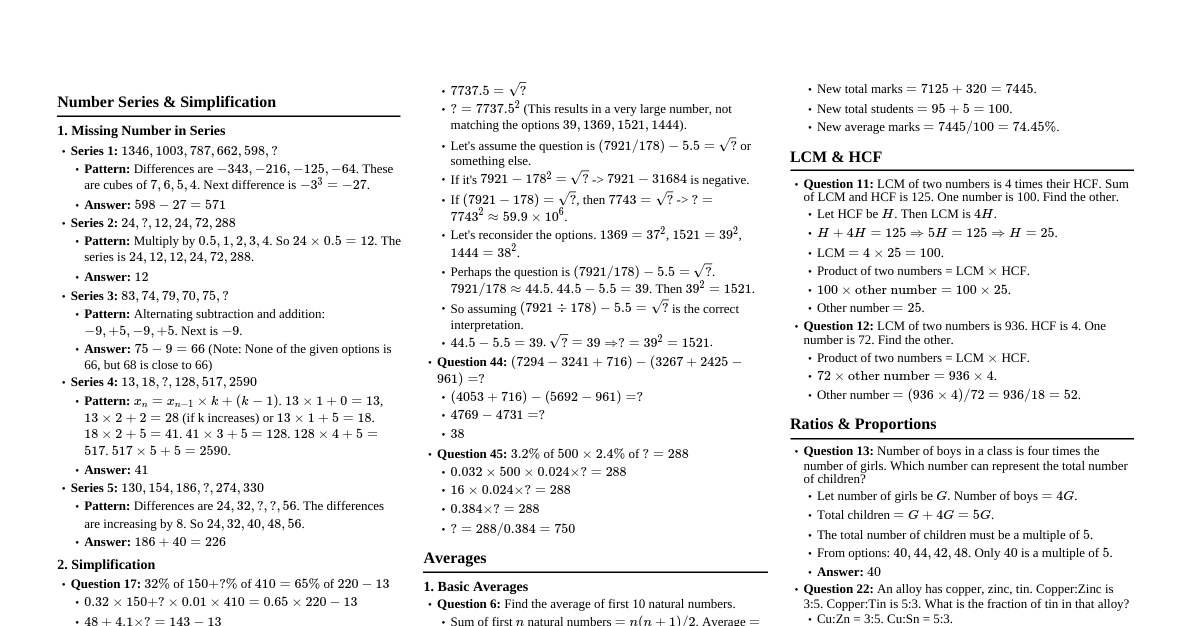
### Arithmetical Reasoning: Introduction Arithmetical reasoning involves solving problems that require basic mathematical operations (addition, subtraction, multiplication, division) combined with logical thinking and pattern recognition. It's a crucial part of aptitude tests, assessing numerical ability and problem-solving skills. #### Key Areas: - **Number Series:** Identifying patterns in sequences of numbers. - **Missing Numbers:** Finding the missing element in a sequence or matrix. - **Coding-Decoding:** Assigning numerical values or patterns to letters/words. - **Mathematical Operations:** Solving problems by applying correct operator precedence. - **Word Problems:** Translating real-world scenarios into mathematical equations. ### Number Series Identifying the pattern in a given sequence of numbers. #### 1. Addition/Subtraction Series - **Constant Difference:** $2, 4, 6, 8, ?$ (Add 2) $\rightarrow 10$ - **Increasing/Decreasing Difference:** $1, 2, 4, 7, 11, ?$ (Differences: +1, +2, +3, +4) $\rightarrow 16$ - **Alternating Difference:** $10, 15, 13, 18, 16, ?$ (Add 5, Subtract 2, Add 5, Subtract 2) $\rightarrow 21$ #### 2. Multiplication/Division Series - **Constant Factor:** $3, 6, 12, 24, ?$ (Multiply by 2) $\rightarrow 48$ - **Increasing/Decreasing Factor:** $2, 6, 24, 120, ?$ (Multiply by 3, 4, 5) $\rightarrow 720$ #### 3. Square/Cube Series - **Squares:** $1, 4, 9, 16, ?$ ($1^2, 2^2, 3^2, 4^2$) $\rightarrow 25$ - **Cubes:** $1, 8, 27, 64, ?$ ($1^3, 2^3, 3^3, 4^3$) $\rightarrow 125$ - **Combined:** $2, 5, 10, 17, ?$ ($n^2+1$) $\rightarrow 26$ #### 4. Alternating Series - Two independent series interwoven: $1, 5, 2, 6, 3, 7, ?$ - Series 1: $1, 2, 3, ?$ (Add 1) $\rightarrow 4$ - Series 2: $5, 6, 7, ?$ (Add 1) $\rightarrow 8$ - Next term is from Series 1: $4$ #### 5. Fibonacci Series - Each number is the sum of the two preceding ones: $0, 1, 1, 2, 3, 5, 8, ?$ $\rightarrow 13$ #### 6. Mixed Series - Combination of multiple patterns: $3, 7, 16, 35, ?$ ($ \times 2 + 1, \times 2 + 2, \times 2 + 3$) $\rightarrow 74$ #### Tips for Number Series: - Look for differences between consecutive terms. - Look for ratios between consecutive terms. - Check for squares, cubes, or powers. - Try alternating patterns. - If numbers are small, try addition/subtraction. If they grow fast, try multiplication/powers. ### Missing Numbers Finding the missing number in a given set, matrix, or figure based on a logical rule. #### 1. Matrix/Grid Problems - The operations (addition, subtraction, multiplication, division, squares, cubes) can be applied: - **Row-wise** - **Column-wise** - **Diagonally** - **Across the entire matrix** | 2 | 3 | 5 | |---|---|---| | 4 | 5 | 9 | | 6 | 7 | ? | - **Pattern:** Column 1 + Column 2 = Column 3 - $6 + 7 = 13 \rightarrow ?$ is $13$ #### 2. Figure/Diagram Problems - Numbers arranged in geometric shapes (circles, triangles) with a central or missing number. - The pattern can involve operations on numbers in segments, vertices, or around the perimeter. (Imagine a circle divided into 4 segments with numbers 3, 5, 7, and a central number 15. Another circle has 4, 6, 8 and a central number 24. A third circle has 5, 7, 9 and a central missing number.) - **Pattern:** Multiply the numbers in segments for the central number. - Circle 1: $3 \times 5 = 15$ (Incorrect, this example pattern needs to be more complex. Let's use a simpler one.) - **Corrected Pattern:** (Sum of numbers) $\times$ constant or (Product of numbers) / constant. - Let's assume the pattern is: (Sum of two numbers) $\times$ third number = central number. - Example: (3, 4, 5 outside, 28 inside) -> $(3+4) \times 4 = 28$ (No, this is wrong for a standard example) **Revised Figure Example:** Assume a figure with three numbers at vertices (e.g., 2, 3, 4) and a number in the center (e.g., 24). Another figure with (3, 4, 5) and center (60). A third figure with (4, 5, 6) and a missing center. - **Pattern:** Product of the numbers at the vertices. - $2 \times 3 \times 4 = 24$ - $3 \times 4 \times 5 = 60$ - $4 \times 5 \times 6 = 120 \rightarrow ?$ is $120$ #### Tips for Missing Numbers: - Analyze rows, columns, and diagonals for patterns. - Look for arithmetic operations, squares, cubes, or combinations. - If numbers are large, consider multiplication or powers. If small, addition/subtraction. ### Coding-Decoding Assigning numerical values to letters or words based on a specific rule. #### 1. Letter to Number Coding - Each letter is assigned a numerical value (A=1, B=2, ..., Z=26). - The code might be the sum of letter values, product, or a specific operation. **Example:** If CAT is coded as 24, how is DOG coded? - C=3, A=1, T=20. Sum = $3+1+20 = 24$. - D=4, O=15, G=7. Sum = $4+15+7 = 26$. - So, DOG is coded as 26. #### 2. Word to Word Coding (with numerical logic) - A word is replaced by another word or phrase using a numerical shift or pattern. **Example:** If "APPLE" is written as "BQQLF", how is "GRAPE" written? - A+1 = B, P+1 = Q, P+1 = Q, L+1 = M (Oops, L->L, so some letters are shifted, others not or a different shift) - Let's re-evaluate: A+1=B, P+1=Q, P+1=Q, L+0=L, E+1=F (Incorrect pattern from example, this is a letter shifting problem, not arithmetical reasoning directly) **Corrected Example for Arithmetical Reasoning:** If "BAT" is coded as 20 and "CAT" is coded as 24, how is "RAT" coded? - B=2, A=1, T=20. Product = $2 \times 1 \times 20 = 40$. (Not 20) - Sum = $2+1+20 = 23$. (Not 20) - Let's assume the code is (Sum of letter positions) - (Number of letters). - BAT: $2+1+20 = 23$. $23 - 3 = 20$. - CAT: $3+1+20 = 24$. $24 - 3 = 21$. (Not 24) **Let's use a simpler, more direct numerical code:** If A=1, B=2, C=3, and so on. If CAT is coded as 7, how is DOG coded? - CAT: C(3) + A(1) + T(20) = 24. $2+4=6$. (Doesn't fit) - Let's try: Number of letters + sum of positions of vowels. (Too complex for simple example) **Simpler Coding-Decoding Example (often seen):** If `EAT` is coded as `318`, `CAB` is coded as `112`. How is `BED` coded? - E=5, A=1, T=20. `318` implies some mapping. - C=3, A=1, B=2. `112` implies some mapping. - **Pattern:** The letter 'A' is 1. 'B' is 2. 'C' is 3. 'E' is 5. 'T' is 8 (last digit of 20). - This is not a standard letter-to-number. Let's assume a simpler one. **Actual common type:** If `E = 5` and `HOTEL = 12`, then `LAMB = ?` - H=8, O=15, T=20, E=5, L=12. - Sum = $8+15+20+5+12 = 60$. - Average = $60 / 5 = 12$. - So, `HOTEL` is coded by the average value of its letters. - L=12, A=1, M=13, B=2. - Sum = $12+1+13+2 = 28$. - Average = $28 / 4 = 7$. - So, `LAMB` is coded as `7`. #### Tips for Coding-Decoding: - Assign numerical values to letters (A=1, Z=26 or Z=1, A=26). - Look for sums, products, differences, or averages of these values. - Check for position shifts (e.g., A becomes C, B becomes D - often +2). - Sometimes, it's about the number of vowels/consonants. ### Mathematical Operations Problems where symbols are substituted for arithmetic operators, or operator precedence is tested. #### 1. Symbol Substitution - Given a set of new definitions for symbols (e.g., '+' means 'x', '-' means '+'). - Evaluate an expression based on these new rules. **Example:** If '+' means '-', '-' means 'x', 'x' means '÷', and '÷' means '+', then what is the value of $15 \times 5 + 10 - 2 \div 4$? - Original: $15 \times 5 + 10 - 2 \div 4$ - New symbols: $15 \div 5 - 10 \times 2 + 4$ - Apply BODMAS/PEMDAS: - Division: $15 \div 5 = 3$ - Multiplication: $10 \times 2 = 20$ - Expression becomes: $3 - 20 + 4$ - Subtraction: $3 - 20 = -17$ - Addition: $-17 + 4 = -13$ - Answer: $-13$ #### 2. Interchanging Numbers/Symbols - You are asked to interchange two numbers or two symbols to make an equation correct. **Example:** Which two numbers should be interchanged to make the equation correct? $12 + 8 \times 2 \div 4 - 3 = 10$ - Try interchanging 8 and 4: $12 + 4 \times 2 \div 8 - 3$ $12 + 8 \div 8 - 3$ $12 + 1 - 3 = 13 - 3 = 10$. (Correct!) #### Tips for Mathematical Operations: - Always follow the BODMAS/PEMDAS rule (Brackets/Parentheses, Orders/Exponents, Division, Multiplication, Addition, Subtraction). - Carefully substitute symbols or numbers. - For interchanging problems, test the options systematically. ### Word Problems Translating real-world scenarios into mathematical equations and solving them. This category covers a vast range of problem types. #### 1. Age Problems - Involve relationships between ages of people at different points in time. - **Example:** A father is twice as old as his son. 20 years ago, the father was four times as old as his son. What are their current ages? - Let son's current age be $S$, father's current age be $F$. - $F = 2S$ (Equation 1) - 20 years ago: Father's age was $F-20$, Son's age was $S-20$. - $F-20 = 4(S-20)$ (Equation 2) - Substitute $F=2S$ into Equation 2: $2S - 20 = 4S - 80$ $60 = 2S \rightarrow S = 30$ - $F = 2 \times 30 = 60$ - Current ages: Son is 30, Father is 60. #### 2. Ratio and Proportion - Problems involving ratios, proportions, and sharing quantities. - **Example:** The ratio of boys to girls in a class is 3:2. If there are 30 students in total, how many boys are there? - Total parts = $3+2 = 5$ - Each part = $30 / 5 = 6$ students - Number of boys = $3 \times 6 = 18$ #### 3. Time and Work - Calculating the time taken to complete a task by individuals or groups. - **Example:** A can do a piece of work in 10 days, and B can do it in 15 days. How long will they take to complete it working together? - A's 1-day work = $1/10$ - B's 1-day work = $1/15$ - Together 1-day work = $1/10 + 1/15 = (3+2)/30 = 5/30 = 1/6$ - Time taken together = 6 days. #### 4. Time, Speed, and Distance - Problems relating distance, speed, and time ($D = S \times T$). - **Example:** A car travels at 60 km/h for 2 hours and then at 80 km/h for 1 hour. What is the average speed? - Distance 1 = $60 \times 2 = 120$ km - Distance 2 = $80 \times 1 = 80$ km - Total Distance = $120 + 80 = 200$ km - Total Time = $2 + 1 = 3$ hours - Average Speed = Total Distance / Total Time = $200 / 3 \approx 66.67$ km/h #### 5. Percentage and Profit/Loss - Calculating percentages, profit, loss, discount, etc. - **Example:** A shopkeeper sells an item for Rs. 480 after giving a 20% discount on the marked price. What was the marked price? - Selling Price (SP) = Rs. 480 - Discount = 20% - If Marked Price (MP) is 100%, then SP is $100\% - 20\% = 80\%$ of MP. - $0.80 \times MP = 480$ - $MP = 480 / 0.80 = 600$ - Marked Price = Rs. 600. #### 6. Simple and Compound Interest - Calculating interest earned on principal amounts. - **Simple Interest (SI):** $P \times R \times T / 100$ - **Compound Interest (CI):** $P(1 + R/100)^T - P$ #### 7. Partnership - Division of profit/loss among partners based on their investments and time. #### 8. Pipes and Cisterns - Similar to time and work, but dealing with filling/emptying tanks. #### 9. Boats and Streams - Problems involving speed of boat and stream, upstream/downstream movement. #### 10. Mixtures and Allegations - Combining different ingredients/solutions and finding resultant properties. #### Tips for Word Problems: - Read the problem carefully to understand the scenario. - Identify the knowns and unknowns. - Assign variables to unknowns. - Formulate equations based on the relationships given. - Solve the equations systematically. - Check if your answer makes sense in the context of the problem. - Pay attention to units and conversions. ### Logical Deduction (Numerical) Problems requiring logical reasoning to deduce numerical facts or relationships. #### 1. Data Sufficiency - Determine if the given statements are sufficient to answer a question. - **Example:** What is the value of X? - Statement 1: $X + Y = 10$ - Statement 2: $Y = 5$ - **Analysis:** - Statement 1 alone is NOT sufficient (two unknowns). - Statement 2 alone is NOT sufficient. - Both statements together ARE sufficient ($X+5=10 \Rightarrow X=5$). #### 2. Seating Arrangement (with numerical attributes) - Arranging people or objects based on given numerical conditions (e.g., ages, scores). - **Example:** Five friends A, B, C, D, E are sitting in a row. A is older than B but younger than C. D is older than E but younger than B. Who is the youngest? - C > A > B - B > D > E - Combining: C > A > B > D > E - The youngest is E. #### 3. Puzzles (Numerical) - General numerical puzzles that don't fit into other categories but require logical steps. - **Example:** In a group of cows and hens, the number of heads is 15 and the number of legs is 46. How many cows and hens are there? - Let C be the number of cows, H be the number of hens. - Heads: $C + H = 15$ (Equation 1) - Legs: $4C + 2H = 46$ (Equation 2) - From Eq 1, $H = 15 - C$. Substitute into Eq 2: $4C + 2(15 - C) = 46$ $4C + 30 - 2C = 46$ $2C = 16 \rightarrow C = 8$ - $H = 15 - 8 = 7$ - There are 8 cows and 7 hens. #### Tips for Logical Deduction: - Break down complex problems into smaller, manageable parts. - Use diagrams or tables to organize information. - For data sufficiency, test each statement independently first, then combine. - Look for direct and indirect relationships. ### General Strategies for Arithmetical Reasoning - **Read Carefully:** Understand every part of the question. - **Identify Keywords:** Look for terms like "sum," "difference," "product," "ratio," "percentage," "speed," "age," etc. - **Formulate Equations:** Translate the problem into mathematical expressions. - **Estimate:** Sometimes, a quick estimate can help eliminate options or confirm your answer. - **Check Units:** Ensure consistency in units (e.g., km/h and hours, not km/h and minutes). - **Practice Regularly:** Familiarity with different problem types is key. - **Don't Rush:** Arithmetical reasoning often requires careful step-by-step thinking. - **Review Mistakes:** Understand why an answer was wrong to avoid repeating the error.