Electrical Engineering
Cheatsheet Content
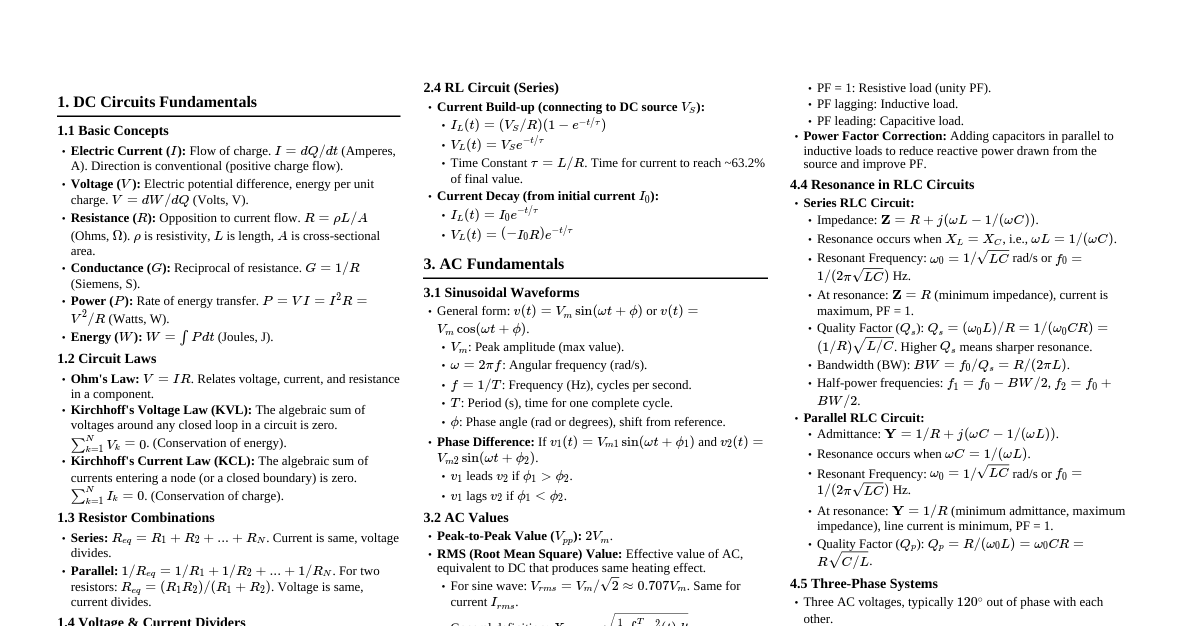
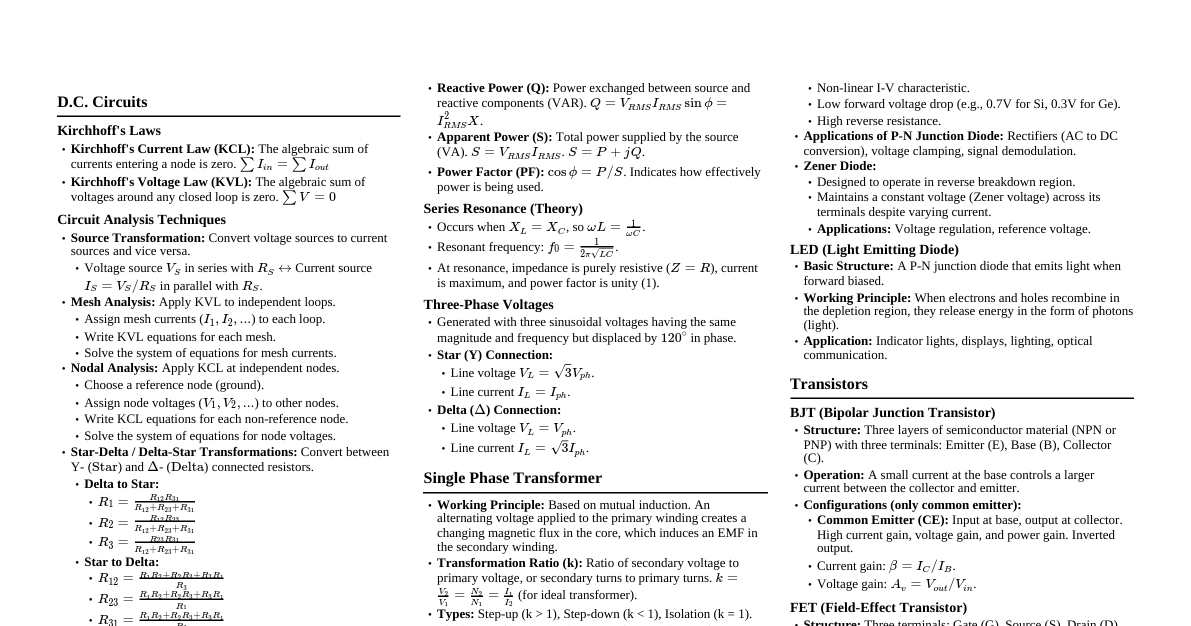
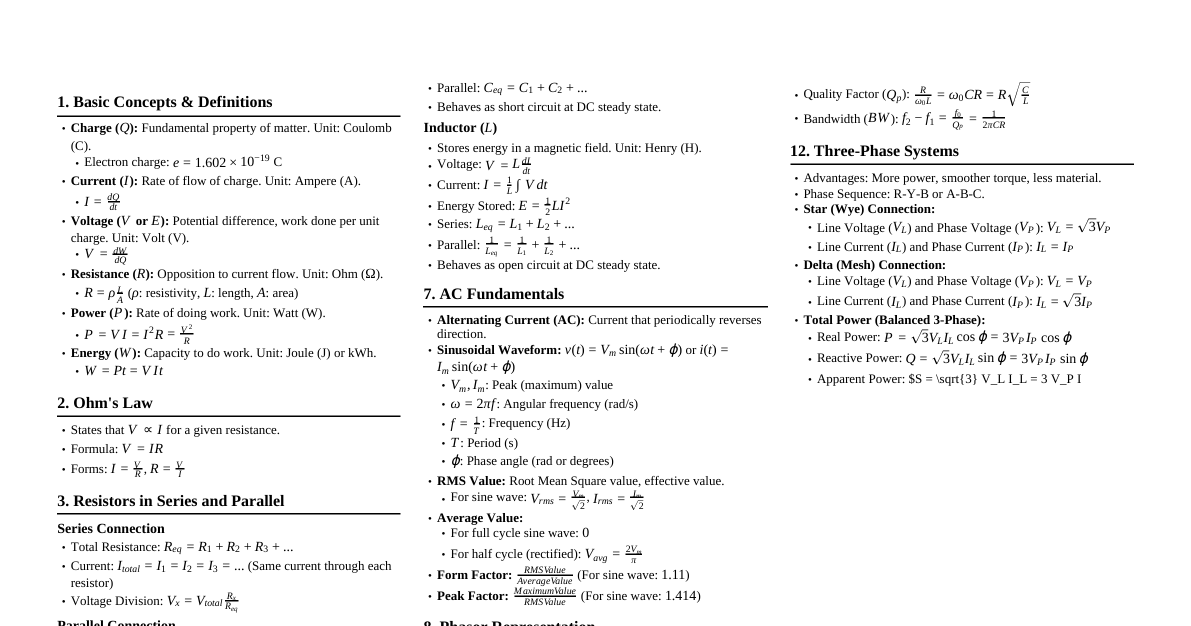
### Basic Circuits - **Ohm's Law:** $V = IR$ - $V$: Voltage (Volts, V) - $I$: Current (Amperes, A) - $R$: Resistance (Ohms, $\Omega$) - **Kirchhoff's Current Law (KCL):** The sum of currents entering a node is equal to the sum of currents leaving the node. $\sum I_{in} = \sum I_{out}$ - **Kirchhoff's Voltage Law (KVL):** The sum of all voltages around any closed loop in a circuit is zero. $\sum V = 0$ - **Power:** $P = VI = I^2R = \frac{V^2}{R}$ (Watts, W) ### Circuit Components #### Resistors - **Series:** $R_{eq} = R_1 + R_2 + ... + R_n$ - **Parallel:** $\frac{1}{R_{eq}} = \frac{1}{R_1} + \frac{1}{R_2} + ... + \frac{1}{R_n}$ #### Capacitors - Stores energy in an electric field. - **Capacitance:** $C = \frac{Q}{V}$ (Farads, F) - **Voltage-Current Relation:** $i(t) = C \frac{dv(t)}{dt}$ - **Energy Stored:** $W = \frac{1}{2}CV^2$ - **Series:** $\frac{1}{C_{eq}} = \frac{1}{C_1} + \frac{1}{C_2} + ... + \frac{1}{C_n}$ - **Parallel:** $C_{eq} = C_1 + C_2 + ... + C_n$ #### Inductors - Stores energy in a magnetic field. - **Inductance:** $L$ (Henries, H) - **Voltage-Current Relation:** $v(t) = L \frac{di(t)}{dt}$ - **Energy Stored:** $W = \frac{1}{2}LI^2$ - **Series:** $L_{eq} = L_1 + L_2 + ... + L_n$ - **Parallel:** $\frac{1}{L_{eq}} = \frac{1}{L_1} + \frac{1}{L_2} + ... + \frac{1}{L_n}$ ### AC Circuits - **Phasors:** Represent sinusoidal voltages and currents as complex numbers. - $v(t) = V_m \cos(\omega t + \phi) \leftrightarrow V = V_m \angle \phi$ - **Impedance (Z):** Generalization of resistance for AC circuits. - **Resistor:** $Z_R = R$ - **Capacitor:** $Z_C = \frac{1}{j\omega C}$ - **Inductor:** $Z_L = j\omega L$ - **Ohm's Law for AC:** $V = IZ$ - **Power in AC Circuits:** - **Apparent Power:** $S = VI^*$ (VA) - **Real Power (Average Power):** $P = |S| \cos\theta = V_{RMS}I_{RMS} \cos\theta$ (Watts, W) - **Reactive Power:** $Q = |S| \sin\theta = V_{RMS}I_{RMS} \sin\theta$ (VAR) - **Power Factor:** $PF = \cos\theta = \frac{P}{|S|}$ ### Thevenin & Norton Equivalents - **Thevenin Equivalent:** A linear circuit can be replaced by an equivalent voltage source $V_{Th}$ in series with an equivalent resistance $R_{Th}$. - $V_{Th}$: Open-circuit voltage across the terminals. - $R_{Th}$: Equivalent resistance looking into the terminals with all independent sources turned off (voltage sources shorted, current sources opened). - **Norton Equivalent:** A linear circuit can be replaced by an equivalent current source $I_N$ in parallel with an equivalent resistance $R_N$. - $I_N$: Short-circuit current between the terminals. - $R_N = R_{Th}$ - **Conversion:** $V_{Th} = I_N R_{Th}$ ### Digital Logic #### Basic Gates - **AND Gate:** Output is 1 only if all inputs are 1. $Y = A \cdot B$ - **OR Gate:** Output is 1 if any input is 1. $Y = A + B$ - **NOT Gate (Inverter):** Output is the complement of the input. $Y = \bar{A}$ - **NAND Gate:** NOT(AND). $Y = \overline{A \cdot B}$ - **NOR Gate:** NOT(OR). $Y = \overline{A + B}$ - **XOR Gate:** Output is 1 if inputs are different. $Y = A \oplus B = A\bar{B} + \bar{A}B$ - **XNOR Gate:** Output is 1 if inputs are the same. $Y = \overline{A \oplus B}$ #### Boolean Algebra Identities - **Commutative:** $A+B = B+A$, $A \cdot B = B \cdot A$ - **Associative:** $(A+B)+C = A+(B+C)$, $(A \cdot B) \cdot C = A \cdot (B \cdot C)$ - **Distributive:** $A \cdot (B+C) = A \cdot B + A \cdot C$, $A + (B \cdot C) = (A+B) \cdot (A+C)$ - **De Morgan's Laws:** $\overline{A+B} = \bar{A} \cdot \bar{B}$, $\overline{A \cdot B} = \bar{A} + \bar{B}$ ### Operational Amplifiers (Op-Amps) - **Ideal Op-Amp Characteristics:** - Infinite input impedance ($R_{in} = \infty$) - Zero output impedance ($R_{out} = 0$) - Infinite open-loop gain ($A = \infty$) - Zero input current ($I_+ = I_- = 0$) - Zero input offset voltage ($V_+ = V_-$) - **Common Configurations:** - **Inverting Amplifier:** $V_{out} = -\frac{R_f}{R_{in}} V_{in}$ - **Non-Inverting Amplifier:** $V_{out} = (1 + \frac{R_f}{R_1}) V_{in}$ - **Voltage Follower:** $V_{out} = V_{in}$ (Non-inverting with $R_f=0, R_1=\infty$)